


Hug Your Customers
Jack Mitchell
Discover the secrets to building lasting customer relationships and achieving remarkable success with the "hugging" philosophy. Learn how to personalize sales, exceed expectations, and create a customer-centric culture that drives loyalty and profitability. From heartfelt gestures to strategic initiatives, this book reveals the power of passion, relationships, and genuine care in transforming your business.
The Effective Executive
Peter F. Drucker
A concise blueprint for effectiveness as an executive within an organization and a practical guide to managing oneself for performance and achievement, whether within an organization or on one’s own. It emphasizes that effectiveness can be learned and provides practices for executives to improve their performance.
The Five Dysfunctions of a Team
Patrick Lencioni
In 'The Five Dysfunctions of a Team,' a new CEO, Kathryn Petersen, takes the reins of DecisionTech, a promising Silicon Valley startup plagued by internal strife. Through a compelling fable, the book explores the critical dysfunctions that hinder teamwork and provides practical guidance on how to overcome them, offering a path to achieving a cohesive and high-performing team.
An Everyone Culture
Robert Kegan
Explore how organizations can create a culture where everyone is growing and developing, leading to increased fulfillment, prosperity, and adaptability. Discover the principles and practices of Evolutionary Organizations and how they use purpose, transparency, and reputation to foster freedom and responsibility.
The Hard Thing About Hard Things
Ben Horowitz
"The Hard Thing About Hard Things" is a brutally honest guide to the grueling reality of being a CEO. Written by Ben Horowitz, co-founder of the venture capital firm Andreessen Horowitz, the book dispenses with the positive spin common in most management literature. Horowitz argues that while it is exhilarating to start a company, it is excruciating to run one. He focuses entirely on the "struggle"—the moments when the market crashes, the product fails, and you run out of cash. The most famous concept in the book is the distinction between the Peacetime CEO and the Wartime CEO. Horowitz explains that management techniques must change drastically depending on the company's context. A Peacetime CEO focuses on fostering culture, encouraging creativity, and expanding the market. A Wartime CEO, however, has no time for consensus. They must be paranoid, dictatorial, and focused solely on immediate survival. The book warns that most leaders fail because they cannot adapt their style when the context shifts. Horowitz also addresses the intense psychological toll of leadership. He asserts that the most difficult skill for a CEO is managing their own psychology while everyone else looks to them for answers. "The Hard Thing About Hard Things" offers no silver bullets, only "lead bullets." It teaches that there is no secret formula for fixing a broken company, only the hard work of making difficult, often painful decisions to keep the business alive.
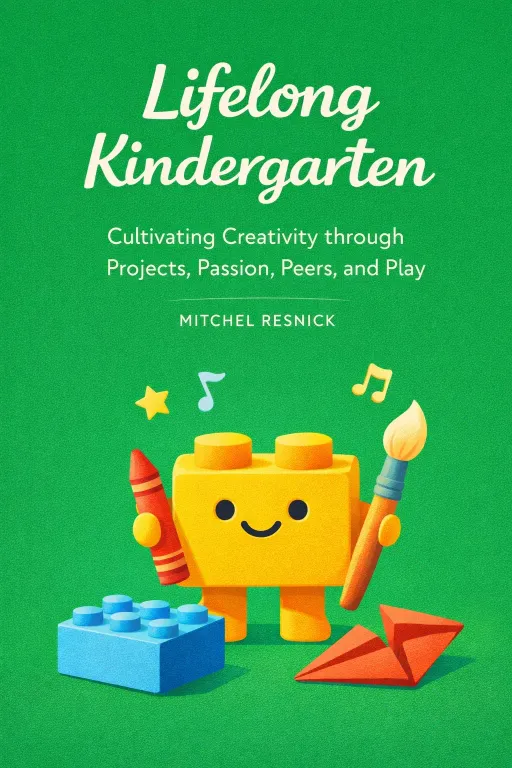
Lifelong Kindergarten
Mitchel Resnick
"Lifelong Kindergarten: Cultivating Creativity through Projects, Passion, Peers, and Play" by Mitchel Resnick, with a foreword by Sir Ken Robinson, explores a new approach to learning that fosters creativity in individuals of all ages. The book champions the "Creative Learning Spiral" – imagining, creating, playing, sharing, and reflecting – as a framework for developing innovative thinkers. It advocates for a shift from traditional instruction to "learning through making," drawing inspiration from the Maker Movement and constructionist learning theories. Readers will discover the importance of projects, passion, peers, and play in cultivating a creative mindset. The book delves into how engaging with personal interests, collaborating with others, and embracing open-ended exploration can lead to profound learning experiences. It contrasts effective and ineffective learning environments, highlighting the value of personalization, collaboration, and a willingness to experiment and learn from mistakes. Ultimately, "Lifelong Kindergarten" envisions a "creative society" where individuals are empowered to express themselves and contribute meaningfully to a rapidly changing world. The book provides actionable tips for learners, parents, teachers, and designers to foster creative learning and break down educational barriers. A comprehensive list of further readings and resources is included, providing a guide for readers interested in exploring the foundational ideas and ongoing research that inspired the author's work.

Thinking in Systems
Donella H. Meadows
"Thinking in Systems" is a concise and crucial introduction to the world of systems thinking, written by the late Donella Meadows, a visionary environmental scientist and lead author of The Limits to Growth. More than just a technical manual, this book offers a profound shift in perspective: moving away from linear, "cause-and-effect" analysis toward seeing the interconnected whole. Meadows demonstrates that everything—from a heating system to a corporation, from a biological organism to the global economy—is a system governed by common rules. She breaks down complex concepts like "stocks and flows" and "feedback loops" with remarkable clarity, showing how hidden structures drive the events we see on the surface. The book’s most enduring contribution is the concept of "leverage points"—places within a complex system where a small shift can produce significant, lasting changes. It explains why well-intentioned fixes often fail (policy resistance) and how to identify the root causes of "wicked problems." Essential for leaders, activists, and problem-solvers, Thinking in Systems provides the mental models necessary to navigate a chaotic world with humility and effectiveness.

Zero to One
Peter Thiel
"Zero to One" is a condensed manifesto on the mechanics of innovation written by legendary contrarian and investor Peter Thiel, with notes from Blake Masters. The book attacks the conventional wisdom of Silicon Valley, arguing that the goal of a startup is not to compete in an existing market but to create a new market entirely. Thiel distinguishes between two types of progress. Horizontal Progress, or going from 1 to n, involves copying things that work. This is globalization. Vertical Progress, or going from 0 to 1, involves doing something nobody has ever done before. This is technology. Thiel posits that the single most important task for an entrepreneur is to find a singular truth that very few people agree with—a Secret—and build a business around it. The most controversial argument in the book is the defense of Monopoly. Thiel asserts that competition is for losers. In a competitive market, profit margins are ground down to zero. A creative monopoly, however, generates such massive profits that it can afford to invest in long-term innovation and the welfare of its employees. The book challenges the reader to build a company that is so unique it has no substitutes.