

Finding Light in the Shadows: Hemingway, Existentialism, and the Search for Order
Golden Hook & Introduction
SECTION
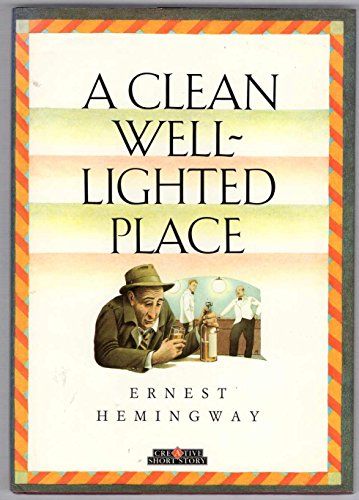
Nova: Imagine standing on a street corner in the middle of the night. The streets are empty, the wind is cold, and the darkness feels almost heavy, like it is pressing down on you. But then, just across the way, you see a warm, bright window of a late-night café. It is quiet, clean, and perfectly lit. Suddenly, the darkness doesn't feel so overwhelming. Why does a simple physical space have that kind of power over our minds? Today, we are diving into Ernest Hemingway's brilliant short story, "A Clean, Well-Lighted Place," to explore this exact question. We will tackle this classic from three different angles. First, we will look at the clash between youthful impatience and the quiet wisdom of age. Second, we will unpack Hemingway's famous concept of "nada," or existential nothingness. And finally, we will discuss how we can all build our own clean, well-lighted places in a chaotic world. I am Nova, and joining me is Abdullah, whose analytical mind is going to help us dissect the deeper layers of this incredible text. Welcome, Abdullah!
Abdullah: Thanks, Nova! I am really excited to be here. You know, what strikes me about this story is how incredibly short it is, yet it manages to carry the weight of the entire human condition. It is a story that does not rely on a massive plot or explosive action. Instead, it relies on atmosphere, subtext, and the quiet spaces between words. As someone who loves looking at how small details build into larger systems of meaning, I find Hemingway's minimalist style absolutely fascinating. It is like a puzzle where the pieces are what is being said.
Nova: Oh, absolutely! Hemingway's famous "Iceberg Theory" is at full play here. Only one-eighth of the story is above water, and the rest is submerged in deep, unspoken emotion. Let us set the scene for our listeners. We are in a Spanish café late at night. There are only three people left: a deaf old man who is drinking brandy alone under the shadow of the leaves, a young waiter who is eager to get home to his wife, and an older waiter who seems to understand why the old man wants to stay.
Abdullah: It is a perfect setup, Nova. It is almost like a theatrical stage. The physical environment itself is a character. You have the bright, clean café contrasted against the dark, quiet street. And right away, we learn something tragic about the old man. He tried to hang himself the week before.
Nova: Yes! And the way the waiters discuss this is so telling. The young waiter asks why he did it, and the older waiter replies, "He was in despair." When the young waiter asks what he was in despair about, the older waiter simply says, "Nothing." And the young waiter asks, "How do you know it was nothing?" To which the older waiter responds, "He has plenty of money."
Abdullah: That exchange is so brilliant because it highlights a massive cognitive disconnect. The young waiter represents a very literal, practical way of looking at the world. To him, if you have money, you should be happy. He cannot comprehend how someone could be in despair over "nothing." But as we will see, that "nothing" is actually the most terrifying thing of all. It is the existential void.
Deep Dive into Core Topic 1
SECTION
Nova: That brings us right into our first core topic: the clash between youth and age, and how they perceive time and meaning. The young waiter is in such a hurry. He wants to close up the café, kick the old man out, and get home. He says, "I wish he would go home. I never get to bed before three o'clock. What kind of hour is that to go to bed?" He is driven by desire, responsibility, and a sense of having a future.
Abdullah: Exactly, Nova. The young waiter has what we might call "existential capital." He has youth, he has a wife waiting for him, and he has a job. He feels secure in his identity and his place in the world. Because of this, he is impatient. He views the old man as an obstacle to his own happiness. He even says to the deaf old man, "You should have killed yourself last week." It is incredibly harsh, but it shows how blind youth can be to the fragility of life.
Nova: It really is heartbreaking. The young waiter just cannot see past his own immediate needs. But the older waiter is different. He defends the old man. He says, "You have youth, confidence, and a job. You have everything." And the young waiter replies, "And what do you lack?" The older waiter says, "Everything but work."
Abdullah: That is a crucial turning point in their dialogue. The older waiter recognizes that youth and confidence are temporary shields. They protect you from the harsh reality of existence, but they eventually wear away. The older waiter does not have youth or confidence anymore. He only has his work, and he understands that the old man is in the same boat. The old man is deaf, lonely, and clean. He drinks neatly, without spilling. There is a dignity in how the old man carries himself, and the older waiter respects that.
Nova: Yes, the dignity is so important! The older waiter points out that the old man is not dirty. He drinks with decorum. Even when he is drunk, he walks away with dignity, paying for his drinks and leaving a tip. Why do you think that neatness and dignity matter so much to the older waiter, Abdullah?
Abdullah: I think it is about maintaining control in a world that feels completely uncontrollable. When you realize that life does not have an inherent, built-in meaning, the only meaning that exists is the order you create for yourself. For the old man, drinking neatly in a clean, well-lighted café is his way of holding onto his humanity. If he were to drink in a messy, chaotic way, or if he were to go to a cheap bar, he would be giving in to the chaos. The older waiter sees this. He knows that the café is a sanctuary where the old man can preserve his dignity for just a little while longer.
Nova: That is a beautiful way to put it, Abdullah. It is like a small, daily ritual of survival. The young waiter, on the other hand, suggests the old man could just go to a bodega and drink there. But the older waiter explains, "It is not the same. An hour is another thing." A bodega is loud, crowded, and dark. It does not offer the same psychological safety as a clean, well-lighted café.
Abdullah: Right. A bodega is just a place to get drunk. It does not provide the illusion of order. The light in the café is literal, but it is also metaphorical. It represents clarity, consciousness, and safety. In the dark, your thoughts can swallow you whole. But in the light, you can see things clearly. You can keep the shadows at bay.
Deep Dive into Core Topic 2
SECTION
Nova: And that leads us directly into our second core topic, which is perhaps the most famous part of this story: the concept of "nada," or nothingness. After they finally close the café and the young waiter leaves, the older waiter has this incredible internal monologue. He starts thinking about the nature of existence, and he realizes that the thing he fears is not a specific danger, but rather... nothing.
Abdullah: Yes, this is where Hemingway gets deeply philosophical. The older waiter thinks to himself, "It was all a nothing and a man was nothing too." He realizes that the light and the clean café are the only things keeping the "nada" away. And then, Hemingway does something incredibly daring. He rewrites the Lord's Prayer and the Hail Mary, replacing key words with the Spanish word "nada."
Nova: It is such a haunting passage! Let me read a bit of it: "Our nada who art in nada, nada be thy name thy kingdom nada thy will be nada in nada as it is in nada. Give us this nada our daily nada and nada us our nada as we nada our nadas and nada us not into nada but deliver us from nada; pues nada." It sounds almost like a chant, doesn't it?
Abdullah: It really does. It is a linguistic representation of emptiness. By stripping away the sacred words of the prayer and replacing them with "nothing," Hemingway is showing how the traditional structures of meaning—like religion and societal expectations—have collapsed for the older waiter. In the modern world, especially after the devastation of World War I, which Hemingway experienced firsthand, many people felt that the old truths had been shattered. There was no grand design, no divine plan. There was only "nada."
Nova: It is a very existentialist view. If there is no inherent meaning in the universe, then we are completely responsible for creating our own meaning. But that responsibility can feel incredibly heavy, almost crushing. The older waiter says, "Some lived in it and never felt it but he knew it was all nada y pues nada y nada y pues nada." He knows that most people, like the young waiter, go through life completely unaware of the void. But once you see it, you cannot unsee it.
Abdullah: Exactly. It is like a cognitive shift. Once you become aware of the fundamental emptiness of existence, you cannot just go back to pretending everything is fine. You need a coping mechanism. For the older waiter, his coping mechanism is empathy and service. He realizes that his job is not just to pour drinks; his job is to keep the light on for others who need it. He says, "Each night I am reluctant to close because there may be someone who needs the café."
Nova: That is such a beautiful, compassionate realization! He is not just keeping the café open for himself; he is keeping it open for all the lonely, desperate people who are terrified of the dark. He is creating a community of survivors, even if they never actually talk to each other. They share a silent understanding.
Abdullah: It is a form of solidarity. They are all united by their shared struggle against the "nada." And what is fascinating is how the story ends. The older waiter goes to a late-night bar, a bodega, to get a drink. He looks at the bar, and he thinks, "The light is very bright and pleasant, but the bar is unpolished." He cannot find the same peace there. He goes home to his room, lies in bed, and tells himself, "After all, it is probably only insomnia. Many must have it."
Nova: "Many must have it." That final line is so powerful because it is his way of normalizing his existential dread. He is trying to convince himself that his deep, existential pain is just a common physical ailment. It is a way of minimizing his own suffering so he can get through the night.
Abdullah: It is a classic psychological defense mechanism. If it is just insomnia, then it is a medical issue, not a spiritual crisis. It is much easier to cope with the idea of a sleepless night than the idea that your entire existence is meaningless. But we, as the audience, know the truth. We know that his "insomnia" is actually a deep, existential wakefulness. He is awake to the reality of the world, and that is a very lonely place to be.
Synthesis & Takeaways
SECTION
Nova: It really is. But even though the story deals with some very heavy, dark themes, I do not think it is entirely pessimistic. There is a strange kind of hope in it, don't you think, Abdullah?
Abdullah: I completely agree, Nova. It is easy to look at this story and see only despair, but I think the real message is about resilience and empathy. Yes, the "nada" is real, and yes, we will all face it eventually. But we do not have to face it in the dark. We can build clean, well-lighted places for ourselves and for each other. We can choose to be kind, to be patient, and to keep the light on for those who are struggling.
Nova: That is a beautiful takeaway. It is about creating small pockets of order and warmth in an otherwise chaotic universe. For some of us, our "clean, well-lighted place" might be a physical space, like a cozy library, a quiet garden, or a favorite coffee shop. For others, it might be a mental space, like a daily meditation practice, a creative hobby, or a deep conversation with a friend.
Abdullah: Absolutely. And as an analytical thinker, I like to look at this as a design challenge. How do we design our lives to withstand the chaos? We do it by building robust routines, cultivating deep connections, and finding meaning in the small, daily acts of service. We might not be able to solve the mystery of the universe, but we can certainly make the night a little less lonely for someone else.
Nova: I love that! It is about turning existential dread into actionable empathy. Well, we are reaching the end of our episode, but before we go, we want to leave our listeners with a question to ponder. What is your "clean, well-lighted place"? What are the rituals, spaces, or relationships that keep the darkness at bay for you? And how can you help keep the light on for someone else this week?
Abdullah: That is a wonderful question to leave everyone with, Nova. Thank you so much for having me on the show today. This was a truly enlightening conversation.
Nova: Thank you, Abdullah! Your insights were absolutely invaluable. And to all our listeners out there, thank you for tuning in. Remember to seek out the light, keep your spaces clean, and be kind to one another. Until next time, take care!