Cultivating Daily Drive and Purposeful Execution
Golden Hook & Introduction
SECTION
Nova: The average person wastes roughly two hours every single day just deciding what they should focus on next. That is fourteen hours a week of pure, unadulterated decision fatigue. We are essentially burning through our most valuable currency—time—before we even start the actual work.
Atlas: That is a staggering number when you put it that way. It feels like we are constantly spinning our wheels, trying to figure out which fire to put out first, and by the time we actually commit to a task, our mental battery is already blinking red.
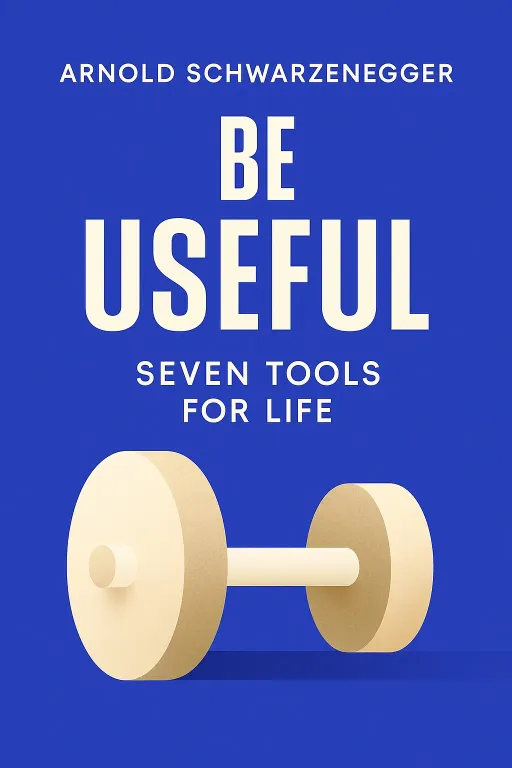
Nova: Exactly. And that is precisely why we are looking at two very different, yet surprisingly complementary, approaches to solving that exact problem today. We are diving into the philosophy of Arnold Schwarzenegger’s book, Be Useful, and contrasting it with the behavioral science found in Mel Robbins’ The High 5 Habit.
Atlas: I love this pairing. You have the ultimate high-achiever in Arnold, who has reinvented himself from a bodybuilder to a Hollywood star to a Governor, and then you have Mel Robbins, who focuses on the neurological side of how we get in our own way. It feels like we are getting both the blueprint for the structure and the fuel for the engine.
Nova: That is the perfect way to put it. Arnold’s book is all about the clarity of the vision, acting as a filter for your daily life. He wrote this from the perspective of someone who had to be hyper-intentional to survive in industries as cutthroat as bodybuilding and politics. Then, you have Mel Robbins, who brings that behavioral research to the table, showing us how to physically rewire our brains to actually start the work once we have that vision.
Atlas: Okay, so we are going to bridge the gap between having a grand plan and actually dragging ourselves across the starting line. Let’s get into it.
The Power of the Visionary Filter
SECTION
Nova: Let’s start with Arnold. The core premise of Be Useful is that you cannot hit a target you cannot see. It sounds basic, but most people operate without a target. They operate by reaction. They wake up, check their emails, look at their social media, and suddenly, they are living in a reactive state.
Atlas: That resonates with me. It is like being a pinball in a machine. You are just bouncing off whatever hits you first. But how does Arnold propose we change that? Is it just about having a big, audacious goal?
Nova: It goes deeper than just having a goal. He talks about defining a singular, useful purpose that acts as a filter. Imagine your day is a funnel. If you have a clear vision, every decision, every meeting, and every task goes through that filter. If it fits the vision, it stays. If it does not, it gets discarded.
Atlas: That sounds like a dream, but I have to play devil’s advocate here. In the real world, you cannot just discard everything that does not fit your grand vision. Sometimes you have to do the boring admin work, the meetings you hate, or the tasks that are just maintenance. How do you reconcile that?
Nova: That is a fair pushback. The trick is that the vision provides the context for those boring tasks. When you know that the boring admin work is the foundation for the project that fulfills your purpose, it changes the weight of that task. It is no longer just busy work. It becomes a necessary step in the architecture of your life.
Atlas: So the vision acts as a re-framing device. It turns the mundane into the meaningful.
Nova: Precisely. Arnold’s background is fascinating here. He came from a small village in Austria, and he had to be incredibly disciplined because he knew that if he did not have a clear path—first to bodybuilding, then to acting—he would have ended up right back where he started. He saw his vision not just as a dream, but as his survival mechanism. He treated his life like a production, where every scene had to serve the story.
Atlas: That makes sense. It is the difference between a tourist and a traveler. A tourist wanders around hoping to find something interesting. A traveler has a destination and a route. The tourist sees a lot, but the traveler actually arrives somewhere.
Nova: That is a great analogy. And for our listeners who are trying to reclaim their time, this is the first step. You have to define what your destination is. If you do not know where you are going, any road will take you there, but you will likely end up somewhere you did not intend to be.
Atlas: I can see how that helps with efficiency. If I have that filter, I can say no to things much faster. I am not deciding based on whether I have time; I am deciding based on whether it aligns with the destination.
Nova: Exactly. And that is where the magic happens. You stop feeling guilty about saying no to things because you realize that every yes to something irrelevant is a no to your vision.
Rewiring the Brain for Action
SECTION
Atlas: Okay, so I have the vision. I have the filter. I know what I should be doing. But here is the problem: knowing what to do and actually doing it are two very different things. I can have the clearest vision in the world, but if I am paralyzed by self-doubt or just plain procrastination, the vision is useless.
Nova: You are jumping ahead to exactly where Mel Robbins comes in. And you are right. We often have the vision, but we lack the immediate, neurological permission to act. That is where The High 5 Habit enters the picture. It is a very tactile, almost physical intervention for the brain.
Atlas: I have heard about this. The mirror thing. It sounds a bit gimmicky at first glance, right? You stand in front of a mirror and give your reflection a high-five. How could something so simple actually change how I work?
Nova: It sounds simple, but the science behind it is rooted in how we handle self-criticism. We are biologically wired to be our own harshest critics. When you look in the mirror, your brain often defaults to scanning for flaws—tired eyes, mistakes you made yesterday, things you need to change. Mel Robbins identifies that moment as the exact point where we sabotage our motivation.
Atlas: So, by high-fiving the mirror, you are essentially interrupting that pattern?
Nova: Exactly. It is a physical pattern interrupt. You are overriding the critical voice by performing a gesture that is universally associated with celebration and support. You are essentially telling your brain, I am on my own team. And the beauty of this is that it is a somatic experience. You cannot think your way out of a negative loop, but you can act your way out of it.
Atlas: That is a fascinating way to look at it. It is like you are hacking your own nervous system. Instead of waiting for a feeling of motivation to arrive, you are physically creating a state of acceptance.
Nova: That is the key. Motivation is unreliable. It is fleeting. But a physical habit? That is something you can control. When you high-five your reflection, you are not just being silly. You are signaling to your brain that you are ready to support yourself, regardless of how you feel about the work ahead.
Atlas: I am curious about the application of this. Does it work for everyone? Or is it more for people who really struggle with low self-esteem?
Nova: It is for everyone who struggles with self-sabotage, which is basically everyone. Think about the Pragmatic Learner profile we often talk about. They are focused, they want efficiency, but they also tend to be perfectionists. Perfectionism is just another form of fear. When a perfectionist looks in the mirror, they see everything they haven't achieved yet. The High 5 Habit forces them to acknowledge themselves as they are, right now, before they have achieved the next milestone.
Atlas: That makes me wonder about the intersection of these two concepts. You have Arnold’s vision, which is about the future, and Mel’s habit, which is about accepting the present.
Nova: That is the synthesis. You need the future-focus of a vision to give you direction, but you need the present-moment self-acceptance of the high-five to give you the fuel to start. Without the vision, you are just high-fiving yourself in a vacuum. Without the habit, you have a beautiful vision that you are too afraid to pursue.
Atlas: It is the difference between a car with a GPS and a car with gas. You need both to get anywhere.
Synthesis & Takeaways
SECTION
Nova: I love that. A car with a GPS and a car with gas. If you are sitting in the driveway, you are not going anywhere, no matter how good your map is.
Atlas: And if you have a full tank of gas but no destination, you are just burning fuel in the driveway.
Nova: Exactly. So, for our listeners who want to integrate this, here is the challenge. Tomorrow morning, before you dive into the noise of your day, you need to do two things. First, define that singular, useful purpose for the day. What is the one thing that actually moves the needle on your vision?
Atlas: And then, the second part. Look at yourself in the mirror. Do not look away. Do not check your hair. Look yourself in the eyes, state that goal out loud, and give your reflection a high-five.
Nova: It is going to feel awkward the first time. I guarantee it. But that awkwardness is just your brain realizing that you are changing the rules of the game. You are moving from being a passive recipient of your day to being the active driver of it.
Atlas: I am going to try this. It sounds ridiculous, but honestly, what do I have to lose? If it takes five seconds and sets the tone for the next ten hours, that is an incredible return on investment.
Nova: That is the pragmatic mindset. It is not about whether it feels silly. It is about whether it works. And when you look at the research, the neurological shift of self-support is undeniable.
Atlas: I love that we are wrapping this up with such a concrete, actionable step. We went from the high-level philosophy of Arnold’s life-defining vision down to the physical, biological reality of Mel’s high-five.
Nova: It is about closing the gap between who you are and who you want to be. And you do that by knowing where you are going and making sure you are on your own side while you get there.
Atlas: That is powerful. It really changes the morning routine from a chore into a launchpad.
Nova: It does. And remember, the vision is your filter, and the habit is your fuel. Use both, and you will find that the noise of the day starts to fade away, leaving you with only what truly matters.
Atlas: I am ready to give it a shot. Thank you for breaking this down, Nova. It feels much more manageable now.
Nova: You are very welcome. And to all our listeners, try it tomorrow. One vision, one high-five. See what happens. This is Aibrary. Congratulations on your growth!