The Dual Engines of Global Evolution and Capital
Golden Hook & Introduction
SECTION
Nova: We often assume that history is just a long, chaotic stream of accidents, wars, and lucky breaks. But what if the rise of the West and the very nature of the money in your pocket are actually the result of specific, installable software updates for humanity?
Atlas: That is a wild way to look at it. You are suggesting that things like the Industrial Revolution or the gold standard weren't just random events, but almost like upgrades to a system that was running on outdated code.
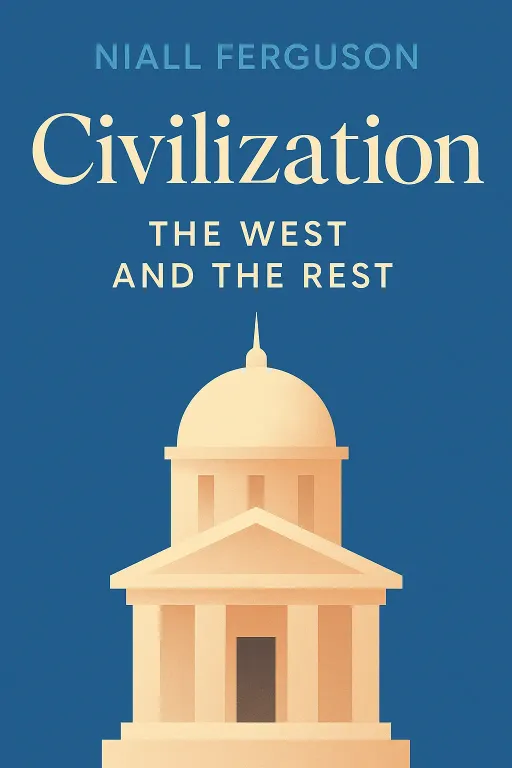
Nova: Exactly. And the most fascinating part is that we are still running on those same versions of the software, even though the world has completely changed around us. Today, we are looking at two massive frameworks that explain how we got here. First, we have Civilization by Niall Ferguson, which identifies six killer apps that allowed the West to dominate the globe. And then, to understand the fuel for that engine, we are diving into The Evolution of Money by David Orrell and Roman Chlupatý.
Atlas: I love the idea of viewing history as a series of software updates. It makes the complexity of global development feel a bit more like something you can actually map out. Niall Ferguson is a powerhouse in this space, right? He has a reputation for being a bit provocative, but his analysis of the Great Divergence is legendary.
Nova: He really is. Ferguson wrote Civilization with a specific, ambitious goal: to explain why the West pulled ahead of the rest of the world starting around the year 1500. He argues it was not about geography or climate, but about these six distinct institutional frameworks—his killer apps—that created a dynamic, self-reinforcing loop of growth.
Atlas: And then you pair that with Orrell and Chlupatý, who take the view that money isn't just a physical object. They track how we moved from tangible assets like gold to this invisible, abstract digital credit system we use today. It feels like we are looking at the hardware of society in one book and the operating system in the other.
The Killer Apps of History
SECTION
Nova: That is the perfect analogy. Let's start with Ferguson’s killer apps. He identifies competition, science, property rights, medicine, consumerism, and the work ethic. If you look at these, they act as the source code for modern Western prosperity.
Atlas: Hold on, I have to push back a little. When you list them out like that, it sounds like a self-help checklist for a corporation. Are you telling me that the secret to global dominance was just being better at property law and having a good work ethic? That feels like it ignores the reality of colonialism and exploitation.
Nova: That is a fair and necessary critique. Ferguson’s work has been praised for its boldness but also criticized for potentially downplaying the darker side of these processes. The key is to understand that these apps were not moral imperatives; they were functional tools. Take competition. Before this, you had centralized, monolithic empires—like the Ming Dynasty in China or the Ottoman Empire—that were massive but relatively static. They lacked internal competition.
Atlas: I see where you are going. If you have one emperor, one set of rules, and one vision, you have a single point of failure.
Nova: Precisely. Europe, by contrast, was a fragmented mess of competing states. It was a chaotic, often violent, laboratory. If you were a scientist, a printer, or a merchant who was silenced in one city, you just packed your bags and moved to the next city-state. That competition forced states to innovate in military technology, economic policy, and naval power just to survive. It was an environment of intense, mandatory Darwinian selection.
Atlas: That makes sense. It reminds me of the tech industry today. You do not want a monopoly because it breeds stagnation. You want a market where companies are constantly trying to kill each other’s business models. So, Ferguson is saying that the political fragmentation of Europe was actually its greatest strength?
Nova: It was a massive engine for iteration. And that leads directly into his second app: science. It wasn't just about having smart people. It was about the institutionalization of the scientific method. The ability to hypothesize, test, and fail—and then share those results—became a standard protocol.
Atlas: Which connects back to the competition point. If you have fifty competing states, you have fifty different places where a new scientific idea can be tested. If one king shuts down a project, another king might fund it because he wants a competitive advantage over his neighbor.
Nova: You nailed it. This created a compounding effect. Property rights allowed individuals to accumulate capital without fear of arbitrary seizure, which incentivized long-term investment. Consumerism then created the demand for the goods those investments produced. It was a virtuous cycle. But here is the catch: these apps were designed for a world of physical resources and tangible growth.
The Abstraction of Value
SECTION
Atlas: That is the perfect bridge to our second topic. Because if the West built its dominance on physical expansion and industrial production, the way we paid for that has fundamentally changed. This is where Orrell and Chlupatý come in. They argue that money has evolved from being a thing into being a concept.
Nova: Exactly. Think about it. We started with commodity money—salt, cowrie shells, gold coins. You had to hold the value in your hand. Then we moved to representative money, where a piece of paper represented a specific amount of gold in a vault. And now? We have credit money.
Atlas: I think about this every time I tap my phone to pay for a coffee. I am not trading gold. I am not even trading paper. I am trading a digital signal that says, "I trust the bank, and the bank trusts the system."
Nova: That is the core of their thesis. Money is not an object. It is a social technology based on trust. Orrell and Chlupatý point out that as money became more abstract—moving from gold to paper to digital entries—the complexity of our society increased, but so did our fragility.
Atlas: That feels like a warning. If money is just trust, what happens when that trust evaporates? We saw that in 2008, and we see it in inflationary periods. If the software running our economy is built on a foundation of "trust" rather than "tangible value," is that a bug or a feature?
Nova: That is the million-dollar question. The authors argue that this transition has allowed us to scale human cooperation to a global level. You can transact with someone on the other side of the planet instantly. But, it has also decoupled money from the physical reality of what we can actually produce.
Atlas: It is like we are playing a game where the score is determined by the number of zeros in a database, but sometimes the database forgets that we still need to grow food and build houses.
Nova: That is a brilliant way to phrase it. Ferguson’s killer apps created the physical world of the West—the factories, the trade routes, the consumer goods. But Orrell and Chlupatý show us that the financial layer we built on top of that has become a world of its own. It is a feedback loop. We need the killer apps to produce real value, but we are increasingly relying on the abstract financial system to coordinate that production.
Atlas: I am curious about the human element here. If we are just living in this abstract financial system, does it change how we behave? Does it make us more short-term focused?
Nova: It absolutely does. When money was tied to gold, you were constrained by physical limits. You could not just print more gold. With our current system, the abstraction allows for massive leverage. It encourages short-term thinking because the digital nature of money allows for high-frequency trading and rapid capital movement. We are chasing the next quarter’s results rather than the next century’s stability.
Navigating the Macro Landscape
SECTION
Atlas: This is starting to feel very real for anyone listening who is trying to build a career or a business. You have these big historical forces—the killer apps of the West—and this abstract financial system that moves faster than we can think. How does the average person, who is just trying to do their job, navigate this?
Nova: That is where the, quote-unquote, pragmatic learner comes in. You do not need to be a macro-economist to benefit from this perspective. You just need to recognize the environment you are operating in.
Atlas: Okay, give me a concrete example. If I am working in healthcare or education, how do these massive, abstract historical forces touch my daily life?
Nova: Let’s look at your niche. Think about the funding and the resources you rely on. Whether it is a government grant, a private investment, or tuition fees, that money is flowing through this abstract, global credit system we were talking about. When macro-trends shift—like interest rates, which are the heartbeat of this abstract money system—it changes the availability of your resources instantly.
Atlas: I see. So, if I am in education, and I see that the cost of capital is rising, I should not just be surprised when my budget gets cut. I should realize that the "abstract money" system is tightening, and that is a direct consequence of the global financial architecture we’ve built.
Nova: Exactly. And the killer apps still apply. Are you fostering competition in your sector? Are you using the scientific method to test your own strategies, or are you just doing things because that is how they have always been done? Ferguson’s point is that the moment you stop iterating, you stop growing.
Atlas: That is actually a really empowering way to look at it. It takes these huge, intimidating concepts and turns them into a diagnostic tool. I can look at my own work and ask, "Am I applying the scientific method here? Am I creating competition, or am I hiding from it?"
Nova: And you can ask, "Am I relying on the abstract system to do the work for me, or am I building real, tangible value?" The most resilient people are those who understand the macro-forces but focus their daily efforts on tangible, high-value outcomes.
Atlas: It also helps with the stress of the unknown. When you understand that we are living in a system that is constantly evolving, you stop expecting it to be static. You stop expecting the rules to stay the same forever.
Nova: That is the key. The world is not a fixed machine. It is an evolving software package. And the beauty of that is that you can always update your own personal code. You can adopt better habits, better ways of thinking, and a more strategic approach to your time.
Synthesis & Takeaways
SECTION
Atlas: I love that. So, we have gone from the six killer apps of Western dominance to the abstract, credit-based nature of money. It is a lot to take in, but it really boils down to how we manage our own resources in this complex environment.
Nova: It does. And for our listeners who want to put this into practice, here is the challenge for the week. Take ten minutes. Just ten. Sit down and look at the macro-trends affecting your specific niche—whether that is healthcare, education, or tech. Look at how funding is changing, look at where the competition is coming from, and ask yourself how those big, abstract forces are actually influencing your local reality.
Atlas: Ten minutes. That is so doable. It is not a huge research project. It is just a quick, focused check-in to see how the "system" is shifting. It prevents you from being blindsided.
Nova: And it helps you align your energy with the direction the world is actually moving. You do not want to be running software from 1995 on a 2024 operating system. You want to be optimized for the current environment.
Atlas: That is a great way to put it. I think I am going to do that for my own projects this afternoon. It is about being an insightful navigator, just like our profile suggests.
Nova: And that is exactly how you make your time count. You don't need to read every book cover to cover to get the insight. You just need to grab the thread that matters to you and pull.
Atlas: I feel like we have covered a lot of ground today, but it all connects. History, money, and personal strategy—it is all one big picture.
Nova: It is. And the more you see that picture, the more you can control your own impact. Thank you for joining us on this deep dive.
Atlas: Thanks for the conversation. It was a great way to break down some really complex ideas.
Nova: We will be back soon with more, but for now, keep sharpening those tools. This is Aibrary. Congratulations on your growth!