

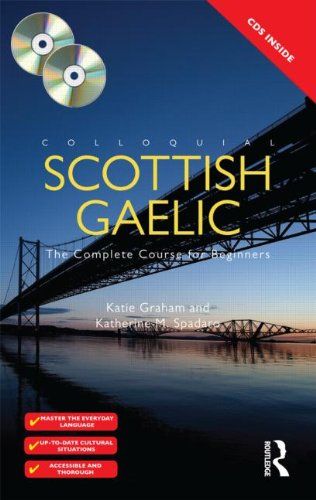
Colloquial Scottish Gaelic
The Complete Course for Beginners
Introduction
Nova: Picture this: you're standing on the windswept Isle of Skye, the Cuillin mountains rising in the distance, and an elderly local greets you with a warm smile and says, "Ciamar a tha thu?" Do you freeze, or do you smile back and answer, "Tha mi gu math, tapadh leat"? Welcome to Aibrary. I'm Nova.
Nova: : And I'm Orion. So Nova, we're talking about a language today that most people have heard of but very few actually speak. Scottish Gaelic. And specifically, a book called "Colloquial Scottish Gaelic" by Katie Graham.
Nova: Exactly. And here's a number that might surprise you: according to Scotland's most recent census, only about 57,000 people speak Scottish Gaelic — that's roughly one percent of Scotland's population. Yet this language has a literary tradition going back to the sixth century, and it's the root of thousands of place names, songs, and stories that define Scottish identity.
Nova: : That's wild. Fifty-seven thousand speakers? That's smaller than the average crowd at a major football match. So why would anyone write a whole textbook for it, and why should we care?
Nova: Because Scottish Gaelic isn't just a language — it's a living connection to one of Europe's oldest continuous cultures. And Katie Graham's "Colloquial Scottish Gaelic," part of the renowned Routledge Colloquial series, has become one of the most accessible entry points for English speakers who want to step into that world. Today we're diving into what makes this book special, how it works, and why learning a minority language might be one of the most meaningful things you ever do.
Nova: : I'm intrigued. Let's get into it.
What Makes Colloquial Scottish Gaelic Tick
The Book at a Glance
Nova: So let's start with the basics. "Colloquial Scottish Gaelic: The Complete Course for Beginners" was co-authored by Katie Graham and Katherine M. Spadaro. It was first published in 2001 by Routledge, and a fully revised second edition came out around 2014. It's part of the Colloquial series, which if you've ever browsed the language section of a good bookstore, you've probably seen — those distinctive yellow and blue covers covering everything from Amharic to Zulu.
Nova: : Right, the Colloquial series has a reputation. I've seen them. They promise to take you from zero to conversational. But Scottish Gaelic is notoriously difficult for English speakers. I mean, the spelling alone looks intimidating. How does this book handle that?
Nova: That's actually one of its strengths. The book is structured into around 18 to 20 units, each built around a practical dialogue. You might follow characters checking into a hotel, ordering at a café, talking about family, or discussing the weather — which, this being Scotland, is a national obsession. Each unit introduces vocabulary, explains grammar in digestible chunks, and includes exercises with an answer key.
Nova: : So it's not just a phrasebook. It actually teaches you the structure of the language.
Nova: Exactly. And here's what's clever: the audio component, which was originally on CDs and is now available as downloadable MP3s, is recorded by native speakers. So you're not just reading Gaelic — you're hearing the rhythm, the intonation, the way words flow together. That's crucial because Gaelic has sounds that simply don't exist in English, like the broad and slender consonants, or the guttural "ch" sound as in "loch."
Nova: : Wait, broad and slender consonants? That sounds like something out of a fantasy novel.
Nova: It does, doesn't it? But it's actually a fundamental feature of Gaelic and all the Celtic languages. Every consonant in Gaelic has two pronunciations depending on whether it's next to a broad vowel — a, o, u — or a slender vowel — e, i. So the letter "s" next to "a" sounds like the "s" in "sun," but next to "i" it sounds like "sh" in "shine." The book walks you through this systematically, which is essential because if you get this wrong, you can change the meaning of a word entirely.
Nova: : So the book doesn't shy away from the hard stuff. That's good to know. But who exactly are Katie Graham and Katherine Spadaro? What's their background?
Nova: Katie Graham is an experienced language teacher and linguist based in Australia, and Katherine Spadaro is also a linguist and educator. They both have deep expertise in Celtic languages and language pedagogy. What's interesting is that they're not native Gaelic speakers themselves — they're linguists who learned the language and then designed a course based on understanding exactly what English-speaking learners struggle with. In some ways, that outsider perspective can be an advantage because they anticipate the pain points.
Nova: : That makes sense. A native speaker might not even realize why something is confusing because it just feels natural to them. So these authors have walked the same path their readers are walking.
How the Course Actually Works
Inside the Lessons
Nova: Let's open up the book and look at how a typical unit works. Each unit starts with a dialogue — maybe two people meeting for the first time, or someone shopping at a local store. The dialogue is presented in Gaelic with an English translation alongside. Then the unit breaks down the vocabulary, explains the grammar points that appeared, and gives you practice exercises.
Nova: : So it's pretty traditional in structure. Dialogue, vocab, grammar, exercises. What makes it different from, say, a high school French textbook?
Nova: Great question. Two things stand out. First, the cultural notes. Throughout the book, there are little boxes and asides explaining aspects of Gaelic culture — the importance of the céilidh, or traditional social gathering with music and storytelling; the significance of the landscape in Gaelic poetry; the history of the language's decline and revival. These aren't just decorative. They give you a reason to care about what you're learning.
Nova: : The céilidh — that's the gathering with music and dancing, right?
Nova: Yes, and it's central to Gaelic social life. The book might teach you phrases you'd actually use at one. But the second thing that makes this book distinctive is its approach to grammar. Gaelic grammar is very different from English. The verb comes first in the sentence. So instead of "I saw the man," you say "Saw I the man" — "Chunnaic mi an duine." There are two genders, four cases, and a system of prepositional pronouns that will make your head spin if you're not prepared.
Nova: : Prepositional pronouns? Okay, you have to explain that.
Nova: Alright. In English, we say "on me," "on you," "on him" — separate words. In Gaelic, these fuse into single words. So "orm" means "on me," "ort" means "on you," "air" means "on him." And there are different forms for every preposition. The book introduces these gradually, unit by unit, so you're not overwhelmed. By the time you reach the later units, you're reading short passages about Gaelic history and culture in the language itself.
Nova: : That's a smart approach — drip-feeding the complexity. But I have to ask: how far can you actually get with this one book? Are we talking ordering a coffee, or having a real conversation?
Nova: By the end of the course, the authors aim for you to be at roughly an A2 to B1 level on the European framework — what's often called "conversational." You should be able to handle everyday situations, talk about yourself, your family, your interests, and understand the gist of a Gaelic radio broadcast. You won't be debating philosophy in Gaelic, but you'll have a solid foundation. And the book includes a reference grammar section and bilingual glossaries at the back, so it continues to be useful even after you've finished the course.
Nova: : So it's a genuine foundation, not just a tourist phrasebook. That's more than I expected.
Why Scottish Gaelic Matters Now
The Bigger Picture
Nova: Let's zoom out for a moment, because this book exists in a fascinating context. Scottish Gaelic was once spoken across most of Scotland. But after the Battle of Culloden in 1746, the British government actively suppressed Highland culture — banning tartan, disarming clans, and marginalizing the Gaelic language. Then came the Highland Clearances in the 18th and 19th centuries, when thousands of Gaelic speakers were forcibly removed from their land.
Nova: : And that's why the numbers are so low today. It wasn't a natural decline — it was systematic.
Nova: Exactly. By the late 20th century, Gaelic was in serious danger of extinction. But here's the hopeful part: there's been a significant revival movement. In 2005, the Scottish Parliament passed the Gaelic Language Act, giving Gaelic equal status with English in Scotland. You now have Gaelic-medium schools, a dedicated BBC Gaelic channel called BBC Alba, and bilingual road signs across the Highlands.
Nova: : I've seen those signs! Driving through Scotland, you see "Welcome to" and then some impossibly long Gaelic word underneath. So the language is having a moment.
Nova: It really is. And that's where a book like "Colloquial Scottish Gaelic" becomes more than just a textbook. It's part of a cultural reclamation. Duolingo launched its Scottish Gaelic course in 2019, and within a year it had over 200,000 active learners. There's a global diaspora of people with Scottish heritage who want to reconnect. And there are people with no Scottish ancestry at all who are simply drawn to the language's beauty and history.
Nova: : That's the thing about minority languages, isn't it? Learning one feels different from learning Spanish or French. It feels like you're helping to keep something alive.
Nova: That's beautifully put. And the book acknowledges this. It doesn't treat Gaelic as a museum piece. The dialogues are set in contemporary Scotland — people using mobile phones, talking about their jobs, going to the pub. It presents Gaelic as a living, breathing language for the 21st century, not just the language of 18th-century poetry, though it honors that tradition too.
Nova: : So how does this book compare to other Gaelic resources out there? Is it the best option?
Nova: It's one of the most comprehensive English-language resources. There's also "Teach Yourself Gaelic" by Boyd Robertson and Iain Taylor, and "Scottish Gaelic in 12 Weeks." But the Colloquial book is particularly strong on grammar explanations and structured progression. Some learners find it a bit dense — it's not gamified like Duolingo. But for someone who really wants to understand how the language works, not just memorize phrases, it's hard to beat.
Nova: : Dense but thorough. I can see the appeal for serious learners.
Challenges, Rewards, and Practical Tips
The Learner's Journey
Nova: Let's talk about what it's actually like to work through this book. I've spoken with learners who've used it, and the consensus is that the first few units are manageable — greetings, introductions, numbers. But around unit five or six, when the prepositional pronouns and the irregular verbs kick in, there's a steep climb.
Nova: : That's the make-or-break point, isn't it? Where a lot of people give up.
Nova: It is. And one criticism some users have is that the book introduces quite a lot of grammar per unit, and if you're studying alone without a teacher, it can feel overwhelming. The audio helps, but you have to be disciplined about listening repeatedly. Gaelic pronunciation is not intuitive for English speakers. The word "fhèin," meaning "self," is pronounced roughly like "hane." The word "oidhche," meaning "night," sounds like "oy-chuh." You can't guess these from the spelling.
Nova: : So the audio isn't optional — it's essential.
Nova: Absolutely essential. But here's the reward: Gaelic is stunningly beautiful when spoken well. It has a musicality that comes from its Celtic roots. And because the language is so different from English structurally, learning it actually changes how you think about language itself. You start to notice things about your own English that you never saw before.
Nova: : That's fascinating. Can you give an example?
Nova: Sure. In Gaelic, there's no word for "yes" or "no." Instead, you answer with the positive or negative form of the verb. So if someone asks "An do dh'òl thu cofaidh?" — "Did you drink coffee?" — you answer "Dh'òl" for yes, literally "Drank," or "Cha do dh'òl" for no, literally "Did not drink." It forces you to pay attention to the verb in the question in a way English never does.
Nova: : That's incredible. No yes or no. It's like the language is training you to be more precise.
Nova: Exactly. And the book highlights these fascinating differences throughout. Another thing Gaelic does is use different counting systems for different things — one system for counting people, another for counting objects, and a third that's a remnant of a vigesimal, or base-20, counting system. So "forty" in the traditional system is "dà fhichead" — literally "two twenties."
Nova: : Like the French "quatre-vingts" — four twenties for eighty. So Gaelic shares that Celtic counting DNA.
Nova: It does. And these are the kinds of discoveries that make learning Gaelic feel less like a chore and more like archaeology of the mind. You're uncovering a completely different way of organizing reality.
Conclusion
Nova: So where does all this leave us? "Colloquial Scottish Gaelic" by Katie Graham and Katherine Spadaro is more than a textbook. It's a carefully constructed bridge between the English-speaking world and one of Europe's oldest living languages. It's methodical, it's thorough, and it doesn't pretend that learning Gaelic is easy — but it does make the case that it's worth it.
Nova: : And I think that's what I'm taking away from this conversation. Learning a language like Scottish Gaelic isn't just a practical skill. It's an act of cultural preservation. Every new speaker, every person who can say "Ciamar a tha thu?" and mean it, is part of a story of revival.
Nova: Beautifully said. If you're thinking about picking up this book, here are three practical takeaways. One: commit to the audio. Listen to each dialogue until you can hear it in your sleep. Two: find a community. There are Gaelic conversation groups online, on Zoom, and if you're lucky, in your local area. The book gives you the foundation, but language lives in conversation. Three: be patient with yourself. Gaelic is a Category III language for English speakers according to the Foreign Service Institute — meaning it takes significantly longer to learn than French or Spanish. Give yourself grace.
Nova: : And maybe plan a trip to the Hebrides while you're at it. Immersion is the best teacher.
Nova: Absolutely. The Outer Hebrides, especially the Isle of Lewis, remain the heartland of spoken Gaelic. Walking into a shop in Stornoway and hearing Gaelic as the first language of daily life — that's something no textbook can fully capture. But Katie Graham's book will make sure you're ready when you get there.
Nova: : Nova, this has been a wonderful journey through a book and a language I knew almost nothing about. Thank you.
Nova: Thank you, Orion. And to our listeners: whether you're drawn to Gaelic by heritage, curiosity, or just the love of a challenge, know that every word you learn is a small act of keeping a beautiful tradition alive. Mar sin leibh an-dràsta — goodbye for now.
Nova: : Mar sin leibh. This is Aibrary. Congratulations on your growth!