Personalized Podcast
Golden Hook & Introduction
SECTION
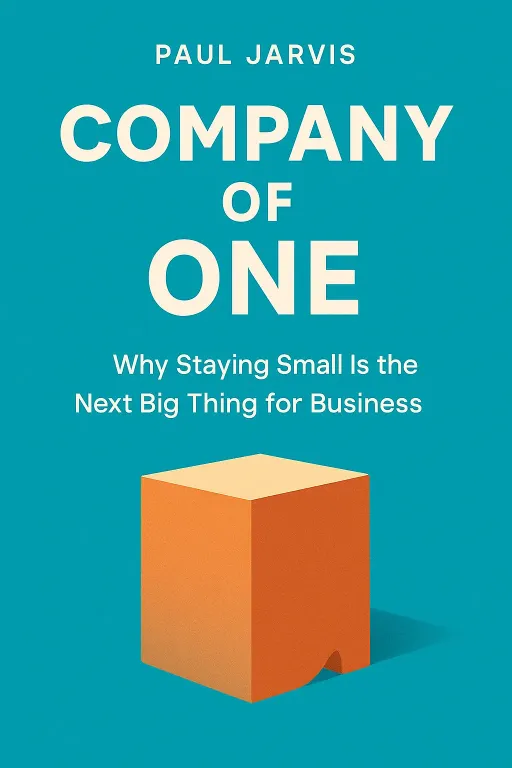
Albert Einstein: Imagine a universe where a single subatomic particle suddenly exerts the gravitational pull of an entire star. Sounds impossible, doesn't it? Yet, in the business landscape of the twenty-first century, the rise of Artificial Intelligence has made this exact phenomenon a reality. A single, focused entrepreneur can now wield the operational leverage of a hundred-person company. So why are we still so obsessed with building massive, complex corporate empires? Today, we are sitting down with emerging AI entrepreneur Charvi Kashyap to dissect Paul Jarvis's groundbreaking book, Company of One. We are going to tackle this from three different angles. First, we will explore the physics of AI leverage and why keeping your team size at one is actually a massive competitive advantage. Then, we will discuss the discipline of Minimum Viable Profit and how to avoid the VC funding trap. And finally, we will focus on how to build an unshakeable moat by out-teaching your competition. Welcome, Charvi!
Charvi Kashyap: Thank you so much, Albert! I have to say, as an AI entrepreneur, that physics analogy hits incredibly close to home. In the tech world, we are constantly bombarded with this narrative that if you aren't raising millions of dollars and hiring a massive team, you aren't a real founder. But as an ENFP, I'm naturally full of ideas, and honestly, the thought of managing a massive corporate structure sounds exhausting. I want to build meaningful projects, but I also want to keep my sanity and my freedom.
Albert Einstein: Ah, the pursuit of freedom! It is the very coordinate system upon which we must map our lives. You see, Paul Jarvis argues that a company of one is not merely a business of one person, though it can be. It is a business that questions growth first, and then resists it if there is a better, smarter way forward. It is about building your business around your life, rather than letting your business consume your life. Tell me, Charvi, in your journey so far, have you felt that gravitational pull to grow just for the sake of growing?
Charvi Kashyap: Absolutely. Every single day. When you look at the tech newsletters or social media, the success stories are always about 'Company X raised ten million dollars' or 'Company Y grew their team to fifty people.' It makes you feel like staying small is a sign of failure, or a lack of ambition. But reading this book made me realize that staying small can actually be a deliberate, highly strategic choice.
The Physics of AI Leverage: Scaling Systems, Not Headcount
SECTION
Albert Einstein: It is a magnificent realization! Let us look at this through the lens of physics. In classical mechanics, the more mass an object has, the more force is required to accelerate it. In business, mass is your overhead. It is your payroll, your office space, your complex bureaucratic systems. When the market shifts—as it so often does in the realm of artificial intelligence—a massive company has too much inertia to pivot quickly. A company of one, however, has almost zero mass. It can accelerate and change direction in an instant!
Charvi Kashyap: That is so true! And with AI, the leverage we have now is unprecedented. I can use AI tools to handle copywriting, customer support, basic coding, and even data analysis. I don't need to hire a department head for each of those tasks. I can build automated systems that run in the background while I focus on the core problem-solving.
Albert Einstein: Exactly! Consider the story of Pieter Levels, which Jarvis highlights in the book. Pieter is a Dutch programmer and digital nomad who runs a platform called Nomad List, along with several other services. He has absolutely no employees. No office. Just his laptop and an internet connection. Yet, he generates over four hundred thousand dollars a year in revenue. He automates almost every single process, from database updates to customer transactions. He is a living, breathing company of one.
Charvi Kashyap: Pieter Levels is a legend in the indie hacker community! What I love about his story is that he didn't start with a massive master plan. He built simple tools to solve his own problems as a traveler, automated the maintenance, and let them grow organically. For someone like me, who is less than a year into this journey, that is incredibly empowering. It means my lack of capital isn't a barrier; it's actually a constraint that can fuel my creativity.
Albert Einstein: Yes! Constraints are the catalysts of genius. Think of a violin string. If it is completely loose, it makes no sound. But tighten it, apply a constraint, and it produces beautiful music. But tell me, Charvi, what is the biggest friction point you face when you try to operate with this lean, automated mindset?
Charvi Kashyap: Honestly? It's discipline. Because I'm curious and love making connections across different domains, I get excited about ten different AI projects at once. I start building one, then I get an idea for another, and suddenly I have five half-finished tools and zero active users. I struggle with narrowing my focus and actually executing one thing to completion.
Albert Einstein: Ah, the entropy of a creative mind! In thermodynamics, entropy is the measure of disorder in a system. Without a conscious input of energy and structure, systems naturally degrade into chaos. For an entrepreneur, that structure is discipline. Jarvis talks about how a company of one requires a mastery of core skills, but also the ability to say 'no' to opportunities that distract from your primary objective. Every new project is not just an opportunity; it is an obligation wearing an appealing mask.
Charvi Kashyap: 'An obligation wearing an appealing mask.' Wow, that is a powerful way to put it. I need to write that down and paste it on my monitor! It's so true. Every time I say 'yes' to a new feature idea or a side project, I am committing my future time and mental energy to maintaining it. I'm essentially increasing my mental overhead.
The Discipline of MVPr vs. The VC Funding Trap
SECTION
Albert Einstein: Precisely! And this brings us to our second core topic: the discipline of Minimum Viable Profit, or MVPr, and how it protects us from the venture capital trap. You see, the traditional startup playbook tells you to raise money, spend heavily on customer acquisition, and worry about profitability later. But Jarvis points to a study by the Startup Genome Project, which analyzed over three thousand high-growth tech startups. Do you know what they found? A staggering seventy-four percent of them failed because they scaled up too quickly!
Charvi Kashyap: Seventy-four percent! That is a terrifying statistic, especially when you realize that most of those founders probably thought they were doing everything right by growing fast.
Albert Einstein: Indeed. They were chasing the illusion of growth. Consider the story of Buffer, the social media scheduling tool. In their early days, they got caught up in a hiring frenzy to hit aggressive revenue targets for their investors. They hired more people than their actual revenue could support, based purely on projected growth. When those projections didn't materialize, they were forced to lay off eleven percent of their team. It was a painful, destabilizing experience that divided their leadership. They had to completely shift their philosophy back to slow, profit-driven growth.
Charvi Kashyap: It's like building a house on a foundation of sand. If you scale your expenses before you've actually proven your business model is profitable at a small scale, any sudden market shift will knock you over. In the AI space, things change so fast. If I raised a bunch of money and hired five developers to build a complex software, and then a major AI platform releases a free feature that does exactly what my software does, I'd be ruined.
Albert Einstein: You would be caught in a gravitational collapse! But if you focus on Minimum Viable Profit, you aim to reach profitability as quickly as possible with a simple, core solution. Look at how Paul Jarvis launched his online course, the Creative Class. He didn't spend months building custom software and writing thirty complex lessons. Instead, he launched a minimal version with just seven lessons, using existing, off-the-shelf software. He got it to market in a single month, validated the demand, made a profit, and then iterated and added more lessons based on actual student feedback.
Charvi Kashyap: That is such a practical lesson in decision-making. It challenges my assumption that I need to have a fully featured, perfect product before I can show it to the world. If I can launch a micro-feature—something that solves just one specific problem for my users—and get them to pay even a small amount for it, I've achieved MVPr. I've proven viability without risking my financial stability.
Albert Einstein: Yes! You must run small, controlled experiments. In physics, we do not build a giant particle accelerator without first testing the magnets on a small scale. Your business is your laboratory. By launching in tiny steps, you gather real-world data. And data, my dear Charvi, is the only cure for the anxiety of uncertainty. It allows you to make decisions based on actual profit, not hopeful projections.
Charvi Kashyap: This makes so much sense. It takes the pressure off. I don't have to build the ultimate AI platform on day one. I just need to solve one problem, for one customer, and make sure the economics of that transaction work. But Albert, once I have that small, profitable product, how do I compete with the giant tech companies who have millions of dollars to spend on marketing?
Out-Teaching as the Ultimate AI Moat
SECTION
Albert Einstein: Ah, this is where we discover the beauty of the company of one mindset. Your competitive advantage is not your budget; it is your personality and your willingness to out-teach the competition. You see, in a world saturated with automated AI tools, code is becoming a commodity. Anyone can replicate a feature. But what they cannot replicate is trust, transparency, and your unique perspective.
Charvi Kashyap: 'Out-teaching the competition.' I love that concept. How does that work in practice?
Albert Einstein: Let us look at Brian Clark, the founder of Copyblogger. In the mid-1990s, Brian was a lawyer who wanted to be a writer. He started a website where he simply shared everything he knew about online writing and content marketing for free. He didn't pitch products aggressively; he focused entirely on educating his audience, helping them become smarter, more successful writers. Over time, that free education built an incredibly loyal community. When he finally launched paid products and software, his audience bought them instantly because they already trusted his expertise. Today, his company, Rainmaker Digital, generates over twelve million dollars a year.
Charvi Kashyap: That is brilliant. By teaching, he wasn't just marketing; he was building social capital. He was banking goodwill. And as the book says, social capital is like a bank account—you can only take out what you put in.
Albert Einstein: Exactly! And for an AI entrepreneur like yourself, this is your golden opportunity. The AI landscape is incredibly confusing for the average business owner. There is so much noise, so much hype. If you can step into that space not as a salesperson trying to pitch a tool, but as an educator who simplifies complex concepts, you build an unshakeable moat. You can share your 'build in public' journey, explain the mistakes you've made, and teach people how to use AI to solve their daily problems.
Charvi Kashyap: That feels so aligned with my personality as an ENFP. I love sharing ideas and connecting with people. Instead of hiding behind a corporate logo and trying to look like a massive, faceless enterprise, I can embrace my quirks, my story, and my smallness. I can be a real human being solving real problems.
Albert Einstein: Yes! Authenticity is a powerful force. It is like a magnetic field that attracts the right particles and repels the wrong ones. Jarvis mentions that we should proudly exclude people because we cannot please everyone. By taking a stand, by being clear about who your product is for—and who it is for—you build a highly focused, loyal niche.
Charvi Kashyap: This is a huge blind spot for me. I've been trying to make my AI ideas appeal to everyone because I thought that's what 'market size' meant. But by trying to please everyone, I end up pleasing no one, and my messaging gets completely diluted. I need to niche down and focus on a specific group of users whose problems I deeply understand.
Synthesis & Actionable Takeaways
SECTION
Albert Einstein: Now we are arriving at the core synthesis of our discussion. Staying small is not a limitation; it is a deliberate strategy for resilience, autonomy, and deep customer connection. It is about finding your 'enough'—that optimal point where your business supports your life without creating unnecessary complexity and stress.
Charvi Kashyap: This conversation has completely shifted my perspective, Albert. I realize that my goal shouldn't be to build a massive startup empire just because that's what the tech industry expects. My goal should be to build a resilient, high-leverage company of one that allows me to do work I love, serve my customers deeply, and maintain my personal freedom.
Albert Einstein: A beautiful and noble formulation! But as we know, ideas without execution are like potential energy stored in a spring—it does no work until it is released. So, let us design a specific, actionable experiment for you to run this week. Are you ready for your challenges, Charvi?
Charvi Kashyap: I am absolutely ready. Give them to me!
Albert Einstein: Excellent. First, I challenge you to define your 'Upper Bound' for your current AI project. Calculate your Minimum Viable Profit—the exact amount of money you need to cover your basic living expenses and business costs. Write that number down. That is your baseline of 'enough.' It will give you the discipline to say 'no' to distractions.
Charvi Kashyap: Okay, I can definitely do that. It will make my financial goals feel so much more concrete and less overwhelming. What's the second challenge?
Albert Einstein: Second, identify one repetitive, administrative task that is currently draining your mental energy—whether it is scheduling, email sorting, or social media posting—and automate it using an AI tool or a simple script this week. Keep your operational mass at zero.
Charvi Kashyap: Done. I know exactly which task I'm going to automate. It's going to save me at least four hours a week. And the third?
Albert Einstein: Finally, I challenge you to 'out-teach' this week. Write a single, highly valuable, transparent post on your social media or blog sharing a specific lesson you've learned while building your AI startup. Share a mistake, explain how you fixed it, and teach your audience how to avoid it. Build that social capital!
Charvi Kashyap: I love that. I'm going to write about a major coding mistake I made last week and how I used an AI assistant to debug it. It's honest, it's helpful, and it shows my process.
Albert Einstein: Magnificent! You are releasing the stored energy of your ideas into the world. Remember, Charvi, success is not measured by how large your shadow is, but by the clarity of the light you cast. By staying small, keeping your systems simple, and building deep trust, you are not just building a business—you are designing a life of true autonomy.
Charvi Kashyap: Thank you so much, Albert. This has been an incredibly grounding and inspiring conversation. I'm excited to step into my laboratory this week and start running these experiments!
Albert Einstein: And I shall be watching your progress with great curiosity! To our listeners, thank you for joining us on this intellectual journey. Until next time, keep wondering, keep experimenting, and remember that sometimes, the most powerful thing you can be is a company of one.