

The Thinking Trap: Unlocking the Psychology of Overthinking with laiba
Golden Hook & Introduction
SECTION
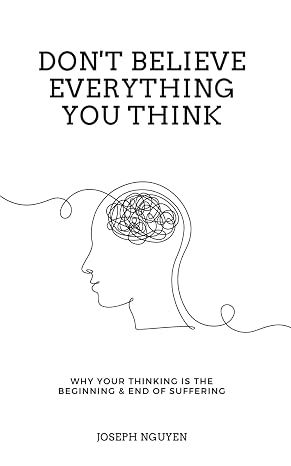
Dr. Warren Reed: Imagine your mind is a supercomputer. Spontaneous thoughts are the software updates. But overthinking? That is a background loop running at one hundred percent CPU, overheating the system until it crashes. Today, we are shutting down the loop. Welcome to the show. I am Dr. Warren Reed, strategist. With me is laiba, a brilliant analytical mind who loves pulling apart complex psychological puzzles. Today, we are dissecting Joseph Nguyen's book,. Bottom line: Your thinking is the beginning and end of your suffering.
laiba: It is wonderful to be here, Warren. When I first read Nguyen's work, what struck me was how counterintuitive it feels to an analytical thinker. We are trained to believe that more thinking leads to better solutions. But psychologically, Nguyen argues the exact opposite. He draws a sharp line between having a thought and the act of thinking. It is a distinction that can completely change how we view anxiety, stress, and decision-making.
Dr. Warren Reed: Let us lay out the roadmap. Today, we will tackle this from three distinct angles. First, we will break down the psychological barrier between thought and thinking. Second, we will look at the simulation trap, how overthinking builds a false mental hologram that we mistake for reality. Third, we will deliver a concrete, no-fluff protocol to bypass the analytical mind and step into high-performance flow. No theories without action. Let us dive in.
Thought vs. Thinking: The Cognitive Divide
SECTION
Dr. Warren Reed: Let us start with the core distinction. Nguyen says thought is a noun. Thinking is a verb. Thought is spontaneous, instant, and creative. Thinking is the heavy processing, the judgment, the analysis. Thought is the spark. Thinking is the smoke that suffocates the room. laiba, from a psychological perspective, why does our brain struggle to see this difference?
laiba: It comes down to how our brains evolved, Warren. From a cognitive standpoint, a thought is just a transient mental event. It is a representation that pops into our consciousness. It is estimated we have thousands of these a day. But thinking is active cognitive processing. It is rumination. When we engage in thinking, we are actively manipulating those thoughts, analyzing them, judging them, and projecting them into the future or the past. Psychologically, this activates what is called the Default Mode Network in the brain. This network is highly active when we are self-referencing, worrying, or over-analyzing. The problem is that our evolutionary biology is wired for survival. So, when a spontaneous thought pops up, our brain treats it as a data point that must be analyzed to keep us safe. We turn a simple, harmless spark into a massive forest fire of anxiety.
Dr. Warren Reed: Let us make this concrete. Take a public speaker standing backstage. A thought pops into their head: I might forget my opening line. That is a thought. It is neutral. It is just a passing cloud. But then, the verb kicks in. They start thinking. What if I forget? What if the audience laughs? What if I get fired? What if I cannot pay my mortgage? Now they are sweating. Heart rate is spiking. They are suffering. The suffering did not come from the thought. It came from the thinking.
laiba: Exactly. That is a perfect example of cognitive fusion. In psychology, cognitive fusion is when we become so entangled with our thoughts that we cannot separate ourselves from them. We treat the thought 'I might forget my line' as an absolute, objective reality happening right now. But if we look at it analytically, the thought is just a brief electrical impulse in the brain. The suffering only begins when we start constructing a narrative around it. The speaker is essentially writing a tragic screenplay in their head and then reacting to it as if it is a real-life documentary.
Dr. Warren Reed: It is a waste of cognitive resources. Here is the strategic breakdown of why this happens. One: We believe thinking solves the problem. It does not. It just loops. Two: We confuse intensity with productivity. Just because your brain is working hard does not mean it is working well. Three: We lack a circuit breaker. We do not know how to stop the machine once it starts. laiba, how do we psychologically install that circuit breaker?
laiba: To install that circuit breaker, we first have to understand the concept of meta-cognition, which is simply thinking about thinking. We need to move from being the actor in the movie to being the audience member watching the movie. When that speaker backstage notices the spiral, instead of trying to fight the thought or solve the problem of 'what if I forget,' they need to label the process. They can say to themselves, 'Ah, I am over-analyzing right now.' This simple act of labeling shifts the brain's activity from the emotional center, the amygdala, to the prefrontal cortex. It creates psychological distance. You are no longer the anxiety; you are the observer of the anxiety.
Dr. Warren Reed: Labeling is key. It is the difference between being in the storm and watching the storm from a window. If you are in it, you get wet. If you watch it, you just observe weather patterns. Nguyen emphasizes that we do not need to control our thoughts. We cannot. We just need to stop pouring fuel on them through active thinking.
laiba: That is such a crucial point, Warren. Many people think the goal of mindfulness or mental mastery is to have a completely blank mind, to have zero negative thoughts. But that is biologically impossible. The brain is a thought-producing organ, just like the heart is a blood-pumping organ. You cannot tell your heart to stop pumping, and you cannot tell your brain to stop producing thoughts. The breakthrough comes when you realize you do not have to believe or engage with every thought that pops up. You can let them pass. It is the difference between a train pulling into a station and you actually boarding the train. You can just stand on the platform and watch it roll by.
The Simulation Trap: How Overthinking Fabricates Suffering
SECTION
Dr. Warren Reed: Let us move to the second core topic: The Simulation Trap. This is where overthinking constructs a simulated reality. We live in a mental hologram. We react to things that have not happened, might never happen, or only exist in our memories. Seneca said it best: We suffer more often in imagination than in reality. laiba, let us look at this from a psychological perspective. Why is the brain so incredibly good at making these simulations feel so terrifyingly real?
laiba: It is because the brain is a prediction machine, Warren. From a neuroscience perspective, the brain does not actually experience the outside world directly. It sits in a dark, silent skull, receiving sensory data and interpreting it based on past experiences. To save energy and keep us alive, the brain creates internal models of the world. It simulates reality. Now, here is the kicker: The brain uses the exact same neural pathways to imagine an event as it does to actually experience it. If you close your eyes and vividly imagine biting into a sour lemon, your mouth will start to salivate. Your brain cannot tell the difference between a vivid mental simulation and physical reality. So, when we simulate a worst-case scenario, like a failed business meeting or a relationship ending, our body reacts as if that catastrophe is happening right this very second. We release cortisol and adrenaline. We go into fight-or-flight. We are literally poisoning our bodies with stress hormones over a simulation we created ourselves.
Dr. Warren Reed: It is a massive strategic failure. Think about an entrepreneur launching a new product. The reality? They have a product, a website, and an email list. That is the physical reality. But the simulation? They imagine launching, getting zero sales, being publicly humiliated, going bankrupt, and sleeping on a friend's couch. They are reacting to the couch, not the product. They freeze. They delay the launch. They tweak the copy for the hundredth time. They are trying to solve a simulated problem in a simulated future. It is a ghost hunt.
laiba: That is a brilliant way to frame it, Warren. A ghost hunt. In psychology, we call this affective forecasting, which is our attempt to predict how we will feel in the future. We are notoriously terrible at it. We overestimate how bad we will feel if things go wrong, and we overestimate how happy we will feel if things go right. The entrepreneur in your example is paralyzing themselves because they are trying to prevent a future emotional state that they have completely fabricated. They are trying to control variables that do not even exist yet. And the tragedy is, by delaying the launch to avoid the simulated failure, they actually create a real failure. The product never gets tested, and the business never grows. The simulation becomes a self-fulfilling prophecy.
Dr. Warren Reed: Action is the only cure for simulation. Here is the strategic reality: You cannot think your way out of a thinking problem. You can only act your way out. When you find yourself in a simulation, you must ground yourself in the physical present. What are the facts? What is the data? What can be done in the next five minutes? Anything else is science fiction.
laiba: Yes, grounding is incredibly effective. It is about shifting from the conceptual mind to the experiential mind. The conceptual mind is where the simulation lives. It is full of labels, judgments, past, and future. The experiential mind is right here, right now. It is what you can see, hear, touch, and smell. When you ground yourself in your senses, you immediately quiet the Default Mode Network. You stop the simulation. It is like pulling the plug on a virtual reality headset. Suddenly, you are back in the room. You realize the monster you were fighting was just a bunch of pixels.
Dr. Warren Reed: Let us look at another example. Think about a manager who receives a brief, direct email from their boss. The email says: 'We need to talk tomorrow morning.' That is the reality. Seven words. But the manager's simulation engine goes into overdrive. They think: 'I am getting fired. I made a mistake on that report. The boss hates me.' They do not sleep all night. They show up to the meeting exhausted, defensive, and anxious. The boss looks at them and says: 'I wanted to talk about promoting you.' The manager suffered twelve hours of intense psychological torture for absolutely nothing.
laiba: That is a classic. It shows how our simulations are almost always biased toward the negative. Psychologically, this is due to the negativity bias. Our ancestors who assumed every rustle in the bushes was a tiger survived. The ones who assumed it was just the wind got eaten. So, our brains are naturally wired to simulate the worst-case scenario. But in the modern world, the rustle in the bushes is usually just an email from your boss. If we do not consciously recognize this bias, we will spend our entire lives reacting to imaginary tigers. We become victims of our own evolutionary programming.
The Flow State: Action Over Analysis
SECTION
Dr. Warren Reed: This brings us to our third core topic: The Flow State. Nguyen calls this the state of non-thinking. It is not a state of being brain-dead. It is a state of high-performance intuition. It is when you are fully immersed in the task, acting without self-consciousness. Athletes call it the zone. Artists call it flow. Strategists call it execution. laiba, what is the neuroscience behind this state of non-thinking?
laiba: It is a fascinating phenomenon called transient hypofrontality. 'Transient' means temporary, 'hypo' means underactive, and 'frontality' refers to the prefrontal cortex. During flow states, the prefrontal cortex, which is the seat of our analytical thinking, our self-criticism, and our sense of time, actually quiets down. It temporarily deactivates. This is why when you are in flow, you lose track of time, you stop second-guessing yourself, and your actions feel effortless and automatic. You are operating from your basal ganglia and cerebellum, the areas of the brain responsible for deep, learned patterns and intuition. You are no longer thinking about what you are doing; you are just doing it. The critic in your head has been temporarily silenced, allowing your natural intelligence and skills to flow without interference.
Dr. Warren Reed: It is the ultimate competitive advantage. When the critic is silent, execution speed skyrockets. You do not hesitate. You do not double-check your double-checks. You just execute. Here is the strategic protocol to trigger this state of non-thinking. Three steps. Step one: Define the immediate target. No vague goals. What is the exact next move? Step two: Eliminate all friction. Close the tabs, silence the phone, clear the desk. Step three: Start with imperfect action. Do not wait for inspiration. Action triggers flow, not the other way around. laiba, how does this align with psychological behavioral activation?
laiba: It aligns perfectly, Warren. In cognitive behavioral therapy, we use a concept called behavioral activation. The core principle is that action precedes motivation. Most people wait until they feel good or feel ready before they take action. But the psychological reality is that taking action is what makes you feel ready. When you take even a tiny, imperfect step, your brain releases a small hit of dopamine. This dopamine spike increases your motivation and focus, which makes the next step easier. By starting with imperfect action, you bypass the analytical gatekeeper that is trying to protect you from failure. You do not give your brain enough time to start thinking and building those negative simulations. You are already moving before the doubt can catch up to you.
Dr. Warren Reed: Movement is medicine. If you are moving, you cannot be overthinking. Think about a writer facing a blank page. If they sit there thinking about how to write the perfect opening sentence, they will stare at that screen for hours. That is paralysis by analysis. But if they just start typing garbage, anything, just to get words on the page, they break the spell. Within ten minutes, the flow state kicks in. The bad words get replaced by good words. The momentum is created.
laiba: Exactly. The act of writing garbage is a form of cognitive defusion. You are giving yourself permission to fail, which lowers the stakes. When the stakes are low, the threat detection system in your brain stands down. The amygdala stops firing, the prefrontal cortex relaxes, and you can actually access your creative reserves. It is the paradox of performance: To perform at your best, you have to stop caring so much about performing perfectly. You have to trust your training and your intuition.
Dr. Warren Reed: Trust the system. Do not micromanage your own brain. If you hired a world-class expert to do a job, you would not stand over their shoulder whispering doubts every five seconds. Yet, that is exactly what we do to ourselves when we overthink. We micromanage our own intelligence.
laiba: That is a powerful metaphor, Warren. We are terrible bosses to our own minds. We are constantly micromanaging, second-guessing, and demanding progress reports every two minutes. No wonder we feel stressed and unproductive. Nguyen's book is essentially an invitation to fire the micromanager. It is about realizing that your mind knows how to do its job if you just get out of the way.
Synthesis & Takeaways
SECTION
Dr. Warren Reed: Let us wrap this up with a hard synthesis. We have covered a lot of ground today. Let us distill it into actionable takeaways. Bottom line: Suffering is not caused by the world. It is caused by your thinking about the world. Thought is the raw material; thinking is the factory that refines it into anxiety. To break the cycle, you must recognize the simulation, ground yourself in the physical present, and take immediate, imperfect action to trigger flow. laiba, what is your final analytical takeaway from Nguyen's work?
laiba: My biggest takeaway is that we need to change our relationship with our thoughts. We do not need to fight them, control them, or fix them. We just need to understand what they are: temporary, subjective mental events. They are not absolute truths. When you realize that you do not have to believe everything you think, you reclaim your power. You stop being a victim of your mind's simulations and start being the conscious creator of your life. It is incredibly liberating.
Dr. Warren Reed: Here is your challenge for this week, listeners. The next time you feel anxious, stressed, or overwhelmed, do not try to solve the problem by thinking more. Stop. Label the process. Say to yourself: 'I am in a simulation.' Then, take one immediate, imperfect action. Write one email. Make one call. Walk for five minutes. Break the loop. Action beats anxiety every single time. laiba, thank you for bringing your analytical depth to this conversation.
laiba: Thank you, Warren. It was an absolute pleasure. I hope our listeners find these psychological tools as transformative as I have.
Dr. Warren Reed: That is it for today. Quiet the noise. Execute. We will see you next time.