

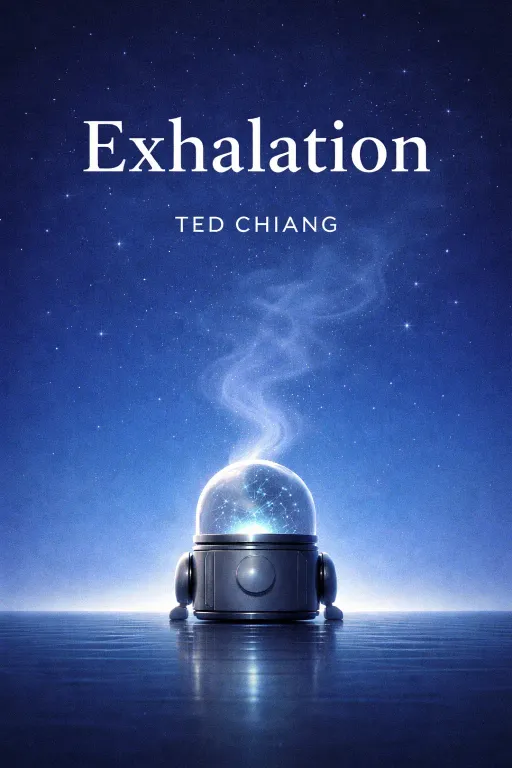
The Architecture of Choice: Deconstructing Memory, Entropy, and Free Will with Ted Chiang
Golden Hook & Introduction
SECTION
Nova: Imagine holding a small plastic device, about the size of a car key fob. It has a single button and a green LED light. You decide to press the button. But the light flashes exactly one second before your finger even moves. You try to trick it. You wait, you twitch, you hesitate, but every single time, the light flashes first. If you don't press, it never flashes. This simple toy, called a Predictor, has just shattered your belief in free will. What do you do next? Welcome to the show, everyone. I am Nova, and today we are diving into the mind-bending speculative worlds of Ted Chiang's brilliant short story collection, Exhalation. Joining me to deconstruct these incredible ideas is our resident analytical thinker, Alex. Alex, it is so wonderful to have you here.
Alex: It is great to be here, Nova. You know, that opening scenario from Chiang's story, What's Expected of Us, is the perfect entry point for today. It takes a massive, abstract philosophical debate—determinism versus free will—and packages it into a simple, interactive device. It is a cognitive trap, really, because it does not just argue that we do not have free will; it proves it to you, experientially.
Nova: Exactly. And today, we are going to tackle this collection from two fascinating perspectives. First, we will explore the paradox of choice, looking at how absolute predictability and parallel universes challenge our sense of agency. Then, we will dive into the technology of truth, comparing perfect digital memory with the fragile, beautiful ways we construct our own pasts. We have got a lot of ground to cover, so let us jump right in.
Deep Dive into Core Topic 1
SECTION
Nova: So, Alex, let us stay with that Predictor device for a moment. In the story, when these devices become widely available, something terrifying happens. People do not just go, oh, that is a neat trick, and move on. Instead, a huge portion of the population falls into what is called akinetic mutism. It is a kind of waking coma. People can track motion with their eyes, they are fully conscious, but they completely lose the will to move, to speak, or even to feed themselves. They just sit there. Why do you think that is?
Alex: It is a profound psychological reaction to the loss of agency. In psychology, we talk about the locus of control—the belief that our actions have outcomes. If you completely remove that belief, if you prove to a person that their future is already written and that their decisions do not actually cause anything to happen, the motivational engine of the human brain just stalls. The doctors in the story try to reason with these patients. They say, look, you lived happy, active lives before you got a Predictor, and you did not have free will then either. Why stop now? And the patients always give the exact same four-word response: But now I know.
Nova: Oh, that is so chilling. But now I know. It is like the knowledge itself is the poison.
Alex: Precisely. It is not the objective lack of free will that paralyzes them; it is the conscious awareness of it. It highlights how much our sanity and our civilization depend on a functional illusion. We have to pretend our decisions matter just to get out of bed in the morning.
Nova: It makes you wonder if self-deception is actually a survival mechanism. But Ted Chiang does not leave us trapped in that fatalistic corner. In the final story of the collection, Anxiety is the Dizziness of Freedom, he introduces a very different kind of technology called a prism. Instead of showing you a fixed future, a prism performs a quantum measurement when you turn it on, and it splits your reality into two parallel timelines. And here is the catch: you can actually communicate with your parallel self, your paraself, in that other branch.
Alex: This is where Chiang's grasp of quantum mechanics is so brilliant. He references the Many-Worlds interpretation, but he grounds it in chaotic systems. He mentions Silitonga's experiments, which show that even if you do not do anything different, the tiniest quantum perturbation—like a single oxygen molecule colliding slightly differently—will completely diverge the weather patterns within a month. And Silitonga's human conception experiment showed that every child born a year after a prism's activation has a completely different chromosomal makeup in the other branch. So, the divergence is massive and rapid.
Nova: It is wild to think about. But having access to those other branches creates this whole new set of psychological issues. We meet a character named Lyle, who is absolutely consumed by envy. He used a prism to make a decision about a job. In his branch, he took the new job and ended up miserable. In the other branch, his paraself stayed at the old job and got a massive promotion. Lyle is literally jealous of himself.
Alex: It is a highly specific, modern form of existential dread. We already suffer from FOMO—fear of missing out—but imagine having literal, video-chat proof of the better life you could have had if you had just made a different choice. It turns regret into a science. Lyle even tries to date the parallel version of his paraself's girlfriend, completely sabotaging his own life because he is trying to copy a reality that is not his.
Nova: It is like we are constantly keeping score across the multiverse. But then we have Dana, who is a therapist running a support group for people struggling with prism obsession. Dana has her own deep-seated guilt. Back in high school, she lied and blamed her friend Vanessa for some Vicodin pills they both had. Vanessa got suspended, and her life spiraled into drug abuse and legal trouble. Dana has spent her whole life believing her one lie ruined Vanessa's life.
Alex: Right, and then Dana gets access to a prism that shows her parallel timelines. She sees branches where she did lie, where she took the blame herself. And yet, in almost all of those branches, Vanessa's life still devolved in a very similar way. It is a massive revelation for Dana. She realizes, if the same thing happens in branches where I acted differently, then I am not the sole cause of her fate. It allows her to finally let go of this crushing, decades-long guilt.
Nova: That is such a beautiful, therapeutic use of a multiverse. But it raises a really tough question, Alex. If Vanessa's life was going to spiral anyway, and if every choice we make is made by some version of us in another branch, does personal morality even matter? If I am a good person here, but a jerk in another branch, does it all just balance out to zero?
Alex: That is the exact crisis Nat, another character in the support group, grapples with. She asks, why bother being nice if I am also being a dick to someone in another branch? But Dana gives this incredibly profound response. She says that every decision you make contributes to your character and shapes the kind of person you are. If you consistently choose to do the right thing, you are training your character. And by becoming a better person in this branch, you are ensuring that more and more of the branches that split off from this point forward are populated by better versions of you.
Nova: Oh, I love that. It is like we are steering the ship of our own character through a sea of infinite possibilities. Even if we cannot control the wind, we control the rudder.
Alex: Exactly. It reclaims moral responsibility. Your choices might not be unique in the grand multiverse, but they are unique to the trajectory of character. It is a beautiful way to reconcile quantum mechanics with ethics.
Deep Dive into Core Topic 2
SECTION
Nova: That transition from character to choice naturally brings us to our second big theme: memory. How do we even know who we are if we cannot trust our own memories? In the story, The Truth of Fact, the Truth of Feeling, Chiang introduces a technology called Remem. It is basically a search engine for your life. You wear retinal projectors that continuously record everything you see and hear, and Remem allows you to instantly search and playback any moment from your past with perfect, unvarnished accuracy. No more misremembering.
Alex: This is such a rich concept because human memory is notoriously fallible. We do not record events like a video camera; we reconstruct them every time we remember them. Chiang compares the introduction of Remem to the historical transition from oral cultures to literate cultures. He tells this parallel story of Jijingi, a young man from the Tiv tribe in Africa, who learns to read and write from a European missionary named Moseby.
Nova: Yes, and the Tiv people have this beautiful, fluid relationship with history. For them, history is oral. It is about genealogy and land disputes, and it is constantly adapted to serve the current social harmony of the tribe. They have a word for this kind of truth: mimi, which means what is right, what is socially and emotionally true. But the missionary introduces the concept of vough, which means precise, factual accuracy.
Alex: Right, and when a dispute arises about land boundaries, Jijingi looks up the old written records from years ago. He finds that the written records contradict what the elders are currently claiming. The elders are furious. The elder Sabe says to Jijingi, you look to paper to tell you what you should already know in your heart. Have you studied paper so much that you have forgotten what it is to be Tiv? Sabe realizes that the rigid, unyielding nature of written text destroys the community's ability to adapt, to forgive, and to maintain harmony. Written words do not allow for the natural, healing process of forgetting.
Nova: It is a clash of civilizations, but also a clash of cognitive styles. And we see that exact same clash play out in the modern story with the journalist who is writing an article about Remem. He is highly skeptical of the technology. He believes that perfect digital memory will ruin human relationships because, as he puts it, we have to forget a little bit before we can forgive. If the pain of an insult is always kept fresh by a perfect video playback, how can we ever move past it?
Alex: He uses his own life as an example. He has this deeply painful memory of an argument with his daughter, Nicole, right after his wife left them. He vividly remembers Nicole screaming at him, telling him that he was the reason her mother left, that he drove her away, and that she would be better off without him. He carried that wound for years, using it to justify his distant relationship with her. He saw himself as the long-suffering, forgiving victim of a rebellious teenager.
Nova: But then he actually searches his own lifelog using Remem. And what does he find?
Alex: It is a devastating twist. He plays the video, and it turns out was the one who said those exact, cruel words to. He told his teenage daughter that she was the reason her mother left, and that he would be better off without her. His brain had completely flipped the script over the years, rewriting the narrative to cast himself as the victim and protect his own ego.
Nova: That is so heartbreaking, but also so incredibly common. We are all the heroes of our own stories, aren't we?
Alex: Absolutely. We all practice a Whig interpretation of our personal histories, seeing our past selves as just stepping stones to our current, glorious selves. But Remem strips away that protective gauze. It forces the journalist to confront his own capacity for cruelty. It is painful, but it is also the only thing that allows him to genuinely apologize to his daughter and rebuild their relationship. So, while perfect memory can be a weapon for score-keeping, its true value is that it forces us to admit when we are wrong. It is a tool for radical self-honesty.
Nova: It is like a mirror that does not let you hide your blemishes. And that idea of confronting the physical reality of our minds is also at the heart of the title story, Exhalation. This is one of my absolute favorites. It is narrated by this incredibly gentle, scholarly anatomist who belongs to a mechanical species. They are made of chromium, and they run on air pressure. They do not eat or sleep; they just replace their lungs with heavy, pressurized cylinders of argon gas every day from these communal filling stations.
Alex: It is such a gorgeous, unique world. But then a societal anomaly occurs. The criers, who recite hours of poetry timed to these massive turret clocks, notice that the clocks are striking the hour before they finish their recitals. At first, everyone thinks the clocks are running fast. But horologists inspect them and find nothing wrong.
Nova: Right, and our anatomist protagonist realizes something much more profound is happening. The clocks are not running fast. Their brains are running slower. To figure out why, he performs this incredibly risky, delicate self-dissection. He constructs an apparatus of mirrors—a solipsistic periscope—and precision manipulators, and he literally opens up his own head to look at his brain while it is still running.
Alex: The imagery there is just stunning. He expects to find gears or switches, or maybe gold foil sheets where memories are engraved. But instead, he sees this incredibly intricate forest of tiny gold leaves, suspended in the air, constantly fluttering and shifting. And he realizes that his thoughts, his memories, his very consciousness, are not static structures at all. They are patterns of air flow.
Nova: All that we are is a pattern of air flow. That is one of the most beautiful lines in the book.
Alex: It really is. But this discovery leads to a tragic realization. The reason their brains are slowing down is that the atmospheric pressure of their entire world is rising. Their universe is not an infinite well; it is a sealed chromium dome. As they breathe and release gas from their high-pressure lungs, they are gradually filling the dome, equalizing the pressure. And once the pressure inside the dome matches the pressure in their lungs, the air will stop flowing. The gold leaves will stop fluttering. Their thoughts will cease forever.
Nova: It is a literal, physical metaphor for entropy. The second law of thermodynamics playing out in a closed system. It is so sad, but the anatomist does not despair. He writes down his findings, hoping that one day, long after his civilization is gone, an explorer from another universe will find his journal. He tells them to contemplate the marvel that is existence, and to rejoice that they are able to do so.
Alex: It is a beautiful synthesis of the themes we have been discussing. Whether we are talking about the air pressure in, or the digital records in, or the quantum branches in, Chiang is telling us that we are temporary, fragile patterns. We are not the physical matter itself; we are the form that matter takes for a brief, shining moment. And our job is to appreciate that pattern while it lasts.
Synthesis & Takeaways
SECTION
Nova: That is so profound, Alex. As we wrap up our conversation today, I am struck by how all of these stories, despite their high-concept sci-fi premises, are ultimately about acceptance and responsibility. Whether we are facing a predetermined future, a chaotic multiverse, or the inevitable heat death of our universe, we still have to choose how to live in the present.
Alex: Absolutely. If I had to distill one actionable takeaway for our listeners today, it would be to practice what I call radical narrative humility. We all construct stories about our past to protect our egos, just like the journalist did. But if we can learn to question our own memories, to be willing to admit when we might have been the antagonist in someone else's story, we open the door to genuine forgiveness and growth.
Nova: Yes, and to embrace the miracle of volition. Even if our choices are predetermined by physics, the act of choosing is still a first cause in our personal lives. We are the ones who have to steer our character.
Alex: Well said, Nova. It is about finding beauty in the pattern, even if the pattern is temporary.
Nova: Thank you so much, Alex, for this incredibly rich discussion. And thank you to all of our listeners for tuning in. Go out there, contemplate the marvel of your own existence, and as the Puerto Rican parrot in The Great Silence would say: You be good. I love you. Until next time, keep exploring.