

The Art of the Hammer: Debugging Limits and Engineering Relentless Growth
Golden Hook & Introduction
SECTION
Shakespeare: What if the errors that crash your digital systems are not signs of your inadequacy, but the very raw material of your masterpiece? Today, we stand at the intersection of the digital forge and the wild, untamed mountain. We are here to dismantle the comfortable lies of mediocrity and peer into the crucible of relentless growth. Welcome, noble listeners, to a chronicle of sweat, steel, and syntax. Joining me on this quest is Jayasree, a brilliant mind navigating the labyrinth of software engineering, seeking to transform the way we learn, think, and conquer the unknown.
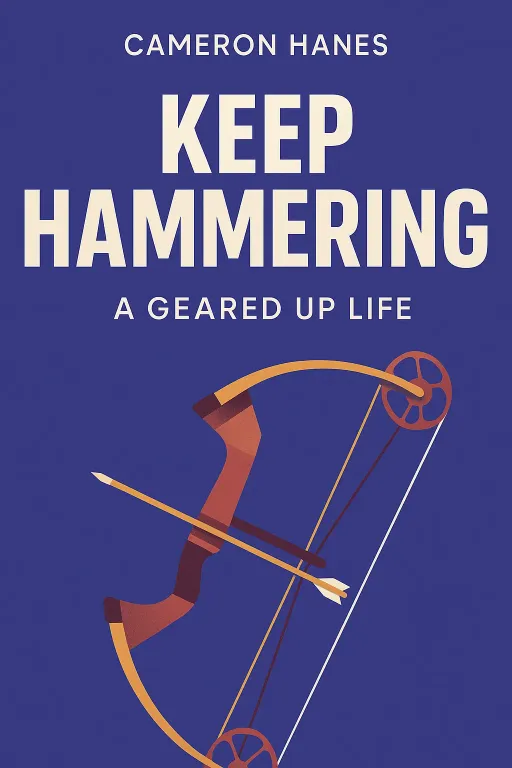
Jayasree: Thank you, Shakespeare. It is wonderful to be here. You know, when I first picked up Cameron Hanes's book, Keep Hammering, I wondered what a world-class bowhunter and ultramarathon runner could possibly teach a software engineer. But as I read about his journey, I realized that the mental discipline required to run a hundred miles through the freezing night or to track an elk through rugged mountains is exactly the same mindset we need when we are staring at a complex, broken codebase at two in the morning. It is all about moving away from easy, rote memorization and stepping into the uncomfortable, beautiful process of deep, curious problem-solving.
Shakespeare: Ah, beautifully spoken! You speak of the transition from the passive observer to the active creator. Today, we shall tackle this extraordinary philosophy from three distinct, powerful angles. First, we will explore the iterative grind of failure as a compiler of character. Second, we shall dissect why deep, obsessive experimentation must triumph over superficial, rote memorization. And finally, we will focus on how to engineer the imposter syndrome itself into an invincible drive to out-prepare any challenge. Let us strike the iron while it is hot!
Deep Dive into Core Topic 1
SECTION
Shakespeare: Let us journey back to the year 1989, to the damp, logging country near Marcola, Oregon. A young Cameron Hanes, barely twenty years of age, stands in the thick timber. His heart is a drumming tempest in his chest. Suddenly, emerging from the emerald shadows, stands a colossus—a massive six-by-seven bull elk. It is his first real bowhunting experience. He draws his bow, but his arms feel like lead, his nerves shattered by the sheer gravity of the moment. He releases the arrow, and... it misses by a wide, embarrassing margin. The great beast vanishes. The young man is left with nothing but the bitter taste of defeat. Jayasree, how does this moment of failure speak to the soul of a creator?
Jayasree: That story resonated with me so deeply. In my first few months of working with complex software systems, I have faced that exact same feeling of paralysis. You spend hours preparing, you think you understand the concepts, and then you run your code—and it completely crashes. The system throws a wall of red error messages. It is so easy in that moment to feel embarrassed, to think, maybe I am just not cut out for this. But what did Cameron do after that devastating miss? He did not throw his bow away. He became obsessed. He hunted for eighteen days straight, waking up before dawn, walking through the rain, analyzing what went wrong with his draw, his stance, his breathing. And on that eighteenth day, he harvested his first spike bull.
Shakespeare: A glorious resurrection from the ashes of defeat! He did not coddle his ego; he chiseled his character against the very mountain that rejected him.
Jayasree: Exactly! In software engineering, we call this the debugging cycle. When your code fails, it is not a personal insult; it is a compiler of character. If we only memorize solutions from textbooks or copy-paste code from Stack Overflow, we never experience that eighteen-day grind. We never learn the arrow missed. True curiosity means looking at that failed run, analyzing the logs, experimenting with different variables, and understanding the underlying architecture deeply. The failure is actually the data we need to succeed.
Shakespeare: Indeed, the error is the guidepost! To run from the error is to run from the truth. Cameron writes that the average success rate for bowhunting elk is a mere ten percent. Yet, he refused to accept that average. He declared, 'Average sucks.' He realized that to rise above that ten percent, he had to embrace the suffering of the grind.
Jayasree: That ten percent statistic is fascinating. In tech, especially when you are learning cutting-edge fields like artificial intelligence or systems engineering, the success rate of your first attempt is probably even lower than ten percent! If you expect immediate success, you will quit. But if you reframe failure as a necessary, iterative step—just like compiling code and fixing syntax errors one by one—then the grind becomes exciting. You start to love the struggle, as Cameron says.
Shakespeare: Ah, 'Love the struggle!' A phrase worthy of being carved into the lintels of our minds. It is the realization that the obstacle is not blocking the path; the obstacle the path.
Deep Dive into Core Topic 2
SECTION
Shakespeare: This brings us to our second grand arena: the battle between superficial knowledge and deep, obsessive mastery. Let us look at Cameron's training regimen. He does not merely run; he runs ultramarathons of over two hundred miles. But there is one specific, legendary feat that captures the imagination. On Mount Pisgah, near his home, Cameron decided to demonstrate his training. He did not use fancy gym equipment. He found a rock. A massive, jagged rock at the base of the mountain. He underestimated its weight, thinking it was seventy pounds, but it was actually a crushing one hundred and thirty pounds. For two agonizing hours, his muscles screaming, his lungs burning, he carried that stone to the summit. He made this a weekly ritual. Jayasree, why must we carry such heavy stones in our intellectual pursuits, rather than seeking the paved, easy paths?
Jayasree: This Mount Pisgah story is the perfect metaphor for deep learning versus rote memorization. Memorization is like taking the paved trail up the mountain with a light backpack. It is easy, it is fast, but it does not build any real strength. When you encounter a truly novel, complex problem—a system failure you have never seen before—your memorized solutions are useless because you do not have the conceptual muscle to carry the weight of the problem. Carrying the one hundred and thirty-pound rock is like forcing yourself to understand the first principles of a technology. It means asking a protocol works, experimenting with the configuration, breaking it on purpose, and rebuilding it from scratch. It is exhausting, and it takes ten times longer, but it builds intellectual stamina.
Shakespeare: By the gods, you speak of forging an intellectual armor! Cameron quotes James Clear's Atomic Habits in his book, drawing a sharp line between the amateur and the professional. The amateur lets life, mood, and convenience dictate their efforts. The professional sticks to the schedule, carrying the rock even when the sky is dark and the mood is sour.
Jayasree: Yes! James Clear writes that professionals take action even when the mood is not right. For me, as a junior engineer, it is so tempting to only study when I feel motivated or when a concept seems easy. But the concepts that actually matter—like deep learning algorithms, database sharding, or concurrent programming—are incredibly dry and difficult at first. They make you feel stupid. The 'amateur' in me wants to close the laptop and look at something simpler. But the 'professional' mindset, the 'Keep Hammering' mindset, says: 'No, stick to the schedule. Put the reps in. Read the documentation again. Write another test script.' You have to find comfort in that cognitive discomfort.
Shakespeare: A magnificent distinction! The amateur seeks the warmth of the hearth, while the professional embraces the biting frost of the peak. Cameron's obsession with bowhunting opened doors to writing, to television, to friendships with giants like Joe Rogan and David Goggins. His obsession was not a prison; it was the key that unlocked his entire life.
Jayasree: That is a crucial point. People often look at someone like Cameron Hanes or David Goggins and think, 'They are crazy, they have no balance.' But as an ISFP, I appreciate the artistry in their obsession. True curiosity is a form of obsession. When you are genuinely curious about how a neural network learns or how a compiler translates code, you don't want balance in that moment. You want to dive deep into the rabbit hole. You want to understand it so thoroughly that it becomes a part of you. That is where innovation comes from. It doesn't come from safe, balanced, average efforts. It comes from a willing, passionate dive into the depths.
Deep Dive into Core Topic 3
SECTION
Shakespeare: Let us now enter the quiet, shadowed chamber of the mind, where a phantom lurks. It is a phantom that haunts both the grand master on the mountain and the novice at the keyboard. Cameron Hanes, a man revered as a legend, confesses to a startling truth in his chapter, 'The Invincible Impostor.' Despite his monumental achievements, he writes of a persistent, gnawing feeling that he is an impostor, a small-town kid who might at any moment be exposed as a fraud. Yet, instead of letting this phantom paralyze him, he transformed it into his greatest ally. He used the fear of being exposed to fuel a level of preparation so intense that no critic could ever stand against him. Jayasree, how do we debug this imposter syndrome in our own lives?
Jayasree: This hit me right in the heart. Entering the tech industry as a recent graduate, surrounded by incredibly smart people who seem to know everything, the imposter syndrome is incredibly loud. You feel like you are constantly playing catch-up, and you worry that one day your team will realize you don't know as much as they thought. But hearing Cameron—a man who runs two-hundred-mile races and is considered the best bowhunter on earth—admit that he feels like an impostor was incredibly liberating. It made me realize that the feeling of being an impostor doesn't mean you are failing; it just means you care deeply about what you are doing. It means you respect the craft.
Shakespeare: Ah! It is the tribute that humility pays to excellence! If you felt no doubt, you would be arrogant, and arrogance is the sleep of the mind.
Jayasree: Exactly. If you think you know everything, you stop learning. You stop questioning. But if you accept the imposter syndrome, you can reframe it. Instead of letting it freeze you with fear, you use it as a signal to prepare. Cameron's response to his self-doubt was to train harder, to shoot his bow every single day, to run when others were sleeping. For a software engineer, that means using that doubt to fuel your curiosity. If you don't understand a system, don't hide it. Let that fear drive you to read the source code, to ask better questions, to build prototype projects in your free time. You out-prepare your self-doubt. You become 'invincible' not because you are perfect, but because your work ethic is undeniable.
Shakespeare: A brilliant strategy! You do not slay the phantom; you harness its energy to turn the wheel of your own progress. Cameron shares a poignant story about his son, Tanner. Tanner was working a stable, high-paying job as a sheriff's deputy, but he decided to leave it all behind to join the Army and attempt to become an Army Ranger. Cameron initially worried that his own relentless talk of 'average is failure' had pressured his son into a dangerous path. He even apologized to his sons, telling them he was wrong to imply that an ordinary life was a failure. But Tanner looked at him and said his decision was about wanting to offer more to the world, to test his own limits.
Jayasree: That story shows such a beautiful evolution of the 'Keep Hammering' philosophy. It is not about judging others or looking down on an 'ordinary' life. It is about your personal relationship with your potential. Tanner didn't join the Rangers to prove something to his father; he did it to see what he was capable of when the stakes were highest. In our careers, we have to realize that the only competition is with our own past self. We shouldn't compare our beginning to someone else's middle. The goal of 'Keep Hammering' is to look at your own limits—whether they are physical, mental, or technical—and slowly, consistently, pound away at them until they break.
Shakespeare: Yes! To pound away at the lie of the impossible! As the great stonecutter hammers his rock a hundred times with no visible change, it is the hundred-and-first blow that finally splits it in two. We must remember that the final breakthrough is born of all the silent, invisible blows that went before.
Synthesis & Takeaways
SECTION
Shakespeare: As our grand discourse nears its twilight, let us gather the precious gems we have unearthed today. We have traveled from the misty forests of Oregon to the high peaks of Mount Pisgah, mapping the rugged terrain of Cameron Hanes's life onto the elegant architecture of the digital world. Jayasree, as we prepare to send our listeners back into their own wildernesses, what is the ultimate synthesis of our journey today?
Jayasree: I think the ultimate takeaway is that deep, meaningful growth—whether you are training for an ultramarathon or learning to build complex software—requires us to embrace the struggle. We have to move away from the safe, easy paths of rote memorization and step into the uncomfortable, iterative process of trial and error. When your code crashes, or when you fail to grasp a difficult concept, remember Cameron's missed shot in 1989. It is not the end of the story; it is just day one of your eighteen-day hunt. Keep debugging, keep experimenting, and keep asking questions.
Shakespeare: And what of the daily battle against inertia, when the mountain of our goals seems too steep to climb?
Jayasree: Cameron has a beautiful, simple piece of advice for that: 'Win the day.' Don't worry about next week, don't worry about the massive project deadline a month from now. Just focus on today. Do something positive today. Write one clean function, understand one new concept, put in one solid hour of deep, focused work. If you win today, you build momentum. And when the self-doubt creeps in, when the imposter syndrome whispers that you aren't good enough, let that be your cue to out-prepare the doubt.
Shakespeare: Go forth, then, noble creators! Let the hammer of your discipline strike the anvil of your challenges. Let the sparks fly, lighting up the dark recesses of the unknown. Do not fear the tempest, for you are the authors of your own resilience. Jayasree, it has been an absolute honor to share this stage with you.
Jayasree: The honor was entirely mine, Shakespeare. To everyone listening out there, whatever your mountain is, whatever complex problem you are trying to solve... just keep hammering.
Shakespeare: Until our paths cross again in the great theater of life, fare thee well!









