

The Ecosystem of Learning: Cultivating the Mind with Eben and Einstein
Golden Hook & Introduction
SECTION
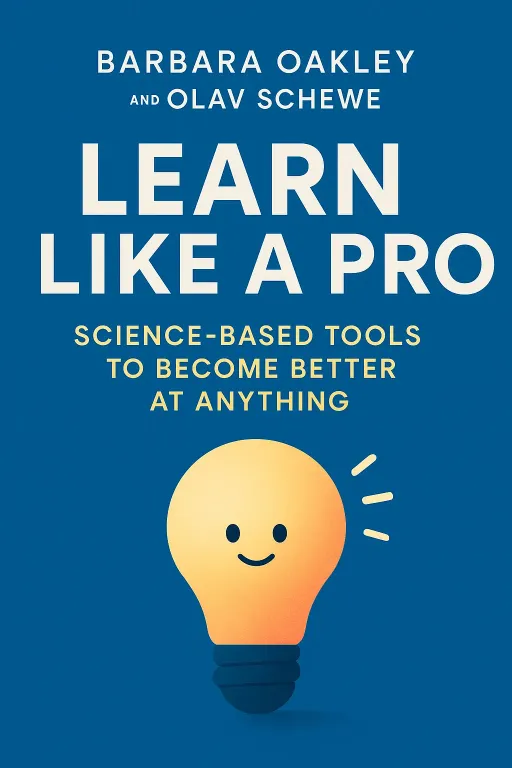
Albert Einstein: Imagine you are trying to design a digital network that connects thousands of small-scale farmers directly to consumers, an Agrosmart linkage system. You are staring at the code, the logistics, the supply chains, and suddenly, you are completely stuck. Your brain feels like over-tilled, dry soil. What if the secret to solving this complex puzzle isn't working harder, but actually letting your mind go wild? Welcome to our show. Today, we are diving into Barbara Oakley and Olav Schewe's masterpiece, Learn Like a Pro: Science-Based Tools to Become Better at Anything. We are going to tackle this book from three different angles. First, we will explore how to balance the focused and diffuse modes of thinking to unlock creative problem-solving. Second, we will discuss how to manage our limited working memory and build procedural intuition. And finally, we will focus on metacognition as a self-regulating feedback loop to become a true master of any domain. I am joined today by Eben, a brilliant graduate student in agriculture and environment, and a true visionary thinker. Welcome, Eben!
Eben: Thanks, Albert! It is an absolute pleasure to be here. You know, when I first read Learn Like a Pro, I kept making connections between how we manage agricultural ecosystems and how we manage our own minds. Just like a farm, the brain needs the right inputs, the right structure, and occasionally, it needs to lie fallow to produce the best results. I am really excited to dig into these concepts with you today and see how we can apply them, not just to studying, but to building complex systems like the Agrosmart network.
Albert Einstein: Ah, the ecology of the mind! I love that analogy, Eben. It is wonderfully elegant. Let us start with that first pillar, the dual engines of our thinking. The authors talk about the focused mode and the diffuse mode. Now, most of us are taught that to learn, we must focus, focus, focus! We squeeze our brains like a lemon. But neuroscience tells us that is only half the story.
Eben: Right, exactly. The focused mode is like a flashlight with a very tight, bright beam. It is perfect for analyzing specific details, doing math calculations, or reading a dense scientific paper. But if you only use that tight beam, you miss the broader landscape. You cannot see the forest for the trees, or in my field, you cannot see the ecosystem for the soil sample!
Albert Einstein: Yes! And when you get stuck, that tight focus actually blocks you. The authors share a wonderful story about Olav Schewe and his stuck drone. Olav was a massive drone enthusiast, and one sunny afternoon, he was flying his drone in a park with these incredibly tall trees. Well, as fate would have it, he crashed the drone right into the very top branches of a massive tree. It was way too high to reach. He spent hours focusing intensely on the problem, trying to throw rocks, thinking about climbing the tree, just getting more and more frustrated. Nothing worked. Finally, he realized he was getting nowhere, so he decided to just stop focusing. He packed up, went home, and let his mind wander. And do you know what happened?
Eben: Ah, the magic of the diffuse mode!
Albert Einstein: Precisely! While he was relaxing, his diffuse mode went to work in the background, making random, creative connections. Suddenly, an image popped into his head: a bow and arrow. He realized he could attach a thin fishing line to an arrow, shoot it over the exact branch where the drone was stuck, and then pull the line to shake the branch. He went back, tried it, and it worked beautifully! The drone fell safely to the ground.
Eben: That is a fantastic example of how the diffuse mode operates. It is like letting the cattle roam free on a pasture. They find paths you would never think to pave. In my studies, when I am trying to map out environmental impact pathways, I often hit a wall. I have learned to use what the book calls the Hard Start Technique. When I am taking an exam or working on a tough project, I start with the most difficult problem first. I load it into my brain, and the moment I feel myself getting stuck, I consciously pull away and switch to an easier problem. While my focused mode is working on the easy stuff, my diffuse mode is quietly untangling the hard problem in the background. It feels almost like magic when you return to the hard problem and suddenly the solution is obvious.
Albert Einstein: It is a beautiful cognitive dance, Eben. You must till the soil with focused attention first, yes, but then you must step back and let the rain and sun of the diffuse mode do their work. If you do not disconnect, you block those creative pathways.
The Attentional Octopus and the Agrosmart Network
SECTION
Albert Einstein: Now, let us move to our second pillar, which is all about working memory and how we process information. The authors use this marvelous metaphor of the attentional octopus. Imagine an octopus living in your prefrontal cortex. It has these little arms that can hold onto pieces of information. But here is the catch: the average human octopus only has about three or four arms! That means we can only hold three or four pieces of information in our working memory at any given time.
Eben: Only three or four! That is incredibly limiting when you think about the sheer volume of data we are bombarded with daily. It explains why we experience cognitive overload so easily. If I am trying to design an Agrosmart linkage network, I am dealing with farmer profiles, crop yields, transport logistics, market prices, and consumer demand. If I try to hold all of those raw variables in my head at once, my poor little attentional octopus gets completely paralyzed. Its arms start tangling, and it drops everything!
Albert Einstein: Oh, absolutely! Even the greatest minds have limits. Though, some octopuses are slightly more athletic than others. Take the legendary mathematician John von Neumann, for instance. He had an almost supernatural working memory. There is a story that when he was just six years old, he could perform complex division with eight-digit numbers entirely in his head. One day, he saw his mother staring aimlessly into space, lost in thought. He walked up to her and innocently asked, "Mother, what are you calculating?" He literally assumed that everyone's mind was constantly running complex mathematical operations!
Eben: That is hilarious! He thought staring into space was just a silent calculation screen. But for the rest of us who are not six-year-old Von Neumanns, we need strategies to help our three-to-four-armed octopus manage complex systems. And that is where the concept of chunking comes in, right?
Albert Einstein: Yes, chunking is the great equalizer! Think of it this way. If I give you the letters a, u, e, i, u, t, f, b, l, and ask you to memorize them, your working memory will struggle. That is nine separate letters, far exceeding the four arms of your octopus. But if we rearrange those exact same letters into the word "beautiful," how many pieces of information is it now?
Eben: Just one! One single, elegant chunk.
Albert Einstein: Exactly! Because you have already built a strong set of neural links for that word in your long-term memory. When you see "beautiful," your octopus only needs one arm to hold it, freeing up the other arms for higher-level thinking.
Eben: This is incredibly profound when we apply it to system design. If we want to build a digital Agrosmart network that connects small-scale farmers to large markets, we cannot just dump raw data on them. A small-scale farmer doesn't have the cognitive bandwidth to manage complex, unchunked logistics while tending to their crops. We have to chunk the information for them. We design the user interface so that complex market trends, weather patterns, and buyer demands are synthesized into simple, actionable visual cues. Green means high demand, red means low. We are essentially extending the farmer's working memory by doing the chunking on the digital side.
Albert Einstein: That is a brilliant application, Eben! You are using technology to respect the biological limits of the human brain. And this ties directly into how we transition from declarative learning to procedural learning. Declarative learning is conscious; it is when you are slowly working through the steps, using all your working memory arms. Procedural learning is when those steps become so well-practiced that they sink into your unconscious. They become automatic.
Eben: Like driving a car! When you first learn, you are hyper-aware of every minor adjustment, the mirrors, the pedals, the steering. That is declarative. But after a few years, you can drive all the way home while thinking about a completely different topic, and you barely remember the drive itself. Your procedural system took over.
Albert Einstein: Yes, and the book highlights how we can actively build these procedural links. They mention Benjamin Franklin's ingenious method for improving his writing. Franklin wanted to write with the elegance of the leading spectators of his day. So, he took some of the best essays he could find and wrote down brief, one-word summaries of the meaning of each sentence. He laid them aside for a few days until he forgot the exact wording. Then, using only his brief notes, he tried to recreate the essays in his own words. Afterward, he compared his version to the original, identified his faults, and corrected them. He was training his procedural brain to recognize and execute high-level writing patterns.
Eben: That is such an active, hands-on approach. It is not just passive reading; it is active reconstruction. In agriculture, we do something similar when we run simulations. We don't just read about soil degradation; we build models, tweak variables, and observe the outcomes. By actively engaging with the system, we build that intuitive, procedural feel for how the environment responds.
Metacognition: The Ultimate Feedback Loop
SECTION
Albert Einstein: Indeed. And to manage this entire process effectively, we need a supervisor. We need what the authors call metacognition, which is essentially thinking about our own thinking. The authors describe it as having an extra brain floating outside your main one, observing your performance and asking, "Is this strategy actually working, or am I just spinning my wheels?"
Eben: Metacognition is the ultimate feedback loop. Without it, we are prone to extreme overconfidence. The book shares a great, albeit painful, story about a talent show contestant. This person walked onto the stage of a major television show, absolutely beaming with confidence, convinced they were the next global superstar. They started singing, and it was, well, let us just say it was a complete disaster. Utterly out of tune. The judges stopped them and said, "You simply cannot sing." But instead of reflecting, the contestant got incredibly angry, dropped the microphone, and stormed off, convinced the judges were just blind to their genius. They lacked the metacognitive ability to step outside themselves and objectively evaluate their own skill level.
Albert Einstein: Ah, yes! The tragedy of the unexamined mind. They were trapped in an illusion of competence. In learning, we see this when students highlight entire pages of a textbook or reread a chapter five times. It feels like you are studying, it makes the brain feel warm and fuzzy with familiarity, but it is a passive illusion.
Eben: Absolutely. Rereading is like looking at a map and thinking you know how to navigate the terrain. True learning happens when you close the book and try to recall the information from memory. That active retrieval is what actually builds the physical neural connections. It is like testing the soil to see if the nutrients are actually there, rather than just assuming the fertilizer did its job.
Albert Einstein: Beautifully put! And the authors provide a highly structured, four-step model for self-regulated learning to help us build this metacognitive habit. Step one is to understand the task. What are the actual requirements? Step two is to set goals and plan. How will you tackle it? Step three is to learn, using active strategies like retrieval practice and elaboration. And step four is to monitor and adjust. You must constantly ask yourself, "Am I actually retaining this? Do I need to change my environment, remove distractions, or try a different technique?"
Eben: That four-step model is identical to how we approach precision agriculture! First, we understand the crop's needs. Second, we plan the irrigation and nutrient schedules. Third, we implement the plan. And fourth, we use sensors to monitor soil moisture and crop health, adjusting our inputs dynamically based on real-time feedback. If we don't monitor and adjust, the crop fails. If we don't monitor and adjust our learning, our education fails. It is all about the feedback loop!
Synthesis & Cultivating the Mind
SECTION
Albert Einstein: It is indeed, Eben. The laws of nature govern both the soil and the synapse. Today, we have journeyed through the fascinating landscape of cognitive science. We explored the dual engines of the mind, learning to balance the intense focus of the flashlight with the broad, creative wanderings of the diffuse mode. We looked at the biological limits of our working memory, the attentional octopus, and how we can use chunking to manage complex data streams, whether we are studying for a graduate exam or designing a digital network for farmers. And finally, we discussed metacognition, the essential feedback loop that keeps us honest, objective, and constantly adapting.
Eben: It has been an incredibly eye-opening conversation, Albert. The biggest takeaway for me is that learning is not a passive spectator sport. It is an active, deliberate process of cultivation. If we want to become pro learners, we have to actively manage our mental ecosystems, protect our working memory from overload, and have the humility to constantly monitor and adjust our strategies.
Albert Einstein: Well said, my visionary friend! Let us leave our listeners with a thought-provoking question to ponder. As you navigate your daily life, are you merely tilling the same patch of mental soil over and over with passive focus, or are you allowing your mind the space to rest, connect, and truly grow?
Eben: And for a practical, immediate action step: next time you are studying or working on a complex project, try pairing the Pomodoro Technique, twenty-five minutes of absolute, distraction-free focus, with a five-minute active recall break. Close your eyes, step away from your screens, and try to explain the core concept you just worked on to an imaginary friend, or even to your pet! You will be amazed at how quickly those neural links begin to solidify.
Albert Einstein: Cultivate your minds, dear friends, and watch the ideas bloom. Thank you for listening, and until next time, keep wondering!









