The Human Equation: Optimizing Meaning with Viktor Frankl
Golden Hook & Introduction
SECTION
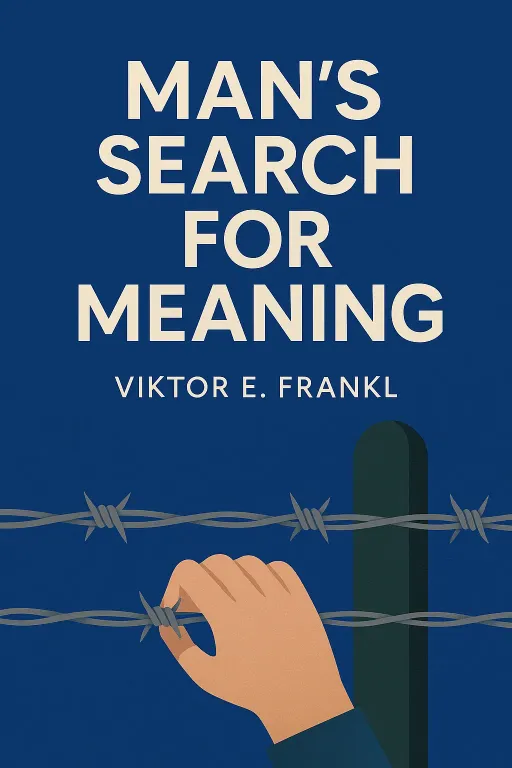
Nova: If you were asked to predict who survives a high-stress, high-mortality environment, what variables would you look at? Physical strength? Age? Wealth? When psychiatrist Viktor Frankl was sent to Auschwitz, he watched all those standard predictive models completely fall apart. He discovered that the ultimate variable for survival wasn't physical at all—it was a psychological why. Today, we're diving into Frankl's classic,, to decode the ultimate human equation of resilience. And I am so excited to have Merab with us today! Merab is a statistics graduate pursuing a career in data science, and she brings a wonderfully analytical eye to how we process life's biggest questions. Welcome, Merab!
Merab: Thanks, Nova! I'm thrilled to be here. You know, as someone who spends all day looking at data, patterns, and predictive modeling, I find Frankl's work absolutely fascinating. In statistics, we always try to identify the independent variables that explain the variance in an outcome. What Frankl does is show us that under extreme conditions, the physical variables we usually rely on have almost zero predictive power. The real signal is hidden in the noise of our internal state.
Nova: Oh, that is such a beautiful way to frame it! The real signal is in our internal state. Today, we're going to tackle this book from two different angles. First, we'll explore the psychological data of survival in the concentration camps and why traditional survival models failed. Then, we'll deconstruct Logotherapy as a practical framework for solving the modern existential vacuum and optimizing our mental health through healthy tension. We've got a lot of ground to cover, so let's jump right in!
Deep Dive into Core Topic 1
SECTION
Nova: Let's start with the first phase of Frankl's journey. He describes his arrival at Auschwitz, and it is just incredibly vivid. Imagine fifteen hundred people packed eighty to a coach, traveling for days on a train with no room to sit, barely any air, and absolute uncertainty about where they are going. When they finally arrive, they are met by SS officers performing what Frankl calls a selection. It was a literal finger game. An officer would stand there, looking completely casual, and point his finger. To the right, or to the left. Frankl didn't know it at the time, but right meant forced labor, and left meant the gas chambers. Ninety percent of his transport was sent to the left.
Merab: It's a brutal, real-world binary classification. One gesture determines life or death. And what strikes me is how the human mind tries to cope with that level of sudden, extreme threat. Frankl talks about the delusion of reprieve, where prisoners desperately believe, right up to the last second, that things won't be that bad, that they might be spared. It's like our cognitive systems have a built-in delay mechanism to prevent us from processing too much trauma all at once.
Nova: Yes, exactly! It's like a shock absorber for the brain. But that shock absorber gets stripped away pretty quickly. Frankl describes how they were taken to a cleansing station and forced to hand over absolutely everything. He had spent years writing a scientific manuscript, his life's work, and he tried to hide it in his coat. He even confided in an older prisoner, asking if he understood its value. And the older prisoner just looked at him and said, "Shit!" In that moment, Frankl realized his entire past life, his identity, his achievements, were completely zeroed out.
Merab: From a systems perspective, that is a total system reset. All your historical data points, your career, your possessions, your social status—they are deleted. You are left with nothing but your bare physical existence. And Frankl notes that this zeroing out actually triggered a strange sense of grim humor and intense curiosity. It's as if, when you have nothing left to lose, your mind detaches and starts observing the situation objectively, almost like a scientist studying a foreign environment.
Nova: It really is a survival mechanism, isn't it? But as the weeks turned into months, that initial shock turned into something else: profound apathy. Frankl describes this as the second phase of camp psychology. He tells this heartbreaking story of being in a typhus ward, where people were dying constantly. He watched, completely devoid of emotion, as other prisoners scavenged a newly dead body. One took leftover potatoes, another took the corpse's wooden shoes, another took the coat. And then, the nurse dragged the body away, and Frankl could hear the head bumping up the wooden steps. And what was Frankl doing? He was calmly sipping his soup. He felt absolutely nothing.
Merab: That is a classic example of emotional blunting. If you keep a system under continuous, high-intensity stress, it will eventually implement a protective dampening. The apathy wasn't a sign of moral decay; it was a local optimization strategy. Your brain realizes that processing grief and empathy in that environment will cause a complete system crash. So, it narrows your focus entirely to immediate survival: finding food, avoiding beatings, staying inconspicuous.
Nova: Right, it's like the brain goes into power-saving mode! But even in power-saving mode, some people survived and others didn't. And this is where Frankl's observations get really profound. He noticed that physical robustness was not a predictor of survival. In fact, sometimes the physically strong prisoners collapsed first, while those with a rich inner life or a fragile constitution managed to endure. Why do you think that is, Merab?
Merab: Well, if we look at it as a predictive model, the physical body is just the hardware. But survival in these extreme conditions required a specific kind of software—a future-oriented goal. Frankl tells the story of a fellow prisoner, a well-known composer named F----, who had a dream in early March of 1945. A voice told him that the war would end for him on March 30. He was full of hope and believed the prophecy. But as the date approached, the war news made it clear that liberation was not coming. On March 29, he fell ill with a high fever. On March 30, he became delirious. And on March 31, he died of typhus.
Nova: Oh, that story always breaks my heart. It's so tragic.
Merab: It is. But Frankl's analysis of it is incredibly scientific. He argues that the sudden loss of hope directly lowered the composer's physical resistance. His immune system was tied to his psychological expectation of the future. When the expected value of his future dropped to zero, his body's defenses collapsed, and the latent typhus virus took over.
Nova: And we actually have macro-level data that supports this, don't we? Frankl mentions that the camp's chief doctor noticed a massive spike in the death rate between Christmas 1944 and New Year 1945. It wasn't because of a change in rations, or colder weather, or a new epidemic. It was simply because so many prisoners had lived with the naive hope that they would be home by Christmas. When that hope was dashed, disappointment overcame them, their physical resistance dropped, and they died.
Merab: That is a stunning data point. It shows a direct correlation between collective expectation and physical mortality. It proves that we aren't just passive biological machines. Our physiological systems are deeply coupled with our cognitive models of the future. This is why Frankl constantly quotes Nietzsche: "He who has a to live can bear with almost any." If you have a future goal, a reason to survive, your system can optimize its resources to endure almost any physical hardship.
Nova: I love that. "He who has a why to live can bear with almost any how." It's like the ultimate survival algorithm! And Frankl actually used this himself. He describes a moment when he was marching in the freezing cold, suffering from painful sores on his feet, and his mind was filled with trivial, depressing thoughts about food, cigarettes, and shoelaces. He got so disgusted with that mental state that he forced his mind to shift. He imagined himself standing in a warm, well-lit lecture hall, giving a presentation on the psychology of the concentration camp! By projecting himself into the future, he was able to objectify his current suffering and rise above it.
Merab: That is a brilliant cognitive technique. In data science, we sometimes use coordinate transformations to make a complex, non-linear problem easier to solve. By shifting his mental coordinates to a future point, Frankl transformed his immediate, overwhelming suffering into a scientific data point. He took control of his internal state. And that brings us to what he calls the last of human freedoms: the ability to choose one's attitude in any given set of circumstances. Even when everything else is stripped away, you still have the freedom to choose how you respond.
Deep Dive into Core Topic 2
SECTION
Nova: That transition is just perfect, Merab, because it leads us right into the second part of the book: Logotherapy. Frankl took these intense, lived experiences from the camps and distilled them into a revolutionary school of psychotherapy. He calls it the Third Viennese School, after Freud's psychoanalysis and Adler's individual psychology. While Freud focused on the will to pleasure, and Adler focused on the will to power, Frankl argued that the primary motivational force in humans is the will to meaning.
Merab: And Frankl actually backs this up with some really compelling empirical data. He cites a survey conducted by social scientists at Johns Hopkins University, which looked at nearly eight thousand students across forty-eight colleges. They asked the students what they considered very important to them. Only sixteen percent checked "making a lot of money." But seventy-eight percent said their first goal was "finding a purpose and meaning to my life."
Nova: Wow, seventy-eight percent! That is a massive majority. It really shows that the search for meaning isn't just some abstract, philosophical luxury for the wealthy. It is a fundamental human drive.
Merab: Exactly. And when that drive is frustrated, we experience what Frankl calls the existential vacuum. It's a pervasive feeling of meaninglessness and boredom. In modern society, we see this manifest as depression, aggression, and addiction. Frankl even talks about Sunday neurosis, which is that specific kind of depression that hits people on the weekend when the busy workweek is over, and they are suddenly confronted with the empty void of their lives.
Nova: Oh, Sunday neurosis! I think a lot of us can relate to that feeling of, "Okay, the rush has stopped, now what?" It's like we're running on a treadmill just to avoid looking at the empty space in front of us.
Merab: Yes! If you don't have a clear objective function—a defined purpose—your system will drift. You end up trying to fill the vacuum with substitutes, like the pursuit of pleasure, power, or material wealth. But those are just temporary fixes. They don't solve the underlying optimization problem.
Nova: So, how do we solve it? How do we find this meaning? Frankl says we can't just ask, "What is the meaning of life?" in some abstract way. Instead, we have to realize that life is asking us. We are the ones being questioned, and we have to respond by taking responsibility for our lives. And he outlines three specific avenues where we can discover meaning: first, by creating a work or doing a deed; second, by experiencing something or encountering someone, like through love; and third, by the attitude we take toward unavoidable suffering.
Merab: I find that third avenue—finding meaning in suffering—to be the most profound. Frankl shares a beautiful clinical case of an elderly general practitioner who came to see him. The doctor was suffering from severe depression after the death of his beloved wife two years prior. Now, Frankl didn't offer him empty platitudes. Instead, he asked him a simple, analytical question: "What would have happened, Doctor, if you had died first, and your wife had to survive you?"
Nova: Oh, and the doctor's response was so powerful. He said, "Oh, for her this would have been terrible! She would have suffered immensely!"
Merab: Right. And then Frankl pointed out that by surviving her, the doctor had spared her that terrible suffering. But the cost of sparing her was that he now had to bear the grief himself. The doctor didn't say a word. He just shook Frankl's hand and left. His grief hadn't magically disappeared, but the meaning of his suffering had completely changed. It was no longer a senseless tragedy; it was a sacrifice of love.
Nova: That is just so beautiful. It's like Frankl helped him reframe the data. The external facts were exactly the same—his wife was still gone—but by changing the internal variable, the suffering ceased to be suffering. It found a purpose.
Merab: It's a perfect coordinate transformation. You flip the sign of the variable from negative to positive. And Logotherapy also offers some incredibly practical, almost counter-intuitive techniques for dealing with daily anxieties. One of my favorites is paradoxical intention. Frankl describes a young physician who had an intense fear of sweating. Every time he anticipated a situation where he might sweat, his anxiety would trigger the sweating, which would then increase his anxiety. It was a classic positive feedback loop.
Nova: Oh, those feedback loops are the worst! The more you worry about something, the more it happens, and the more it happens, the more you worry! How did Frankl help him break it?
Merab: He told the physician to do the exact opposite of what he normally did. Instead of trying to prevent himself from sweating, he was instructed to deliberately try to sweat as much as possible! The next time he felt an attack coming, he was supposed to say to himself, "I only sweated out a quart before, but now I'm going to pour out at least ten quarts!"
Nova: That is hilarious! Did it actually work?
Merab: It worked incredibly well! The physician, who had suffered from this phobia for four years, was completely free of it within a single week after just one session. By actively desiring the very thing he feared, he short-circuited the anticipatory anxiety. You can't experience fear and a sense of humorous detachment at the same time. It's like introducing a phase shift into a feedback loop to cancel out the signal.
Nova: That is absolutely brilliant! It's like noise-canceling headphones for your anxiety! You just phase-shift the worry by leaning into it with a bit of humor. I love that.
Synthesis & Takeaways
SECTION
Nova: As we start to wrap up our conversation, I want to bring us to Frankl's concept of tragic optimism. This is the idea that we can maintain optimism even in the face of what he calls the tragic triad of human existence: pain, guilt, and death. It's about saying yes to life in spite of everything. He shares the story of Jerry Long, a young man who became a quadriplegic at seventeen after a diving accident. Despite being paralyzed from the neck down, Jerry went to college, learned to type with a mouth stick, and wrote to Frankl, saying, "I broke my neck, it didn't break me." He believed his accident had actually enhanced his ability to help others and find deep meaning in his life.
Merab: Jerry Long's story is the ultimate proof of concept for tragic optimism. He was faced with extreme physical constraints, yet he optimized his life within those constraints to achieve a high level of purpose. It shows that our value as human beings isn't determined by our utility or our productivity, which is what a purely materialistic, nihilistic view would suggest. Our value is inherent, and we can realize it by choosing our attitude toward our limitations.
Nova: That is such an important distinction, Merab. We are not just products of our environment or our biology. We have the freedom to take a stand.
Merab: Exactly. In data science, we talk about deterministic systems where the output is entirely determined by the inputs. But human beings are non-deterministic. We have agency. We are the ones who write the transfer function. What we become, within the limits of our environment, we make out of ourselves. In the camps, Frankl saw some people behave like swine, while others behaved like saints. Both potentialities exist within all of us. Which one we actualize depends on our decisions, not our conditions.
Nova: That is a beautiful and empowering takeaway. We write the transfer function. Merab, thank you so much for sharing your incredible, analytical perspective with us today. You've helped us see the deep, systematic logic behind Frankl's message of hope.
Merab: Thank you, Nova. It's been an absolute pleasure. If I could leave our listeners with one final thought, it's this: don't look at your challenges as errors in the code of your life. Look at them as constraints within which you can optimize for meaning. You always have the freedom to choose your attitude.
Nova: What a perfect note to end on. We always have the freedom to choose our attitude. To our listeners, we leave you with this question: What is one area in your life right now where you can choose to flip the sign, reframe the data, and find a deeper why? Until next time, keep searching, keep learning, and remember—we are all in this human equation together.