Mastering Emotional Regulation and Letting Go
Golden Hook & Introduction
SECTION
Nova: If you are the type of person who treats your calendar like a holy text and your to-do list like a sacred contract, you have probably noticed that your emotions are the one variable you just cannot seem to schedule.
Atlas: Oh, that is the understatement of the year. I know plenty of people who can optimize a supply chain or restructure a department in a weekend, but the moment they feel a spike of anxiety or a wave of frustration, it is like the operating system crashes.
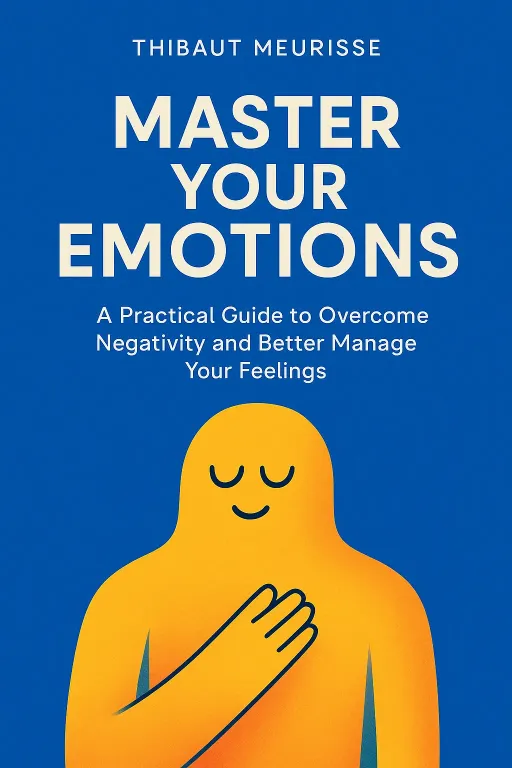
Nova: Exactly. We try to manage our emotions with the same logic we use for project management, and that is where the friction starts. Today, we are looking at two distinct ways to handle that internal chaos. We are diving into the practical, almost engineering-like approach of Thibaut Meurisse’s Master Your Emotions, and balancing that with the more philosophical, acceptance-based wisdom from Let That Sh*t Go by Nina Purewal and Kate Petriw.
Atlas: I love that pairing. Meurisse is essentially the go-to for anyone who views personal development as a systems-optimization problem. His work is widely recognized for taking the "woo-woo" out of feelings and turning them into measurable data points. On the other hand, Purewal and Petriw bring in this layer of mindfulness that is often missing from high-performance circles. It is like having the technician and the philosopher in the same room.
Nova: That is the perfect way to frame it. Meurisse spent years studying how to overcome his own social anxiety and lack of confidence, which gives his writing this grounded, "I did this, so you can too" authority. And Purewal and Petriw, they come from this background of high-stress corporate environments, so they are not teaching this from a mountaintop. They are teaching it from the middle of the boardroom.
Atlas: Which is exactly where our listeners live. So, let’s get into the mechanics. If we are treating emotions as signals, where do we even start?
The Biophysics of Emotion
SECTION
Nova: The first thing we have to dismantle is the idea that emotions are these uncontrollable weather patterns that just happen to us. Meurisse argues that emotions are biophysical signals. They are essentially data. They are produced by three things: your focus, your physiological state, and your interpretations.
Atlas: Okay, I have to stop you there. I am a fan of the "emotions are data" concept, but that sounds great on a slide deck. In the real world, if I am sitting in a high-stakes meeting and a team member drops the ball, my physiological state is not a choice. My heart rate goes up, my blood pressure spikes. How am I supposed to reframe that in real-time?
Nova: That is the million-dollar question. Meurisse’s point isn’t that you can magically switch off the chemical reaction. It is that you can change the input that feeds the reaction. He talks about posture as a primary lever. When you are slumped, looking down, and breathing shallowly, you are literally giving your brain the physical feedback that says, "I am defeated, I am small, I am in danger."
Atlas: So, you are saying the physical posture is the signal, not just the reaction to the emotion?
Nova: Precisely. It is a loop. If you force an upright, expansive posture, you are sending a contradictory signal to your nervous system. You are telling your brain, "I am ready, I am open, I am capable." It does not instantly eliminate the stress, but it changes the baseline. It is like changing the filter on a camera lens. The scene is the same, but the colors you see are different.
Atlas: I can see that working. It is like a manual override for your nervous system. But what about the mental side? Because even if I am sitting up straight, if my internal monologue is screaming, "This project is going to fail and it is entirely my fault," that is a pretty powerful interpretation.
Nova: That is the second piece of the puzzle. Meurisse emphasizes that our interpretations are often habitual. We have these automatic scripts running in the background. When something goes wrong, the script says, "Disaster." He suggests that you have to treat those interpretations like a hypothesis, not a fact. You ask yourself, "Is this interpretation serving me, or is it just a habit?"
Atlas: I like that framing. Treating an emotion as a hypothesis is a very "Strategic Architect" way of looking at it. It turns the emotional experience from a trap into a diagnostic test. But let’s play devil’s advocate. What if the emotion is valid? What if the anger I am feeling is a legitimate reaction to someone being unethical? Do I just "reframe" my way out of a moral compass?
Nova: That is a crucial distinction. Meurisse isn’t suggesting you suppress the emotion. He is suggesting you regulate the intensity so you can act effectively. If you are blinded by rage, you cannot hold someone accountable effectively. You just become a source of noise. By regulating your physiology and questioning your interpretation, you are not killing the anger. You are channeling it into a controlled, strategic response.
Atlas: So, it is about maintaining bandwidth. If I am running at 100 percent emotional intensity, I have zero cognitive bandwidth left for strategy.
Nova: Exactly. You are basically overclocking your processor, and the system is going to crash. By using these physical and cognitive interventions, you are essentially cooling the CPU. You are lowering the temperature so you can actually do the work of leadership or problem-solving.
Atlas: That makes sense. It is not about being a robot; it is about being an efficient human. But let’s pivot to the second half of this equation. Because even if I am cool as a cucumber, there are things in life that I just cannot control. And that is where, if I am understanding the premise of Let That Sh*t Go correctly, I might be setting myself up for failure.
The Trap of Control
SECTION
Nova: You are hitting on the exact thesis of Purewal and Petriw. Their argument is that most of our chronic stress doesn't come from the events themselves, but from the friction between reality and our expectations. We have this mental map of how things should go, and when reality deviates from that map, we suffer.
Atlas: I feel like that is the default setting for anyone who is ambitious. If you do not have expectations, you are not striving for anything. How do you balance having high standards—which is necessary for success—with this idea of letting go?
Nova: That is the tension, isn't it? Purewal and Petriw are not suggesting you lower your standards. They are suggesting you release the need for control over the outcome. Think of it like a sailor. You have a destination, and you have to steer the ship. You have to be precise. But you cannot control the wind, the waves, or the currents. You can only control your response to them.
Atlas: So, the "letting go" part isn't about giving up on the destination. It is about accepting the variability of the journey.
Nova: Exactly. And the "sh*t" you need to let go of is the internal narrative that says, "If this doesn't go exactly according to my plan, then I have failed." That narrative is what causes the chronic stress. It is not the obstacle; it is the judgment of the obstacle.
Atlas: I can relate to that. I have spent many nights staring at the ceiling, replaying a conversation or a project update, not because I needed to fix it, but because I was angry that it didn't go the way I anticipated. That is purely wasted energy.
Nova: It is the definition of wasted energy. Purewal and Petriw use this great analogy of a suitcase. We carry around these mental suitcases full of expectations, grudges, and "should-haves." And then we wonder why we are exhausted. Letting go is essentially putting the suitcase down. You are still walking the same path, you are still going to the same destination, but you are not dragging the extra weight.
Atlas: It is a massive efficiency gain. But let’s talk about the difficulty of this. For the "Mindful Operator," the "Strategic Architect," letting go feels like vulnerability. It feels like if I stop obsessing over the outcome, I will lose my edge. How do these authors address that fear?
Nova: They address it by reframing mindfulness as a tool for clarity. If you are obsessing over the outcome, your vision is clouded. You are looking at the destination, not the path. When you practice acceptance, you are actually sharpening your focus. You are able to see the situation as it is, not as you want it to be. And that is where true power lies. You cannot solve a problem you refuse to acknowledge.
Atlas: That is a powerful distinction. Acceptance is not passivity. It is the prerequisite for accurate problem-solving. If I am in denial about the reality of a situation because it hurts my ego or contradicts my plan, I am effectively blind.
Nova: Precisely. And that is where Meurisse’s biophysical regulation and Purewal and Petriw’s acceptance meet. You regulate your body to keep your mind clear, and you practice acceptance to keep your vision accurate. When you combine those two, you are not just efficient—you are resilient.
Atlas: I want to dig into that specific "Deep Question" we talked about earlier. The one about unmet expectations. For someone listening right now, who is sitting at their desk or in their car, how do they actually identify which expectation is causing the friction?
Nova: It is usually found in the frustration. Whenever you feel that spike of irritation, ask yourself: "What expectation is being violated right now?" Is it that someone should have responded to my email faster? That the project should have been approved by now? That my team should be more proactive?
Atlas: And once you identify it, then what?
Nova: Then you do the work of letting go. You say, "I expected X. Reality is Y. The friction is in my head. I can either continue to be frustrated by the gap, or I can accept the gap and figure out the most effective way to cross it." It is a choice between suffering and strategy.
Atlas: Suffering or strategy. I like that. It is a binary, and it is a stark one. When you put it that way, the choice becomes obvious. Why would I choose suffering?
Nova: Because it is addictive. We think that if we are frustrated, we are caring. We think that if we are stressed, we are working hard. We have conflated emotional volatility with productivity.
Atlas: That is a hard truth to swallow. I have definitely been guilty of wearing my stress like a badge of honor. Like, "Look how much I care, I am miserable."
Nova: We all have. But the reality is that the most effective people in the world are the ones who have mastered the art of being calm in the eye of the storm. They are not unaffected—they are just regulated.
Synthesis & Takeaways
SECTION
Atlas: This has been a really useful breakdown. We have gone from the biophysical "hack" of posture and framing, which gives us immediate control over our internal state, to the philosophical practice of acceptance, which gives us long-term clarity and reduces the drag of unnecessary expectations.
Nova: And the synthesis is really about energy management. If you are a high-performer, your greatest asset is your attention. When you are caught in an emotional loop, you are losing attention. When you are clinging to an unrealistic expectation, you are losing attention. By applying these principles, you are not just managing your emotions—you are reclaiming your most valuable resource.
Atlas: It is a complete workflow. Use Meurisse to handle the immediate spikes in arousal—the "emergency" emotional responses—and use the Purewal and Petriw approach to handle the chronic, long-term friction of expectations.
Nova: Exactly. And the next step for our listeners is to put this into practice. Pick one area of your life where you feel that constant friction. Maybe it is a project that is dragging on, or a relationship that feels strained. Identify the expectation you are holding onto. Write it down. Look at it. And then, for just one day, practice letting it go. See what happens when you stop trying to force reality to match your map.
Atlas: I suspect what they will find is that the world doesn't fall apart. In fact, it probably starts working a lot better.
Nova: That is the irony. The less we try to force, the more we are able to influence.
Atlas: I am definitely going to take that into my next deep-work session. Focus on the strategy, let go of the friction.
Nova: It is a practice, not a destination. But it is one that pays dividends every single day.
Atlas: Thanks for walking through this with me. It is rare to get a conversation that balances the "how-to" with the "why-it-matters" so effectively.
Nova: It is always a pleasure to unpack these frameworks. And to our listeners, remember: the goal isn't to be emotionless. The goal is to be the master of your own internal landscape, so you can focus on building the external one.
Atlas: Well said. This is Aibrary. Congratulations on your growth!