

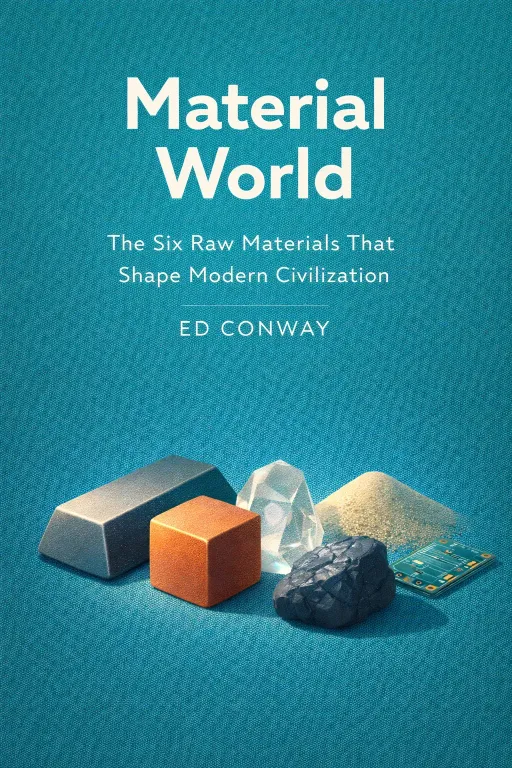
The Invisible Foundations: Compounding Value in a Material World
Golden Hook & Introduction
SECTION
Nova: Imagine standing on the edge of a massive pit in the Nevada desert, watching a scheduled explosion blast thousands of tonnes of rock into the air. To get just one standard bar of gold, miners have to dig up, crush, and chemically treat five thousand tonnes of earth. That is roughly the weight of ten fully laden passenger planes, all for a single bar of metal. We are constantly told we live in a weightless, digital world of apps, clouds, and online services. But the physical reality beneath our feet tells a completely different story. Welcome to the show, everyone. Today, we are diving into Ed Conway's brilliant book,. And I am absolutely thrilled to have marketing strategist and aspiring investor, Ashma, here with us. Ashma, welcome.
Ashma: Thanks, Nova. I am so excited to be here. You know, as someone who works in marketing, I spend a lot of time dealing with intangibles, like brand perception, digital campaigns, and software-as-a-service. But reading this book was a massive wake-up call. It made me realize that all of our flashy digital tools are completely anchored to the dirt, rocks, and metals of the physical earth. As an investor, it completely reframed how I look at value.
Nova: It really does force you to look beneath the surface, doesn't it? Today, we are going to tackle this book from three fascinating angles. First, we will shatter the myth of the weightless digital economy and look at the physical foundations of value. Second, we will explore Wright's Law and how the industrial learning curve applies beautifully to career growth and investing. And finally, we will unpack the material-heavy paradox of the green energy transition.
Deep Dive into Core Topic 1
SECTION
Nova: Let's start with this idea of the invisible infrastructure. We live in this highly optimized, modern world where we can order a product with a tap on a screen and have it arrive at our door the next day. But Conway points out that we have become completely disconnected from how things are actually made. He references a classic essay from 1958 called by Leonard Read. The essay explains that not a single person on earth knows how to make a simple lead pencil from scratch. It requires cedar from Oregon, graphite from Sri Lanka, clay from Mississippi, brass from copper and zinc, and castor oil. It is this mind-boggling, uncoordinated global dance just to create a tool we buy for pennies.
Ashma: That essay is such a masterpiece of economic thinking, Nova. And what Conway does so brilliantly is take that 1958 concept and scale it up for the twenty-first century. Think about a smartphone or a microchip. We talk about silicon chips as if they are pure intellect, but they start as high-purity quartz mined from very specific quarries. Then they go through this incredibly intense, energy-guzzling chemical process to become ultra-pure polysilicon. From there, they are sliced into wafers and etched using photolithography machines that are so complex they require global collaboration across dozens of countries. As an investor, this is a crucial lesson. If you only look at the software company at the top of the chain, you are missing the real story. The true power, and often the most defensive investment moats, lie in the physical bottlenecks of the supply chain.
Nova: Oh, absolutely. Like ASML in the Netherlands, which makes the extreme ultraviolet lithography machines, or TSMC in Taiwan. If those physical links in the chain break, the entire digital economy grinds to a halt. Conway talks about how we saw this during the pandemic with borosilicate glass. Suddenly, there was a massive panic that we wouldn't have enough medical-grade glass vials to distribute the COVID-19 vaccines. We take glass for granted, but without it, modern medicine and scientific observation are practically impossible.
Ashma: Exactly. And as a marketer, I look at this and think about how we position value. We tend to overvalue the final, shiny product and undervalue the foundational elements. But there is also a beautiful parallel here for personal development and career growth. In our careers, we often want to focus on the flashy, visible projects, the equivalent of the software app. But your true career resilience comes from building those invisible, foundational skills. Things like deep analytical thinking, understanding basic economics, or mastering communication. Those are the raw materials of your professional life. If you don't secure those, the flashy stuff won't hold up.
Nova: That is a wonderful way to frame it, Ashma. We need to build our own robust supply chains of skills. And speaking of foundations, Conway highlights six key materials that literally built the modern world: sand, salt, iron, copper, oil, and lithium. Take salt, for example. Most of us think of it as a simple condiment on our dinner table. But Conway takes us to the solution mines in Cheshire and explains that salt is the bedrock of the chemical industry. It gives us chlorine for water purification and pharmaceuticals, and soda ash for glass production. Without salt, our cities would literally collapse from disease and lack of clean water.
Ashma: It is mind-blowing. We pay almost nothing for a container of salt at the grocery store, which reflects its market price. But its true societal value is infinite. If we lost access to it, civilization would disintegrate. This distinction between price and value is something every wise investor has to master. The market often misprices foundational assets because they aren't flashy. But when a crisis hits, like the UK carbon dioxide shortage in 2021, which was a byproduct of fertilizer plants shutting down due to high natural gas prices, suddenly everyone realizes how interconnected and fragile these cheap materials really are.
Deep Dive into Core Topic 2
SECTION
Nova: That fragility is real, but there is also a massive force driving the cost of these technologies down over time, which brings us to our second topic: Wright's Law. Now, many people have heard of Moore's Law, which says computing power doubles every two years. But Conway introduces us to Wright's Law, formulated by aeronautical engineer Theodore Wright. He observed that every time the cumulative production of an item doubles, the cost of producing it falls by a constant percentage. It is the formal economic rule for the learning curve.
Ashma: Yes, and this is where my inner investor gets incredibly excited. Wright's Law is essentially the math behind compounding experience. Conway gives some staggering examples. In 1960, a megabyte of computer memory cost over five million dollars. By 2016, it was well under a cent. Or look at solar panels. Photovoltaic module prices halved five hundred times between 1975 and 2019. And lithium-ion batteries? Their cost per kilowatt-hour fell by ninety-seven percent between 1991 and 2018. A Tesla battery that cost twelve thousand dollars in 2022 would have cost nearly a million dollars in the early nineties.
Nova: Those numbers are just staggering. And Wright's Law works because of specialization, iterative improvements, and the slow accretion of experience by workers, managers, and suppliers. It is a virtuous circle of learning by doing. The more we make, the better we get at making it, and the cheaper it becomes.
Ashma: Think about what that means for a growth mindset, Nova. We often get discouraged when we start learning a new skill because the initial effort is so high and the output is so low. It feels like we are grinding our gears. But if you apply Wright's Law to your own life, every time you double your cumulative practice hours, the cognitive cost of performing that skill drops, and your efficiency skyrockets. The first time you write a marketing proposal or analyze a financial statement, it might take you twenty hours and feel incredibly painful. But by the tenth time, you've built up that compounding experience. The "cost" to your brain plummets, and the quality of your work increases. It is all about staying in the game long enough to let that learning curve work its magic.
Nova: I love that. "Compounding experience." It means that consistency isn't just a moral virtue; it is an economic law of personal growth. We are literally driving down our own internal production costs through repetition.
Ashma: Exactly. And as an investor, when you are looking at emerging industries, you want to back companies that are riding these steep Wright's Law curves. It is why solar and batteries have scaled so fast. But Conway also warns us that Wright's Law isn't a magic wand that solves everything. It relies on uninterrupted access to the raw materials. If the supply chain for lithium or copper hits a physical bottleneck, the cost curve can actually reverse, which is exactly what we saw in 2022 when battery prices rose for the first time in decades due to raw material supply concerns.
Deep Dive into Core Topic 3
SECTION
Nova: That is the perfect transition to our third topic: the paradox of the green energy transition. We are currently embarking on what Conway calls the fifth great energy transition, moving away from fossil fuels toward renewables. But there is a massive, uncomfortable irony here. To build a "green," low-carbon future, we have to extract more metals and minerals from the earth's surface in the coming decades than we have in the entire history of humanity.
Ashma: This is the green paradox, and it is one of the most critical concepts for any modern investor or professional to understand. We have this clean, pristine image of wind turbines and electric vehicles. But when you look at the raw material balance sheets, they are incredibly heavy. Nova, walk us through what actually goes into a single offshore wind turbine.
Nova: It is mind-boggling. A single offshore wind turbine is a massive monument to the material world. Its foundation is a heavy steel monopile weighing around eight hundred tonnes—that is the weight of three jumbo jets. The tower, the nacelle, the blades—they all require massive amounts of steel, fiberglass, and carbon fiber, which are derived from oil, gas, and salt. And then you have the copper. A single wind turbine requires miles of copper wiring to generate and transmit electricity. Conway notes that replacing a small one-hundred-megawatt natural gas turbine with wind power requires twenty large wind turbines. That means using thirty thousand tonnes of iron, fifty thousand tonnes of concrete, and over five hundred tonnes of copper. The gas turbine, by contrast, needs a tiny fraction of that.
Ashma: It is a complete shift in how we think about resources. We aren't burning fossil fuels anymore, but we are building with them. We are using fossil fuels to mine, transport, and refine the massive amounts of metals needed for the transition. One calculation Conway cites suggests that humanity will need to mine more copper in the next twenty-two years than we have in the entire past five thousand years. As an investor, this tells me that the demand for these foundational materials is going to be structural and long-term. It is not a passing trend.
Nova: And it creates this fascinating geopolitical shift. We are moving from the era of "petrostates," where countries like Saudi Arabia held immense power because of oil, to the era of "electrostates," where countries that control the mining and processing of critical minerals will hold the cards. China, for example, has spent decades quietly securing a dominant position in processing silicon, lithium, and cobalt. They don't just mine them; they refine them and manufacture the batteries and solar panels.
Ashma: It is a masterclass in long-term strategic planning. While the West was focused on the digital software layer, China was building the physical foundations of the twenty-first century. For an investor, this means we have to look past the superficial "green" marketing. You can't just invest in the flashy EV startup; you have to look at who controls the lithium brine in the Atacama Desert, or who has the technology to recycle these batteries. Conway takes us to Umicore in Belgium, a company that transitioned from a traditional mining giant with a dark colonial history in the Congo to a pioneer in "urban mining" and battery recycling. That circular economy is going to be essential.
Nova: It really is. We have to learn to "unmanufacture" as well as we manufacture. And that brings us back to the human element. Conway points out a really worrying trend: the decline in mining engineering and material science studies in Western universities. We want the green technology, but we have stigmatized the very industries required to procure the raw materials for it. If there is no one left who knows how to safely and efficiently extract these minerals, our green transition is going to hit a massive wall.
Ashma: That is such a profound point, Nova. It is a form of cognitive dissonance. We want the end product, but we want to ignore the process. And that brings us right back to the growth mindset. You can't achieve a major breakthrough in your career or your life without going through the messy, difficult, and sometimes gritty process of building it. There are no shortcuts. You have to do the heavy lifting, mine the raw materials of your skills, and put in the energy to refine them.
Synthesis & Takeaways
SECTION
Nova: I love how you've connected the physical laws of our material world to the psychological laws of personal growth, Ashma. As we wrap up this incredible journey through sand, salt, iron, copper, oil, and lithium, what are the key takeaways you want our listeners to walk away with?
Ashma: First, always look for the invisible foundations. Whether you are analyzing a stock, a business model, or your own career, don't just look at the flashy digital surface. Ask yourself: what is the physical or foundational bottleneck that makes this work? Second, trust Wright's Law. Embrace the learning curve. Every time you double your experience in a skill, you are compounding your value and driving down your internal cognitive costs. And finally, embrace the complexity and the paradoxes of growth. Just like the green transition, personal progress is material-intensive. It requires energy, effort, and a willingness to engage with the gritty realities of life.
Nova: That is absolutely beautiful, Ashma. Thank you so much for sharing your insights with us today. You've given us a completely new lens to view both the global economy and our own personal development.
Ashma: Thank you, Nova. It was an absolute blast.
Nova: And to our listeners, we leave you with this question to ponder: What is the "salt" of your career? What is that quiet, unglamorous, foundational skill that underpins everything else you do—and how can you invest in doubling your experience with it today? Until next time, keep exploring, keep growing, and remember to appreciate the incredible material world that supports us all.