Accelerating Impact and Masterful Execution
Golden Hook & Introduction
SECTION
Nova: The old mantra of moving fast and breaking things is officially dead. It was a reckless philosophy that treated people and processes like disposable parts in an engine. We have entered an era where speed is still the currency of success, but the mechanism has fundamentally shifted. Now, it is all about moving fast and fixing things.
Atlas: That is a massive shift in perspective. Most high-performers I talk to are still operating under the assumption that if you aren't leaving a trail of wreckage behind you, you aren't moving fast enough. They wear their burnout like a badge of honor.
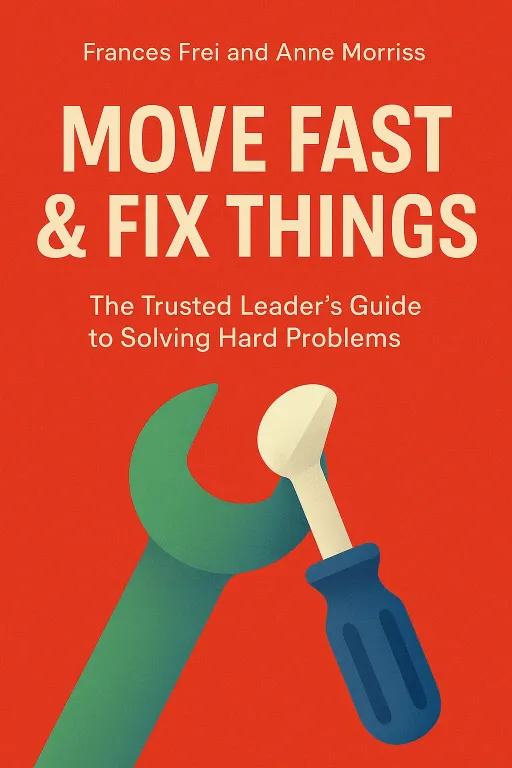
Nova: Exactly, and that is where the trap lies. Today, we are dissecting how to maintain that critical velocity without sacrificing the psychological safety that actually drives innovation. We are looking at the work of Frances Frei and Anne Morriss in their book Move Fast and Fix Things, and we are pairing it with the foundational goal-setting mechanics of Zig Ziglar in The Goals Program.
Atlas: It is an interesting pairing. Frei and Morriss come from a very modern, corporate-turnaround perspective—Frances Frei was a professor at Harvard and famously helped Uber navigate their massive culture crisis. Then you have Zig Ziglar, who is essentially the architect of the classic self-help, goal-oriented movement. Bringing those two together feels like we are bridging the gap between high-level leadership strategy and the gritty, daily work of individual execution.
Nova: That is the perfect way to frame it. The core of our discussion today is really an exploration of how to build a foundation of trust that allows for rapid execution, and then how to layer a structured system on top of that so you actually hit your targets. We are going to break down how to stop the cycle of frantic, directionless activity and replace it with masterful, high-impact execution.
The Trust Triad as a Velocity Multiplier
SECTION
Atlas: I want to dive straight into this concept of trust. In the corporate world, trust is often treated as a soft skill—something you focus on during the annual retreat or after a crisis hits. But Frei and Morriss argue that trust is actually a hard, mechanical necessity for speed. If you don't have it, you literally cannot move fast.
Nova: That is the crucial insight. Think about a car. If you are driving a car that you don't trust—maybe the brakes feel loose, the steering is vibrating, you hear a strange clicking sound—what do you do? You slow down. You drive with extreme caution. You are constantly checking the dashboard. You are not going to hit top speed because your brain is occupied with the risk of failure.
Atlas: That is a brilliant analogy. So, in an organization, if a team doesn't trust their leader, or they don't trust each other, they are driving with the parking brake on. They are double-checking every email, they are waiting for permission, they are holding back information.
Nova: Precisely. And Frei and Morriss identify three specific pillars that hold up this trust structure. They call it the Trust Triad: Empathy, Logic, and Authenticity. If any one of these is missing, the trust collapses, and your speed drops to zero.
Atlas: Let’s break those down, because they sound simple, but I imagine they are deceptively difficult to get right. Start with Empathy. I see a lot of leaders who think empathy is just about being nice or friendly. Is that what they mean?
Nova: Not at all. Empathy, in this context, is about ensuring the other person feels like you are on their side. It is the ability to communicate that you are looking at the world through their eyes. It is not about agreeing with them; it is about demonstrating that you understand their reality. If a team member feels like you are only interested in your own agenda, empathy is absent. They will immediately become defensive.
Atlas: That makes sense. It is the difference between saying, I hear what you are saying, versus, I understand why this is a challenge for you, and here is how we can fix it together. It shifts the dynamic from adversarial to collaborative. But then there is Logic. That seems like the easy one. Surely, most leaders are logical?
Nova: You would think so, but logic is where many people trip up. Logic here refers to the quality of your ideas, your reasoning, and your track record. It is about whether people trust your competence. If you are empathetic—you listen, you care—but your ideas are constantly flawed, or your reasoning is inconsistent, people will like you, but they won't trust you to lead them to success. They will feel like they are on a sinking ship, but at least the captain is a nice person.
Atlas: That is a dangerous combination. I have seen that in teams. The leader is beloved, but the project keeps failing because the strategy is nonsensical. And then the third one is Authenticity. That feels like the most elusive one. What does it actually mean to be authentic in a high-stakes meeting?
Nova: Authenticity is about being the same person in every room. It is the absence of a hidden agenda. It is when people feel like they are seeing the real you, not a polished, corporate version that is calculated to say exactly what everyone wants to hear. If people sense that you are performing, they will spend their energy trying to figure out what you are hiding, rather than focusing on the work.
Atlas: So, if you have empathy but no authenticity, you are just a pandering politician. If you have logic but no empathy, you are a cold robot. And if you have empathy and logic but no authenticity, you are a performer. You have to nail all three to get that speed.
Nova: Exactly. And the most interesting part of the Frei and Morriss argument is that you can diagnose which of these is broken. Most leaders have a wobble in one of these legs. If you are constantly finding that your team is slow to adopt your ideas, it is rarely because they are stubborn. It is almost always because one of these three pillars is cracked.
Atlas: That is a powerful diagnostic tool. It moves the conversation away from, Why is my team difficult? to, Which part of the trust equation am I failing to provide?
Executing with Clarity and Structure
SECTION
Nova: Once you have that trust, you have the clearance to move fast. But speed without direction is just chaos. This is where we need to bring in the second piece of the puzzle: The Goals Program by Zig Ziglar.
Atlas: Ziglar is a classic for a reason. His approach to goals is incredibly structured. It is the antidote to the vague, wishful thinking that plagues so many professional plans.
Nova: He emphasizes that success is not an accident. It is a formula. And his formula starts with something that sounds painfully simple, but almost nobody does correctly: writing down your specific objectives. He argues that if it is not written down, it is just a wish.
Atlas: I think people avoid writing things down because it makes them accountable. If I write down, I will finish this project by Friday, and Friday comes around and I haven't done it, I have to face that failure. If I just keep it in my head, I can tell myself I am still working on it. It is a psychological defense mechanism.
Nova: That is exactly it. And Ziglar’s program forces you to move past that defense. He insists on a structured process: you define the goal, you identify the potential obstacles, you align it with your core values, and then you break it down into micro-steps.
Atlas: The obstacle identification part is what I find most fascinating. Most goal-setting advice focuses entirely on the vision, the outcome, the dream. They tell you to visualize the success. Ziglar flips that. He says, You need to visualize the failure points.
Nova: He does. He asks, What is going to stop you? By identifying the obstacles before they arise, you are essentially creating a contingency plan. You are not just hoping for the best; you are preparing for the reality of the friction you will encounter. It is like planning a road trip and checking the weather report and the traffic patterns before you leave the driveway.
Atlas: It changes your mindset from passive to active. Instead of being surprised when a problem hits, you are ready for it. It is the difference between a panicked reaction and a pre-planned response.
Nova: And that connects back to the trust triad we discussed earlier. If you have a team that trusts you—because you have demonstrated empathy, logic, and authenticity—you can be transparent about these obstacles. You can say, Here is the goal, and here is where I think we are going to struggle. Let’s figure this out together. That level of transparency is only possible when the team feels safe.
Atlas: So, you are using the trust to create a safe environment, which allows you to be brutally honest about the goals and the obstacles. It is a self-reinforcing loop.
Nova: Precisely. And this is where the Pragmatic Learner, the person we are speaking to today, can really make an impact. You don't need to overhaul your entire life or your entire company overnight. You just need to apply these two frameworks to one bottleneck.
Atlas: Let’s make that concrete. If I am listening to this, and I am feeling the pressure of a stalled project, what is my first move?
Nova: Start with the bottleneck. Don't try to fix everything at once. Pick the one professional area where you feel the most friction. Maybe it is a project that isn't moving, or a team dynamic that feels tense.
Atlas: Okay, I have the bottleneck. Now what?
Nova: Apply the trust triad. Ask yourself: am I failing on empathy, logic, or authenticity? Am I not listening to their concerns? Is my strategy unclear? Am I trying to be someone I am not? Once you identify that gap, you communicate that realization to your team. You say, I realize I haven't been transparent about our goals, or I realize I haven't listened to the challenges you are facing. That act of vulnerability is a massive trust accelerator.
Atlas: I love that. It is not about fixing the project first; it is about fixing the relationship that allows the project to move. And then, once that foundation is set, you bring in the Ziglar formula.
Nova: Exactly. You sit down and you write out three micro-goals for the next month. Not ten, not twenty. Three. And for each one, you write down the goal, you write down the likely obstacles, and you write down why this goal matters to your core values.
Atlas: That is the key, isn't it? If the goal isn't aligned with your values, you won't have the discipline to overcome the obstacles when they inevitably pop up.
Nova: Correct. If the goal is just about hitting a number, it is easy to quit. If the goal is tied to your sense of purpose or your professional integrity, you will find a way to navigate around the obstacles.
Synthesis & Takeaways
SECTION
Atlas: It is interesting how these two approaches—Frei and Morriss on the one hand, and Ziglar on the other—really cover the internal and external aspects of high performance. Frei and Morriss are about the internal state of the team and the leader. It is about clearing out the emotional and psychological friction. Ziglar is about the external structure, the roadmap, the mechanics of how you get from point A to point B.
Nova: That is a great synthesis. You cannot have one without the other. If you have the roadmap but no trust, you will be constantly fighting your team to get them to follow it. They will resist, they will drag their feet, and the plan will fail. If you have the trust but no roadmap, you will have a very happy, very connected team that is wandering around in circles, not getting anything done.
Atlas: It is the difference between a high-functioning family and a high-functioning business unit. You need both the emotional connection and the clear, measurable objectives.
Nova: And for the person listening who feels like they don't have time for this—who feels like they have to move fast and just get things done—that is the most important realization. The time you spend building trust and setting structured goals is not time lost. It is time invested. It is the difference between sprinting in the wrong direction and walking steadily toward a clear, valuable objective.
Atlas: It is the ultimate efficiency hack. You are front-loading the effort to save yourself from the massive, time-consuming disasters that come from lack of trust and lack of focus.
Nova: Precisely. The goal is to move fast, but with precision. To fix things permanently rather than patching them up temporarily. When you combine the humanity of the trust triad with the rigor of structured goal setting, you don't just get more done. You get the right things done, and you bring your team along with you.
Atlas: I am curious to see how this plays out for our listeners this week. If you take that one bottleneck—just one—and you apply those two lenses, I suspect you will see a shift in the energy of your team and the speed of your results almost immediately.
Nova: It is a small experiment with potentially massive returns. Identify the bottleneck. Check your trust pillars. Write down your three micro-goals. And see what happens. That is the path to masterful execution.
Atlas: It sounds like a solid plan. I am going to apply this to my own planning for the next few weeks. It is easy to get caught up in the noise, but this provides a very clear, very sharp framework for cutting through it.
Nova: That is the goal of all of this, isn't it? To reclaim your time by prioritizing what actually matters. We have covered a lot of ground today, from the nuances of human trust to the mechanics of goal achievement. But the real value is in the application.
Atlas: Absolutely. And for everyone listening, don't just consume the information. Pick the bottleneck, write the goals, and start building that trust. It is the most valuable work you can do.
Nova: Well said. This is Aibrary. Congratulations on your growth!