Designing a Sanctuary of Joy and Boundaries
Golden Hook & Introduction
SECTION
Nova: Imagine you have just climbed the mountain you have been staring at for years. You reach the summit, plant your flag, and wait for the overwhelming sense of bliss to wash over you. But instead of joy, you feel... nothing. Or worse, you feel the crushing weight of the next mountain already looming on the horizon. That is the achievement hangover, and it is the hallmark of a culture that has fundamentally misunderstood happiness.
Atlas: Oh, the achievement hangover. That is a familiar ghost. It is that strange, hollow feeling where you accomplish exactly what you set out to do—get the promotion, finish the project, hit the revenue goal—and your brain just immediately asks, what is next? It is like eating a massive, delicious meal and still feeling hungry five minutes later.
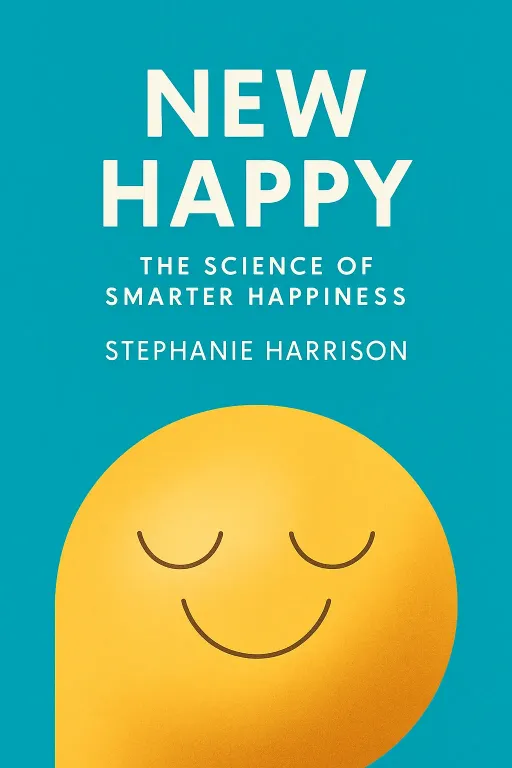
Nova: Exactly. And that is the trap we are dismantling today. We are exploring how to break free from the "Old Happy" culture, which insists that happiness is a prize you earn through individualistic achievement. We are looking at this through the lens of two brilliant thinkers. First, we have Stephanie Harrison and her book, New Happy, which challenges us to find well-being through our unique contributions to others. And to make sure we actually have the capacity to make those contributions, we are pairing her work with Natalie Lue’s The Joy of Saying No. She dives deep into the architecture of people-pleasing and why boundaries are actually the ultimate form of self-care.
Atlas: That is a perfect pairing. It feels like we are talking about the "what" and the "how." Stephanie Harrison gives us the new destination—happiness through connection and service—and Natalie Lue gives us the map to get there by clearing the brush of obligation.
Nova: That is the perfect way to frame it. Stephanie Harrison’s work is fascinating because she spent years studying the science of happiness, and she realized that most of us are running on a treadmill designed by a culture that values individual status above all else. She argues that we have been sold a lie about what it takes to thrive.
Atlas: I am curious about the science behind that. Because, let’s be honest, achievement feels good. It provides a hit of dopamine. Are you saying that feeling is a lie, or just that it is the wrong kind of fuel?
The Trap of Old Happy
SECTION
Nova: The feeling is real, but the sustainability is the issue. Think of it like a sugar rush versus a nutrient-dense meal. Achievement gives you that spike, but then you crash, and you need another achievement to get that same level of validation. Stephanie Harrison points out that this individualistic model, what she calls Old Happy, isolates us. It makes us view others as competitors for resources or status. It turns life into a zero-sum game.
Atlas: That resonates. When I am in that mode, every conversation feels like a transaction. I am scanning to see if this person can help me reach my next goal. And that is exhausting.
Nova: It is, and it is also lonely. The New Happy, as Harrison defines it, is a complete shift in orientation. It is not about what you can get, but about what you can give. It is about leveraging your unique gifts—the things you are naturally good at and enjoy—to help others. The science shows that when we act in ways that contribute to the well-being of others, our own nervous systems regulate better, our stress decreases, and we feel a deeper, more enduring sense of fulfillment.
Atlas: I can see the logic there, but let’s play devil’s advocate for a second. If I am a high-achiever, my identity is wrapped up in being the person who delivers, the person who wins. If I pivot to this "contribution" model, does that mean I stop aiming for excellence? Does that mean I just become a nice person who fades into the background?
Nova: That is a critical distinction. It is not about lowering your standards or stopping your pursuit of excellence. It is about changing the of that excellence. Think of it this way: instead of "I want to be the best so I can be recognized," the New Happy mindset is "I want to be the best so I can be the most effective instrument for helping others." The excellence stays, the ambition stays, but the ego-driven anxiety fades because your success is no longer tied to a ranking. It is tied to your impact.
Atlas: So the goal shifts from "look at me" to "look at what I can do for you." I like that. It feels less like a performance and more like a craft. But here is the problem: if I am the person who is suddenly focused on "contribution" and "helping others," I am going to become the magnet for every request, every favor, and every obligation that comes down the pipeline. I am going to be the person everyone relies on, and I will be back to being exhausted in a week.
The Boundary Paradox
SECTION
Nova: And that is exactly why we need Natalie Lue. You have hit on the paradox of the helper. If you are a high-achiever and you are now motivated by service, you are a prime candidate for burnout. This is where The Joy of Saying No becomes essential. Natalie Lue is an expert on the psychology of people-pleasing, and her work is a masterclass in understanding why we say yes when we want to say no.
Atlas: I have read a bit about this, and the idea that people-pleasing is a form of self-care is counterintuitive. Most of the time, we are taught that saying no is selfish.
Nova: That is the misconception we have to dismantle. Natalie Lue identifies that people-pleasing is often not about kindness; it is about fear. It is fear of rejection, fear of conflict, or a fear that our value is only tied to our utility. She breaks down six different styles of people-pleasing.
Atlas: Six styles? That sounds like a lot to unpack. Give me the highlights. Which ones do you think are the most common for high-achievers?
Nova: There are two that stand out for the people listening to us right now. The first is the "Perfectionist Pleaser." This is the person who thinks that if they do everything perfectly, they will be safe from criticism. They say yes to everything because they believe they are the only ones who can do it right. Then there is the "Rescuer Pleaser." This is the person who feels responsible for everyone else’s emotions. They see someone struggling, and they immediately jump in to fix it, often at the expense of their own well-being.
Atlas: That "Rescuer" one hits home. I think many people in leadership or management roles fall into that trap. You see a team member struggling, and your instinct is to take the work off their plate because you think you are "helping." But you are actually robbing them of the chance to learn, and you are robbing yourself of time you need to do your own work.
Nova: Exactly. And Natalie Lue argues that this is not actually kindness. It is a form of control. When you rescue someone, you are essentially saying, "I don't trust you to handle your own experience." When you say yes to everyone, you are not being generous; you are being dishonest. You are promising time and energy you do not have.
Atlas: That is a sharp way to put it. Being dishonest. It sounds harsh, but it is true. If I say yes to a meeting I do not have time for, I am effectively lying about my capacity. I am showing up half-present, distracted, and resentful. That is not a gift to the other person.
Nova: You are spot on. Natalie Lue emphasizes that a "no" is not a rejection of the person. It is a boundary that protects the relationship. When you say no, you are saying, "I care about this relationship enough to not show up half-baked." You are creating the space to actually be effective when you do say yes.
Atlas: So, how do we integrate these two ideas? If Stephanie Harrison says, "Use your gifts to help others," and Natalie Lue says, "Stop saying yes to everything," how do we find the balance? Because it feels like a tension.
Integrating Service and Boundaries
SECTION
Nova: The balance is in the word "alignment." This is where the two books harmonize. You use your gifts to help others, but you are selective about others and problems you are solving. You are not a universal service provider. You are a specialist. You identify where your unique contribution has the highest impact, and you fiercely protect the time and energy required to make that contribution.
Atlas: I like that. It is the difference between being a generalist who is drowning in requests and a specialist who is surgical about their impact. It changes the nature of the "no." Instead of saying "no" because I am lazy or selfish, I am saying "no" because I am committed to something else that matters more.
Nova: That is the key. When you have a "yes" that is deeply meaningful—a project you are passionate about, a person you are truly dedicated to supporting—the "no" becomes easy. The "no" is just the shield that protects your "yes."
Atlas: What about the feeling of guilt? Because even when I know I am doing the right thing, there is this little voice that says, "You are letting them down."
Nova: Natalie Lue addresses this beautifully. She talks about how we need to separate our identity from our output. You are not a bad person for having limits. In fact, people who have boundaries are generally more respected and trusted because their "yes" actually means something. When you say "yes," people know you are fully committed.
Atlas: That is a great point. I have colleagues who say yes to everything, and I have learned to take their yes with a grain of salt because I know they are overextended. But the person who says "no" occasionally? When they say "yes," I know they are all in.
Nova: Exactly. Reliability is a form of integrity. Let’s bring this back to our listeners. We want to challenge everyone to look at their current commitments.
Atlas: Yes, the "Deep Question" we mentioned earlier. I have been thinking about this while we have been talking. We all have those obligations that we keep out of momentum. "I have always done this, so I must keep doing it."
Nova: Right. It is the "obligation yes." It is the meeting you attend that could have been an email, the committee you sit on because you feel guilty leaving, the favor you do that drains you for three days.
Atlas: So, what is the strategy for the listener to audit this? If I am a focused achiever, I want a process.
Nova: Start with a simple inventory. Look at your calendar for the last two weeks. Identify three things that felt like a drain rather than a contribution. Ask yourself: "Did I say yes to this because it aligned with my unique gifts and my mission, or did I say yes because I was afraid of what would happen if I said no?"
Atlas: That is a powerful filter. Fear versus alignment. If it is fear, that is a boundary issue. If it is alignment, that is a contribution issue.
Nova: Precisely. And once you identify those "fear yeses," you practice the "no." Natalie Lue suggests that you do not need to over-explain. A simple, "I am not able to take that on right now, but I appreciate you thinking of me," is sufficient. You do not need to justify your existence.
Atlas: I think the over-explaining is the trap. We think if we provide enough evidence of why we are busy, the other person will understand. But the truth is, the more we explain, the more we open the door for them to negotiate our boundaries.
Nova: You are absolutely right. An explanation is an invitation to a debate. A boundary is a statement of reality.
Synthesis & Takeaways
SECTION
Atlas: This has been a great conversation. We started with the idea of the "achievement hangover" and the "New Happy"—this shift from individual status to meaningful contribution. And we realized that you cannot actually make that shift if you are bleeding out your energy on things that don't matter.
Nova: It is about reclaiming your agency. When you stop saying yes to everything, you reclaim the time to focus on the things that actually make you feel alive and make the world better. You stop being a performer for an audience that isn't watching, and you start being a participant in a life that actually matters.
Atlas: And that is the ultimate form of self-respect. It is realizing that your time, your energy, and your unique gifts are a finite resource. You get to decide how to spend them.
Nova: That is the deepest takeaway. Happiness isn't a destination you reach by checking off boxes. It is a byproduct of living in a way that aligns your internal gifts with external needs, all while holding the boundaries that keep you healthy enough to keep going.
Atlas: I love that. It turns the whole thing into a sustainable practice rather than a sprint to the finish line.
Nova: Before we wrap up, I want to leave our listeners with that challenge again. Look at your schedule this week. Find that one thing you are doing out of obligation rather than alignment. And ask yourself: what would happen if I said no? What space would that open up for the contribution I actually want to make?
Atlas: It is a scary thought, but I think the result might be more freedom than we can imagine.
Nova: It is the freedom to be truly happy, not just "achieving." Thank you for joining us in this exploration today. Remember, your impact is not defined by how much you do, but by the intention behind what you choose to do. This is Aibrary. Congratulations on your growth!