The Non-Obvious Path: Redefining Success When the Standard Formula Fails
Golden Hook & Introduction
SECTION
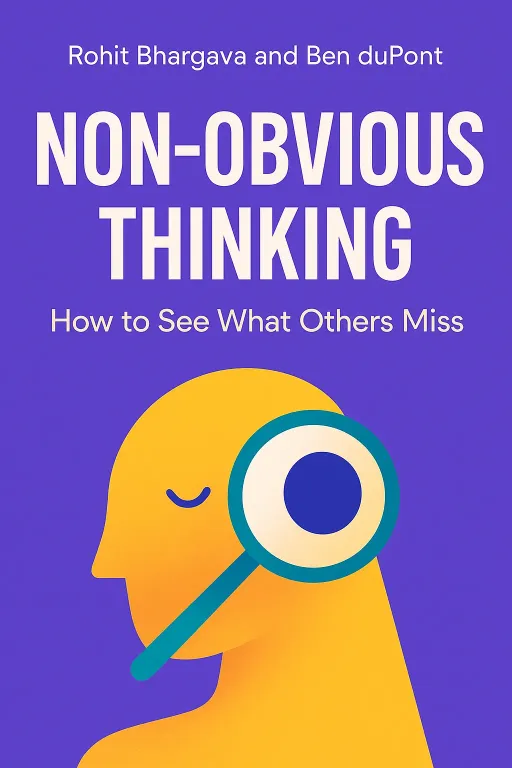
Orion: For over a century, sailors navigated the South Pacific using maps that clearly marked a fifteen-mile-long landmass called Sandy Island. It was on Google Earth, GPS databases, and maritime charts. But in 2012, a team of scientists sailed to those exact coordinates and found nothing but fourteen hundred meters of open, deep blue ocean. The island never existed. It was an entrenched mistake born of nautical errors and wishful thinking. How many of us are navigating our careers using maps of success that are just as fictional? Welcome to the show. I am Orion, and today we are diving into the core principles of Non-Obvious Thinking, a brilliant framework by Rohit Bhargava and Ben duPont. Joining me is Büşra Bayıroğlu, a dietitian who, despite her hard work and analytical mind, has found herself stuck in the frustrating waters of career stagnation. Büşra, welcome.
Büşra Bayıroğlu: Thank you, Orion. That Sandy Island story really strikes a nerve. For the past few years, I feel like I have been sailing toward an island called the perfect career path, using the exact map I was given: pass the entrance exam, get the master's degree, apply to traditional jobs. But the island is not there, and I am left feeling hopeless, angry, and honestly, wondering if my entire perspective is flawed.
Orion: It is a incredibly common trap. We mistake the map for the territory. Today, we are going to tackle this book from two distinct angles to help you redraw your map. First, we will explore how to clear the mental clutter of failure and look at ourselves through a more objective lens. Second, we will focus on how to redefine the actual problems we face and design a Twist, an Option C, that bypasses traditional gatekeepers entirely. Let us start with the first part of the authors' SIFT framework: creating space and uncovering insights.
Deep Dive into Core Topic 1
SECTION
Orion: Büşra, when we experience setbacks, our minds become cluttered. The authors argue that modern life is filled with physical and digital clutter, but the most dangerous kind is mental clutter. When you did poorly on your entrance exam, what kind of mental noise started filling your space?
Büşra Bayıroğlu: It was deafening, Orion. It was a constant loop of self-doubt. I told myself that because I did poorly on that specific exam, I was not cut out for a master's degree. I started anticipating rejection before I even applied for jobs. The authors call these prebuttals, right? Counterarguments we make in our heads before we even speak or act. I was prebutting my entire career.
Orion: Exactly. Prebuttals shut down dialogue and narrow our perspectives. They prevent us from seeing what is actually there. To break this cycle, the authors suggest we need to uncover insights, which they define as surprising truths that explain why things are the way they are. To illustrate this, they point to a famous experiment conducted by the brand Dove for their Real Beauty campaign. They brought a forensic sketch artist from the FBI into a sparse, neutral warehouse. The artist sat behind a curtain and drew portraits of several women based solely on how they described their own facial features.
Büşra Bayıroğlu: I remember hearing about that. And then they had strangers describe those same women to the artist, correct?
Orion: Yes, that is the crucial twist. The artist created two sketches for each woman: one based on self-description, and one based on a stranger's description. When the two portraits were hung side by side, the difference was staggering. The self-described portraits consistently portrayed faces that were meaner, sadder, and far less friendly. The stranger-described portraits were more open, happier, and, as the campaign tagline put it, more beautiful. The insight was clear: we judge ourselves far more harshly than the world perceives us. Our self-perception is distorted by our insecurities.
Büşra Bayıroğlu: That is a powerful metaphor for how I have been viewing my professional self. When I look at my career right now, I am looking at the self-described sketch. I see the failed exam, the lack of a job, the fear. I have let those elements define my entire professional identity. But a stranger, or a potential employer looking at my analytical skills and my passion for dietetics, would likely see a completely different portrait.
Orion: Precisely. Your self-sketch is cluttered with the trauma of the exam. To clear that space, the authors suggest practicing what they call time spaciousness and making oasis moments. This is not just about time management. It is about mental agility. It is about stopping the autopilot routine of worry and deliberately anchoring your attention on different details. For example, the Korean concept of Nunchi, which the book highlights, is the art of reading a room and gauging unspoken thoughts and feelings. If you step out of your own head and observe the unspoken needs of the people around you, what do you see?
Büşra Bayıroğlu: If I look at the actual market, rather than my exam scores, I see a world desperate for clear, analytical guidance on nutrition. People are overwhelmed by conflicting dietary information online. They do not care about my entrance exam score; they care about whether I can help them navigate their health.
Orion: That is a major insight. The exam is a gatekeeper for a specific, traditional academic path, but it is not a measure of your value to the people who actually need your expertise. By focusing on the exam, you are letting a single metric clutter your entire horizon. We need to move from this insight to the next step of the SIFT framework: focusing your ideas and defining the twist.
Deep Dive into Core Topic 2
SECTION
Orion: This brings us to the concept of distillation. The authors use the beautiful example of Damascus rose oil production in Turkey. Every May, family farmers pick tens of thousands of soft, blooming rose petals. It takes more than ten thousand individual flowers to produce just a single drop of pure rose oil, making it worth more per ounce than gold. That is distillation: taking a massive amount of raw material and focusing it down to its absolute essence. Büşra, we need to distill your career problem. What is the actual, core bottleneck you are facing?
Büşra Bayıroğlu: I have always assumed the bottleneck was my lack of a master's degree or my exam score. But if I distill it, the real problem is that I am trying to fit into a highly traditional, gatekept employment model. I am waiting for someone to hire me as a standard clinical dietitian in a hospital or clinic. But those positions are scarce, and the hiring process is rigid.
Orion: Excellent analysis. You are identifying the real problem by asking the deeper questions. The authors suggest using the five whys technique to get to the root of a frustration. Why can you not get a job? Because you are applying to traditional roles. Why are you applying to traditional roles? Because that is what the standard map says a dietitian must do. Why must you follow that map? Because you have not looked for Option C.
Büşra Bayıroğlu: Option C. The book talks about avoiding limited, binary thinking. We often think our choices are either succeed on the traditional path or fail entirely. But Option C is the nuanced, original third option that others miss. How do we find that?
Orion: We find it by defining the twist. The twist is where non-obvious thinking becomes concrete and actionable. Consider the story of James Dyson. In the late twentieth century, Dyson was frustrated with his vacuum cleaner constantly losing suction because the bag kept clogging with dust. He did not just try to make a better bag; that would be obvious thinking. Instead, he observed an industrial cyclonic separator at a local sawmill, which used centrifugal force to spin dust out of the air without any filters. Dyson took that existing industrial technology, spent years creating over five thousand prototypes, and successfully miniaturized it to create the bagless vacuum cleaner. He did not invent cyclonic separation, but he redefined its application. He found the twist.
Büşra Bayıroğlu: He took something from an entirely different industry, a sawmill, and applied it to household cleaning. That is intersection thinking.
Orion: Exactly. Intersection thinking is the idea that groundbreaking concepts occur at the intersection of seemingly unrelated fields. For you, Büşra, the traditional clinical dietitian path is the vacuum bag that keeps clogging. You are trying to force yourself into a system that is not working for you. What if we look at the intersections? What are your other interests or cognitive strengths?
Büşra Bayıroğlu: I have always been a highly analytical thinker, and I love exploring new ideas across different domains. I am deeply interested in behavioral psychology and how people make decisions. I also enjoy writing and translating complex scientific data into simple, actionable advice.
Orion: Now we are distilling the rose petals. Let us look at the intersection of dietetics, behavioral psychology, and clear communication. A traditional dietitian tells a client what to eat. A non-obvious dietitian, operating at that intersection, might focus on the behavioral design of eating environments, or create digital content that helps people overcome the psychological barriers to healthy eating. You could design a niche consultancy that helps busy professionals restructure their daily habits, bypassing the hospital hiring managers entirely.
Büşra Bayıroğlu: That feels incredibly liberating, but also terrifying. It requires stepping away from the safety of the traditional map. The authors talk about embracing danger and friction to build resilience. I suppose my fear of starting a master's degree or trying something unconventional is just a refusal to embrace that necessary friction.
Orion: Friction is where learning happens. When we bubble-wrap our lives to make them ultra-safe, we lose the ability to adapt. The authors argue that rigid routines put our brains on autopilot. If you treat your career path not as a rigid track, but as a series of morning ritual experiments, the fear begins to dissipate. You are not committing to a lifetime of failure; you are simply running an experiment to see what works.
Synthesis & Takeaways
SECTION
Orion: Let us synthesize what we have discussed today. We started with the realization that you have been navigating with an outdated map, much like the fictional Sandy Island. To redraw that map, we must apply the SIFT framework. First, we create space by clearing the mental clutter of past failures and recognizing, through the lens of the Dove experiment, that our self-perception is often highly distorted. Second, we uncover insights by observing the actual, unspoken needs of the market rather than focusing solely on gatekeepers. Third, we focus by distilling the real problem, moving away from binary choices. And finally, we define the twist by finding our Option C at the intersection of dietetics and your unique analytical strengths.
Büşra Bayıroğlu: It really comes down to the distinction the authors make in the conclusion of the book, quoting Kevin Ashton: confidence is belief in yourself, while certainty is belief in your beliefs. Confidence is a bridge; certainty is a barricade. I have been seeking certainty. I wanted a guaranteed, certain path through the entrance exam and the traditional job market. But that certainty became a barricade. I need to have the confidence to step onto the bridge of the unknown, to experiment, and to trust my analytical mind to navigate the open ocean.
Orion: That is a profound realization, Büşra. Certainty is an illusion, just like Sandy Island. Confidence is what allows you to sail anyway, knowing you can adapt when you find open water where land was supposed to be. For our listeners today, the actionable takeaway is simple: identify one area in your life where you are clinging to a binary choice, an either-or scenario. Ask yourself, what is the Option C? What is the non-obvious twist that lies at the intersection of your unique skills and an unmet need? Büşra, thank you for your vulnerability and your sharp insights today.
Büşra Bayıroğlu: Thank you, Orion. This conversation has given me the space to breathe and the courage to start redrawing my map.
Orion: And thank you all for listening. Remember, the world does not just need more hard workers; it needs more non-obvious thinkers. Keep observing, keep distilling, and we will see you next time.