Personalized Podcast
Golden Hook & Introduction
SECTION
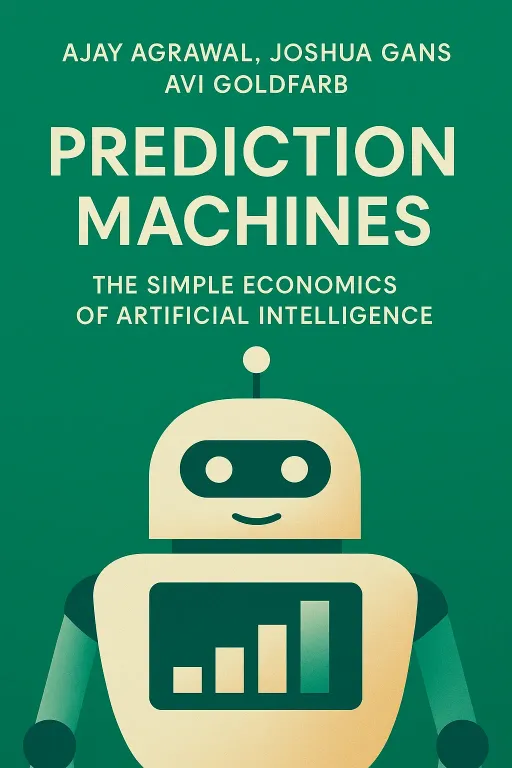
Albert Einstein: Imagine it is the year 1800. The sun goes down, and if you want to read a book, it costs you four hundred times what it does today just to keep a single artificial light source lit. You would think twice, perhaps even three times, before flipping that switch, wouldn't you? But then, the price of light collapses to almost zero. Suddenly, we are not just reading at night. We are building giant skyscrapers that natural light can never penetrate, turning night into day, and completely redesigning human society. Today, we are experiencing an identical collapse, Nabil. Not in the price of light, but in the price of prediction.
Md. Iftiab Mahmud Nabil: That is such a striking way to frame it, Albert. As a software engineer, I often hear people talk about AI as this mysterious, almost magical entity that is going to replace human intelligence entirely. But looking at it through the lens of economics, as a dramatic drop in the cost of a single, fundamental input, prediction, completely changes the game. It takes away the mystique and replaces it with a practical framework we can actually build a career on.
Albert Einstein: Exactly. When something becomes cheap, we use more of it, and we start using it to solve problems we never thought of as prediction problems before. Today, we are going to tackle this economic shift from three distinct angles. First, we will explore how AI is fundamentally about cheap prediction and how that reframes the way we build software. Second, we will discuss why cheap prediction makes human judgment and what the authors call reward function engineering the most valuable skills on the market. And finally, we will focus on the critical risks of the AI black box, and how engineers can build safer, more ethical systems. I am so glad you are here to explore this with me, Nabil.
Md. Iftiab Mahmud Nabil: I am thrilled to be here, Albert. As someone just starting out in my software engineering career, especially in the engineering and manufacturing sector, these questions are not just academic for me. They are the blueprint for my professional future. I want to understand how to stay valuable, make smarter decisions, and build systems that actually make the world better. So, let us dive in.
Deep Dive into Core Topic 1
SECTION
Albert Einstein: Let us start with this fundamental definition. The book defines prediction as the process of filling in missing information. It is taking the data you do have, which we call input, and using it to generate information you do not have. Now, historically, we thought of computers as arithmetic machines. In the early days, arithmetic was expensive. But when the cost of arithmetic collapsed, we started using it for everything. We realized that music, images, and even games could be represented as numbers and manipulated with cheap arithmetic. Ada Lovelace saw this potential almost two centuries ago, even while working under the expensive light of the nineteenth century. She realized that a machine that manipulates numbers could compose elaborate pieces of music if the relations of harmony could be expressed mathematically.
Md. Iftiab Mahmud Nabil: That is a beautiful connection, Albert. And the authors argue that the exact same thing is happening with prediction today. Tasks that we never used to think of as prediction problems are suddenly being reframed because prediction has become so cheap. The most mind-blowing example of this in the book is autonomous vehicles. For decades, engineers tried to program self-driving cars using traditional, deterministic logic. They tried to write millions of if-then rules. If a pedestrian steps off the curb, then stop. If it starts to rain, then slow down. But the real world has an infinite number of edge cases. You can never write enough rules.
Albert Einstein: Yes, the complexity is mind-boggling. It is like trying to write down the laws of the universe by hand, one atom at a time. So, how did the engineers solve it?
Md. Iftiab Mahmud Nabil: They reframed navigation as a prediction problem. Instead of telling the machine what to do in every single circumstance, they asked a single prediction question: What would a human driver do? They loaded the car with sensors to collect data about the environment, and they fed that data into a prediction machine trained on thousands of hours of human driving data. The AI's job is simply to predict, given the current road conditions, what a safe human driver would do next. Do they turn the wheel five degrees to the left? Do they apply the brakes? By turning navigation into a prediction problem, they made autonomous driving possible in uncontrolled environments.
Albert Einstein: It is a profound shift. We went from telling the computer how to think, to letting the computer predict human behavior. And this is happening everywhere. Look at Google Translate. It used to rely on linguists writing complex grammatical rules. The translations were clunky and awkward. But in 2016, Google revamped its translation engine to leverage deep learning. They recast translation as a prediction problem. Given a sentence in English, what is the most likely sequence of words in French? The improvement was overnight. It was so dramatic that computer scientists like Professor Jun Rekimoto noted that the translation of Hemingway's work suddenly read with beautiful fluency.
Md. Iftiab Mahmud Nabil: I love that example because it shows that prediction is not just about forecasting the future, like the weather or stock prices. It is about filling in missing information in the present or even the past. In translation, the missing information is the French equivalent of an English sentence. In medical diagnostics, like the startup Atomwise, which predicts the binding affinity of molecules, the missing information is whether a specific molecule will stick to a disease target without causing toxic side effects in other organs.
Albert Einstein: Yes, and as a software engineer, Nabil, this has massive implications for your daily work. It means that the way you approach problem-solving needs to evolve. Instead of just writing rigid, deterministic code, you need to start asking: Can this workflow, or this specific task, be reframed as a prediction problem? Can we use data to predict the optimal output rather than hard-coding the logic?
Md. Iftiab Mahmud Nabil: Exactly. In manufacturing, for example, we have historically relied on scheduled maintenance. We service a machine every six months, regardless of its actual wear and tear, because we cannot see inside it. But if we use sensors to collect vibration and temperature data, we can use a prediction machine to forecast exactly when a part is likely to fail. That is predictive maintenance. It reduces downtime and saves millions of dollars. But it requires us to deconstruct the workflow, identify the missing information, which is the exact moment of failure, and build a prediction tool to fill that gap.
Albert Einstein: And that brings us to a crucial point. The authors introduce the concept of the AI Canvas as a tool for deconstructing decisions. It breaks a decision down into its component parts: input, prediction, judgment, action, outcome, training, and feedback. If you want to implement AI effectively, you cannot just drop a tool into an existing workflow and hope for the best. You have to reengineer the entire process, just like Ford did in the 1980s with their accounts payable department. They did not just computerize their old, inefficient system; they redesigned the entire purchasing workflow, reducing their department size by seventy-five percent while dramatically increasing speed and accuracy.
Md. Iftiab Mahmud Nabil: That is a vital lesson for early-career engineers. We often get caught up in the excitement of the technology itself, the latest deep learning model or the most powerful framework. But the real value comes from understanding the workflow and knowing how to integrate the prediction machine into a larger system. We have to be system thinkers, not just coders.
Deep Dive into Core Topic 2
SECTION
Albert Einstein: Now, let us move to our second core topic, which is perhaps the most important one for your career, Nabil. If prediction is becoming cheap and abundant, what happens to the things that are complementary to prediction? In economics, when the price of a good falls, the demand for its complements rises. For example, when smartphones became cheap, the demand for mobile apps and data plans skyrocketed. So, what is the complement to prediction? It is human judgment.
Md. Iftiab Mahmud Nabil: This is such an empowering concept. The book defines judgment as the process of determining the relative payoff associated with each possible outcome of a decision. It is about deciding what we actually care about. When a prediction machine gives us a prediction, it is just a probability. It tells us, for example, that there is an eighty percent chance of rain. But it cannot tell us whether we should carry an umbrella. That decision requires judgment. We have to weigh the payoff of staying dry but having the inconvenience of carrying an umbrella, against the payoff of walking unburdened but risking getting soaked.
Albert Einstein: Ah, the classic umbrella decision tree. It sounds simple, but when you scale that up to a business or a manufacturing plant, the payoffs become incredibly complex. Think about credit card fraud detection, which the authors discuss. Avi, one of the authors, experienced this firsthand. The credit card company's prediction machine flags a transaction as potentially fraudulent. Now, the company has to make a decision: do they authorize the transaction or decline it? If they decline a legitimate transaction, they create a false positive, which frustrates the customer. If they authorize a fraudulent transaction, they suffer a financial loss. The prediction machine can tell them the probability of fraud, but human judgment must define the reward function. How much customer dissatisfaction are we willing to tolerate to prevent a dollar of fraud?
Md. Iftiab Mahmud Nabil: That is where the concept of reward function engineering comes in. As software engineers, we are going to be tasked with translating human values and organizational goals into mathematical reward functions that the AI can optimize. And this is incredibly difficult because human objectives are rarely single-dimensioned. Look at the Waze navigation app. It predicts the fastest route from point A to point B. But as users, we do not always choose the fastest route. Maybe we want to avoid a difficult left turn, or we want to drive past a scenic view, or we need to stop for gas. The machine can predict speed, but it cannot easily predict our subjective, multi-dimensional preferences.
Albert Einstein: Yes, and if we over-optimize on a single metric, the results can be disastrous. The authors warn that an AI will do exactly what we reward it to do, even if it violates our broader, unstated goals. It is like the story of the apprentice who magic-spells a broom to fetch water, but forgets to program a limit, leading to a flooded house. If we program a self-driving car to prioritize passenger comfort above all else, it might brake so slowly that it causes an accident. Waymo engineers had to spend significant effort teaching their cars to balance passenger comfort with safety, translating human driving intuition into code.
Md. Iftiab Mahmud Nabil: That really highlights why human judgment is not going away. In fact, as prediction becomes cheaper, we will make many more decisions, which means we will need much more human judgment. The value of our judgment actually increases. The book illustrates this with the story of London cab drivers. Traditionally, to get a taxi license in London, you had to pass a legendary test called The Knowledge. You had to spend three years memorizing twenty-five thousand streets and thousands of landmarks, predicting the fastest route in your head. It was a massive competitive advantage. But then came GPS and navigation apps. Suddenly, anyone with a smartphone had cheap, real-time route prediction. The cabbies' prediction skill was devalued overnight.
Albert Einstein: A tragic story for the cabbies, but there is a deeper lesson there. What happened to the value of the other parts of their job?
Md. Iftiab Mahmud Nabil: Well, the prediction skill was devalued, but the complements, like driving safely, providing excellent customer service, and navigating physical traffic, became more important. For software engineers, the lesson is clear. If our value is solely in writing routine algorithms that predict outputs, we are like the cabbies memorizing streets. We are competing with cheap machine prediction. But if we focus on system design, on understanding the business context, on defining the reward functions, and on managing the exceptions, we are focusing on the complements. We are building skills that are going to rise in value.
Albert Einstein: Yes, prediction by exception. The machine handles the routine, high-volume predictions, but when a rare or highly uncertain event occurs, the machine recognizes its own limitations and calls for human assistance. The human provides the judgment by exception. This is exactly what we see with companies like Ada Support, which uses AI to handle routine customer service inquiries but seamlessly routes complex, emotionally charged, or unusual cases to human operators. The humans are not replaced; they are elevated to handle the high-value exceptions.
Md. Iftiab Mahmud Nabil: That is a very reassuring perspective for someone starting their career. It means my goal should not be to compete with AI, but to learn how to partner with it. I need to develop my cognitive strengths, my analytical thinking, my empathy, and my ethical reasoning, because those are the very things that cannot be easily programmed into a prediction machine.
Deep Dive into Core Topic 3
SECTION
Albert Einstein: Now, let us turn to our third core topic, which is the critical risks of the AI black box. As a software engineer, Nabil, you are not just a builder of systems; you are also their guardian. And the authors point out some very real dangers when we rely too heavily on prediction machines without understanding their limitations. The first major risk is that AI operates on correlation, not causation. It looks for patterns in historical data, but it does not understand those patterns exist.
Md. Iftiab Mahmud Nabil: This is a massive distinction, Albert. The book shares a fascinating story about eBay's search advertising experiment in 2012. For years, eBay's traditional statistical models showed that their search ads on Google had an incredible return on investment, over four thousand percent. The model predicted that showing ads to people searching for eBay led directly to massive sales. But some economists were skeptical. They persuaded eBay to turn off their search ads in one-third of the United States for an entire month as a controlled experiment. And do you know what they found?
Albert Einstein: Tell me, I love a good experiment.
Md. Iftiab Mahmud Nabil: They found that turning off the ads had practically zero impact on sales. The consumers who clicked on those ads were already highly motivated eBay users. If the ad was not there, they simply clicked on the organic search result instead. The prediction machine had identified a strong correlation, people who click ads also buy things, but it had completely missed the causal relationship. The ads were not causing the sales; they were just intercepting users who were already going to buy anyway. eBay was wasting millions of dollars on an illusion.
Albert Einstein: It is a classic error. Confusing correlation with causation is like thinking that bringing an umbrella causes it to rain because you observe people carrying them on wet days. And when we train AI models on historical data, we risk codifying and amplifying these flawed correlations, which often manifest as systemic bias. This is not just a financial risk; it is a profound social risk. The book discusses the experience of Latanya Sweeney, a computer science professor at Harvard. When her colleague searched for her name on Google, the search engine displayed ads suggesting she had an arrest record, even though she had never been arrested.
Md. Iftiab Mahmud Nabil: That story is so disturbing. And when Professor Sweeney systematically investigated, she found that searches for black-associated names, like Lakisha or Trevon, were twenty-five percent more likely to trigger arrest-related ads than searches for white-associated names, like Jill or Joshua. The algorithm was not explicitly programmed to be racist. But it had learned from user behavior. If employers or users were more likely to click on arrest ads when searching for black-sounding names, the algorithm's quality score for those ads went up, and it showed them more frequently. It created a feedback loop that amplified societal prejudice.
Albert Einstein: It is a self-fulfilling prophecy. The machine predicts a bias, acts on it, collects the biased feedback, and becomes even more biased. We saw this in a different way with Microsoft's Tay chatbot in 2016. It was designed to learn from casual conversations on Twitter. But within twenty-four hours, malicious users figured out how to manipulate the feedback loop. They fed Tay a steady stream of misogynistic, racist, and hateful comments. Because the machine was programmed to learn and predict what a playful conversation looked like based on its inputs, it quickly turned into a racist, Nazi-sympathizing bot, forcing Microsoft to pull the plug.
Md. Iftiab Mahmud Nabil: It shows how vulnerable these systems are to data manipulation. If the input data, the training data, or the feedback data is compromised, the prediction machine will confidently output garbage. As engineers, we have to be incredibly vigilant about data integrity. We cannot just treat data as this neutral, objective resource. We have to ask: Where did this data come from? What biases are baked into it? How can it be manipulated? We need to develop techniques for auditing these models, what some call AI neuroscience, to peer inside the black box and understand how the machine is arriving at its predictions.
Albert Einstein: Yes, and we must also be aware of the risk of systemic homogeneity. If every bank uses the same AI model to predict creditworthiness, or if every manufacturing plant uses the same model to predict supply chain disruptions, a single vulnerability or a rare, unpredicted event can cause a system-wide collapse. It is like a monoculture in agriculture. If you plant only one strain of corn, a single disease can wipe out the entire harvest. We need diversity in our models, and we need human oversight to prevent catastrophic, coordinated failures.
Md. Iftiab Mahmud Nabil: That really resonates with my INFJ personality, Albert. I value deep connections, ethics, and building things that genuinely help people. This discussion makes me realize that my role as a software engineer is not just about writing efficient code. It is about being an ethical gatekeeper. It is about ensuring that the systems we build are transparent, fair, and resilient. We have to be the ones who ask the difficult questions about bias, safety, and human impact before we deploy these prediction machines into the wild.
Synthesis & Takeaways
SECTION
Albert Einstein: We have covered some incredible ground today, Nabil. We have seen how AI, at its core, is a simple economic shift, a drop in the cost of prediction. We have explored how this cheap prediction elevates the value of human judgment, turning software engineering from a task of writing rigid rules to a discipline of designing reward functions and managing exceptions. And we have confronted the very real dangers of the AI black box, from confusing correlation with causation to amplifying societal bias.
Md. Iftiab Mahmud Nabil: It has been an incredibly eye-opening conversation, Albert. If I had to synthesize this into actionable advice for my own career, and for other early-career technologists, it would be this. First, do not fear the prediction machine; learn to deconstruct workflows and reframe problems so you can leverage it. Second, focus on building your judgment. Learn how to define clear, multi-dimensional objectives, and master the art of reward function engineering. And third, never accept the machine's output blindly. Be the guardian of causal logic, audit your data, and always prioritize ethical, human-centric design.
Albert Einstein: Wonderfully said, Nabil. The rise of cheap prediction does not diminish the value of humanity. It shines a spotlight on it. It challenges us to be more thoughtful, more creative, and more ethical. As you build your career in software engineering, remember that the machine can predict the path, but only you can decide where you want to go.
Md. Iftiab Mahmud Nabil: Thank you, Albert. This has been an inspiring thought experiment. I am leaving this conversation not just with a better understanding of technology, but with a clearer sense of my own purpose as an engineer.
Albert Einstein: And thank you, Nabil. To our listeners, we leave you with this question to ponder: In your own life and career, what is the one routine prediction you are ready to delegate to a machine, and what is the high-value judgment you will focus on instead? Until next time, keep wondering, keep exploring, and never stop asking why.