Personalized Podcast
Golden Hook & Introduction
SECTION
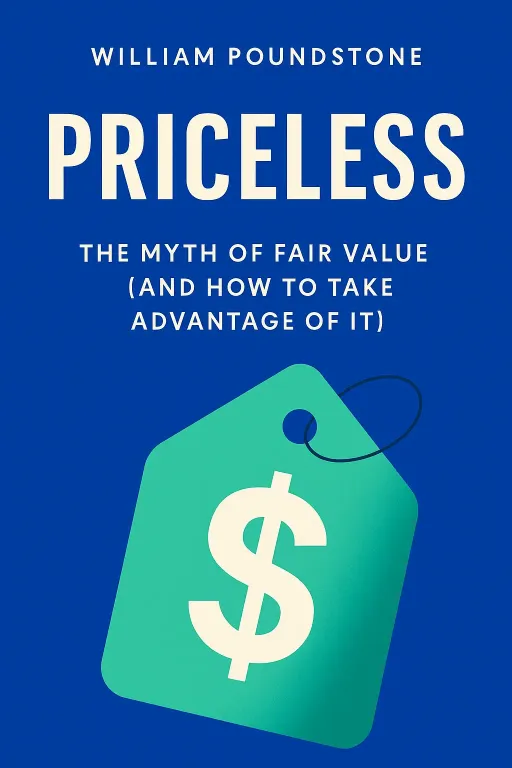
Nova: If I asked you to write down the last two digits of your phone number, and then immediately asked you what you would pay for a rare, exquisite bottle of French wine, would those two completely random digits change your answer? Standard economics says absolutely not. We are rational creatures, right? But psychology says: yes, they will, and dramatically so. Welcome to The Price of Perception, the podcast where we unmask the invisible forces shaping what we think things are worth. I'm Nova, and today we are diving into William Poundstone's mind-bending book,. And we have a very special guest with us today, Huzaifawaheed_7, a healthcare professional who is passionate about learning, personal growth, and understanding how our minds actually make decisions. Welcome to the show!
Huzaifawaheed_7: Thanks, Nova! It is wonderful to be here. You know, when I first picked up, I thought it was just going to be a book about marketing tricks and retail pricing. But as I read on, I realized it's actually a profound look at human cognitive vulnerability. It challenges the very core of how we think we think.
Nova: Oh, absolutely! Poundstone basically argues that we are completely clueless about absolute value. We live on a sort of psychological planet where prices and values are made up, and all we really understand are relative differences. He calls this "coherent arbitrariness."
Huzaifawaheed_7: Yes! That term, "coherent arbitrariness," coined by Dan Ariely and his colleagues, is so fascinating. It means that our initial valuation of something is often completely arbitrary—influenced by whatever random number happens to be floating around. But once that arbitrary baseline is established, we become incredibly consistent and coherent in how we scale our subsequent decisions. It's like we build a perfectly logical house on a foundation of pure sand.
Nova: That is such a vivid way to put it! A logical house on a foundation of sand. Today, we're going to tackle this book from two major angles. First, we'll explore the invisible power of anchoring and how arbitrary numbers set our mental baselines. Then, we'll dive into the fascinating mechanics of Prospect Theory and how framing can completely flip our perception of gains and losses, especially when we're trying to make critical decisions under pressure.
Deep Dive into Core Topic 1
SECTION
Nova: So, let's start with the big one: anchoring. This is the cognitive bias where an initial value, even a completely irrelevant one, acts as a heavy anchor that we just can't seem to drag our minds away from. Poundstone shares this classic experiment conducted by the legendary psychologists Amos Tversky and Daniel Kahneman back in 1974. They had participants watch a carnival-style wheel of fortune marked with numbers from 1 to 100. But the wheel was secretly rigged to only stop on either 10 or 65.
Huzaifawaheed_7: Right, and after the wheel stopped, they asked the participants two questions. First, is the percentage of African nations in the United Nations higher or lower than the number on the wheel? And second, what is your actual estimate of that percentage? Now, logically, a random spin of a wheel should have zero impact on your knowledge of geography or international politics.
Nova: Exactly! But the results were wild. When the wheel stopped on 10, the average estimate was 25 percent. But when it stopped on 65, the average estimate shot up to 45 percent! Just seeing that arbitrary number on the wheel completely dragged their estimates up or down.
Huzaifawaheed_7: It's incredible, isn't it? It shows that when we are faced with uncertainty, our brains desperately grasp at whatever number is nearby, using it as a starting point and then adjusting from there. But our adjustments are almost always insufficient. We stay way too close to the anchor. And what's even more alarming is that this doesn't just happen to college students in a lab. It happens to highly trained professionals in high-stakes environments.
Nova: Yes! Poundstone highlights this incredible study by Margaret Neale and Gregory Northcraft from 1987, focusing on the real estate market in Tucson, Arizona. They took a real house that was on the market—it had been professionally appraised at $135,000—and they wanted to see how listing prices affected people's valuations. They split their participants into groups, including both amateur undergraduate business students and local, experienced real estate agents who knew the Tucson market inside and out.
Huzaifawaheed_7: This is where the experimental design was so brilliant. They gave everyone the exact same packet of information: the MLS sheets, the neighborhood demographics, and the actual prices of comparable homes that had recently sold nearby. The only difference was the fictitious listing price printed on their sheet, which ranged from $119,900 to $149,900.
Nova: And what happened? Did the professional real estate agents see right through the fake listing prices?
Huzaifawaheed_7: You would think so, right? They claimed they did! When surveyed, the professionals insisted that the listing price was just a minor factor and that they relied on their objective market expertise. But the data told a completely different story. Both the amateurs and the pros were heavily anchored. For the amateurs, raising the listing price by $30,000 increased their average estimate of the home's value by nearly $31,000. But even for the seasoned pros, that same $30,000 increase in the anchor raised their estimates by sixteen thousand dollars!
Nova: Wow. So even the experts, with all their training and local knowledge, were pulled along by the anchor. They just couldn't escape its gravity.
Huzaifawaheed_7: Exactly. And as a healthcare professional, this really made me pause. In medicine, we talk about "diagnostic anchoring." If a patient is admitted to the emergency room and the initial triage note says "suspected flu," subsequent clinicians might anchor on that initial label. They might interpret all subsequent symptoms—even ones that don't quite fit—through the lens of the flu, potentially overlooking a much more serious, underlying condition. It's the exact same cognitive trap.
Nova: Oh, that is a powerful and honestly quite sobering connection. It shows that anchoring isn't just about how much we pay for a house or a cup of coffee; it can literally be a matter of life and death. Our brains are wired to seek patterns and shortcuts, and once a number or a label is put out there, it becomes the lens through which we view everything else.
Huzaifawaheed_7: Precisely. We like to think of our minds as objective calculators, but in reality, we are highly suggestible. And when we don't have a clear, objective formula for value or truth, we let the context make up our minds for us.
Deep Dive into Core Topic 2
SECTION
Nova: And that brings us beautifully to our second core topic: Prospect Theory and the power of framing. This was Kahneman and Tversky's masterpiece, which eventually won Kahneman the Nobel Prize in Economics. They realized that the traditional economic model of "Homo economicus"—this perfectly rational being who evaluates decisions based on absolute wealth—is a myth. Instead, they proposed that we evaluate choices relative to a reference point, and we are incredibly sensitive to whether something is framed as a gain or a loss.
Huzaifawaheed_7: Yes, and the most famous element of Prospect Theory is loss aversion. The simple idea that the pain of losing something is psychologically about twice as powerful as the pleasure of gaining that exact same thing. We absolutely hate losing.
Nova: We really do! Poundstone illustrates this with a fascinating study on fairness and inflation. Imagine a company that is facing a mild recession. In the first scenario, there is no inflation, and the company decides to cut its employees' wages by 7 percent. When asked, 62 percent of the public judged this wage cut as completely unfair. It felt like a direct, painful loss.
Huzaifawaheed_7: Right. But now look at the second scenario. The company is facing the same economic difficulty, but there is an inflation rate of 12 percent. This time, the company decides to give its employees a 5 percent raise. Now, if you do the math, a 5 percent raise during 12 percent inflation means your actual buying power has still decreased by about 7 percent. It is the exact same economic outcome as the first scenario.
Nova: But because it was framed as a "raise"—a nominal gain—instead of a "cut," a whopping 78 percent of the public found it completely acceptable!
Huzaifawaheed_7: It's the "money illusion" in action. Our brains are so focused on the nominal numbers and the positive framing of a "raise" that we completely overlook the real, inflation-adjusted loss. We are ratio-wise but price-foolish. We react to the description of the choice rather than the choice itself.
Nova: "We choose between descriptions of options, rather than the options themselves." That is a quote from Amos Tversky that always sticks with me. It's all about the frame. And this framing effect is incredibly potent in your world of healthcare, isn't it?
Huzaifawaheed_7: Oh, absolutely. There have been numerous studies showing how the framing of medical risks completely alters patient decisions. For example, if you tell a patient that a surgical procedure has a 90 percent survival rate, they perceive it as a gain. They feel safe, and they are much more likely to consent to the surgery. But if you frame the exact same statistic as a 10 percent mortality rate, it triggers loss aversion and fear. Even though the mathematical risk is identical, patients suddenly become much more hesitant or seek risky alternative treatments.
Nova: That is fascinating. It's like our brains have these automatic, emotional alarm bells that go off the moment we hear words associated with loss or death, bypassing our rational, analytical thinking.
Huzaifawaheed_7: Yes, and it's because our evolutionary history didn't design us to be perfectly rational logicians; it designed us to survive. In a harsh, primitive environment, avoiding a mortal threat—a loss—was far more critical than securing an extra benefit. So we evolved to be hyper-sensitive to losses. But in the modern world, where we have to navigate complex financial systems, medical choices, and statistical data, this evolutionary programming can lead us astray.
Nova: It really can. Think about the game show, which Poundstone talks about. It's basically a giant, televised behavioral economics experiment! Contestants are faced with choosing between a sure thing—the banker's cash offer—and a gamble on the remaining briefcases.
Huzaifawaheed_7: Yes! And researchers found that contestants' risk tolerance shifted dramatically based on their prior luck in the game. If a contestant had a great run and eliminated all the low-value cases, they became risk-averse, happy to take a deal. But if they had a string of bad luck and eliminated the million-dollar cases, they suddenly became highly risk-seeking. They would reject huge cash offers to chase a tiny chance of a comeback, because they were trying to avoid the pain of leaving with less than their initial expectation. They were playing "catch-up" with their mental reference point.
Nova: They hadn't "made peace with their losses," as Kahneman and Tversky would say. It's a classic human struggle. We let our past losses dictate our future risks, often digging ourselves into an even deeper hole.
Synthesis & Takeaways
SECTION
Nova: So, Huzaifawaheed_7, we've looked at the deep, psychological gravity of anchoring, and we've seen how framing and loss aversion can completely warp our perception of reality. The big question now is: how do we fight back? Is there an antidote to these cognitive biases, or are we just doomed to be manipulated by clever marketers, menu designers, and our own evolutionary programming?
Huzaifawaheed_7: Fortunately, there is hope! Poundstone discusses a powerful debiasing technique called "consider the opposite." It was tested in Germany by researchers Thomas Mussweiler and Fritz Strack using a ten-year-old Opel Kadett car. They took the car to sixty professional mechanics and car dealers, claiming a girlfriend had dented it, and asked for a value estimate.
Nova: And let me guess, they used a high or low anchor?
Huzaifawaheed_7: Exactly. They mentioned a high value of 5,000 marks or a low value of 2,800 marks. And just like the Tucson real estate agents, the mechanics were heavily influenced by the anchor. But for some of the mechanics, the researchers added a twist: they asked them to first list reasons why the mentioned anchor value might be completely wrong.
Nova: Ah! Forcing them to actively look for disconfirming evidence.
Huzaifawaheed_7: Yes! And that simple mental exercise of "considering the opposite" dramatically reduced the anchoring effect. By forcing their brains to generate associations that contradicted the anchor, they broke free from its psychological pull. Their estimates became much more realistic and aligned with the car's actual condition.
Nova: That is a brilliant and highly actionable strategy. In our daily lives, whenever we are faced with a major decision—whether it's negotiating a salary, buying a car, or even evaluating a personal belief—we should stop and ask ourselves: "What are three reasons why my initial assumption or the first number I heard might be completely wrong?"
Huzaifawaheed_7: Absolutely. It's about cultivating a habit of active, critical reflection. For personal growth, this is incredibly powerful. We often anchor on our past failures or on labels that others have placed on us. We frame our challenges as insurmountable losses rather than opportunities for learning. By consciously "considering the opposite" and reframing our narratives, we can reclaim our agency and make more conscious, empowered choices.
Nova: I love that. Reframing our personal narratives from a place of growth rather than loss. It's about moving from passive reaction to active, mindful decision-making. Well, Huzaifawaheed_7, this has been an absolutely exhilarating conversation. Thank you so much for sharing your analytical insights and your unique perspective with us today.
Huzaifawaheed_7: Thank you, Nova! It was an absolute pleasure. I hope our listeners take these ideas and start noticing the "anchors" in their own lives. Once you see them, they lose their power over you.
Nova: Beautifully said. And to all our listeners, thank you for tuning in to. Remember, the next time you see a price tag, a diagnostic label, or a high-stakes choice, take a deep breath, consider the opposite, and look beyond the frame. Until next time, keep learning, keep growing, and stay curious!