

The Growth Machine: Coding Our Principles for Personal Evolution
Golden Hook & Introduction
SECTION
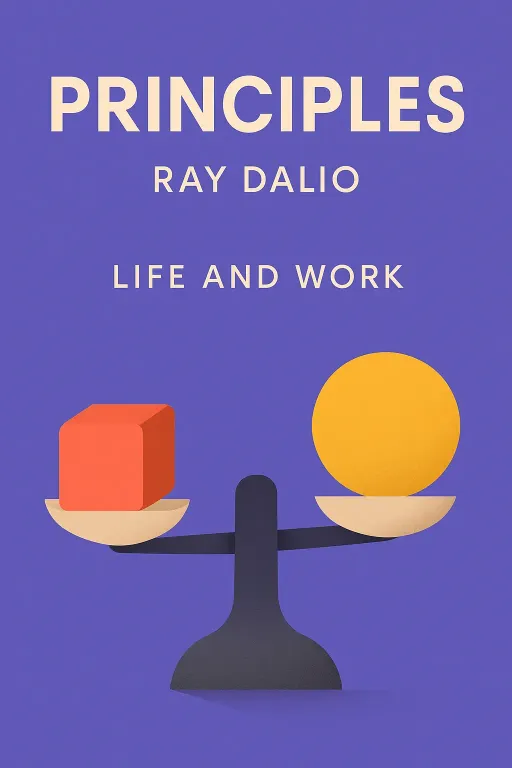
Nova: Imagine it is 1982. You are a brilliant, rising star on Wall Street. You go on national television and confidently declare that the global economy is headed for a massive depression. You are so sure of yourself that you bet your entire firm's future on it. But instead of a crash, the market goes on a historic bull run. You lose everything. You have to lay off your entire staff, close your office, and borrow four thousand dollars from your dad just to pay your family's utility bills. That was Ray Dalio's rock bottom. But it was also the birth of a revolutionary idea: that life is a machine, and failures are just data points. Welcome to the podcast! I am Nova, and today we are diving deep into Ray Dalio's masterpiece,. Joining me is Frank Wu, cofounder of Aibrary, a Harvard Master in Public Policy graduate, and a pioneer in building Agentic AI for personal growth. Frank, it is so wonderful to have you here!
Frank Wu: Thanks, Nova! It is an absolute pleasure to be here. You know, that 1982 story about Dalio always gives me chills. As someone who is constantly thinking about how we learn, grow, and build systems for personal evolution, Dalio's journey is like the ultimate case study. At Aibrary, we are trying to make growth seamless in everyday life, and Dalio's book is basically the blueprint for that.
Nova: It really is! And today, we are going to tackle this book from three different angles. First, we will explore the alchemy of failing well, and why Dalio says pain plus reflection equals progress. Second, we will look at how to build a personal "idea meritocracy" using believability-weighted decision-making. And finally, we will focus on how we can use modern technology, like the agentic systems you are building, Frank, to actually code these principles into our daily lives. Sound like a plan?
Frank Wu: I love it. Let's build the machine!
The Alchemy of Failing Well
SECTION
Nova: Let's start with that formula: Pain plus Reflection equals Progress. Dalio writes that life is like a river that carries us forward into encounters with reality that require us to make decisions. We cannot stop the river, and we cannot avoid the encounters. But when we hit a rock—when we experience pain—most of us run away from it. We get defensive, or we blame external circumstances. But Dalio did something wild after his 1982 crash. He didn't just rebuild; he changed his entire relationship with being wrong. He went from thinking "I know I'm right" to asking himself, "How do I know I'm right?"
Frank Wu: That shift is so profound, Nova. As an ENFP, I am naturally driven by big, imaginative ideas. We love the "what if." But the danger of being an idealist is that you can easily fall in love with your own theories and ignore the cold, hard facts of reality. Dalio calls himself a "hyperrealist." He says that understanding, accepting, and working with reality is both practical and beautiful. When he lost everything, he realized that his pain was actually a signal. It was reality telling him, "Hey, your mental map of how the world works is incorrect."
Nova: Yes! He even looks to nature to understand this. He tells this fascinating story about being in Africa and watching a pack of hyenas take down a young wildebeest. At first, his human emotions kicked in, and he thought, "This is horrible! How can nature be so cruel?" But then he stepped back and looked at it from a higher level. He realized that if this didn't happen, the wildebeest population would overpopulate, starve, and the entire ecosystem would collapse. Nature optimizes for the whole, not the individual. And in the same way, our personal failures are just nature's way of pruning our bad ideas so we can evolve.
Frank Wu: Exactly! It is the "evolve or die" principle. And you know, as a dad of a three-year-old girl, this resonates with me on a deeply personal level. When you watch your child learn to walk, or try to build a tower of blocks, they fail constantly. They fall, they get frustrated, they cry. As a parent, your instinct is to rush in and catch them, to prevent the pain. But if you do that, you rob them of the reflection phase. They never learn where their center of gravity is, or why the blocks fell. We have to teach our kids—and ourselves—how to "fail well." Failing well means striving for audacious goals, experiencing the inevitable painful mistake, but then having the humility and open-mindedness to reflect on it and write down a principle so you never repeat that specific mistake again.
Nova: "Failing well." I love that term. It makes failure sound like a skill we can practice, rather than a moral defect. But Dalio says the biggest barrier to this is our own ego and our blind spots. Our brains are literally wired to fight. The conscious, logical mind is constantly at war with the subconscious, emotional mind. When someone points out a mistake, our amygdala registers it as a physical threat, and we go into fight-or-flight mode.
Frank Wu: Oh, absolutely. We see this in education and marketing all the time. People would rather protect their image of being smart than actually find out what is true. But Dalio's first principle is to think for yourself to decide what you want, what is true, and what you should do to achieve your goals—and to do that with radical open-mindedness. He has this great quote: "If you know that you are blind, you can figure out a way to see, whereas if you don’t know that you’re blind, you will continue to bump into your problems." That is why we need a system. We cannot rely on our willpower to stay calm when our ego is threatened. We need to build a machine that forces us to reflect.
The Believability-Weighted Machine
SECTION
Nova: And that brings us perfectly to our second topic: the "Idea Meritocracy." How do we build a machine that helps us see our blind spots? At Bridgewater, Dalio built a system where the best ideas win, regardless of hierarchy. But he didn't do it through simple democracy, where everyone gets one vote. He realized that treating all opinions equally is actually a recipe for bad decisions. Instead, he created "believability-weighted decision-making." Frank, as a public policy graduate, how do you view this system of governance?
Frank Wu: It is brilliant, and honestly, it is a masterclass in institutional design. In public policy, we study how to design systems that align individual incentives with collective goals. Usually, organizations fall into one of two traps. Either they are autocracies, where the boss's opinion is law, even if the boss is clueless. Or they are democracies, where decisions are made by consensus, which often leads to the lowest common denominator or mob rule. Dalio's believability weighting is a third way. It says: let's look at the data. Who has a track record of successfully accomplishing the thing we are trying to do, and can they logically explain the cause-and-effect relationships behind their conclusions?
Nova: Right! He uses this hilarious, simple example. Imagine you are getting a baseball lesson from Babe Ruth, one of the greatest players of all time. And some kid who has never played baseball keeps interrupting Babe Ruth to argue about the proper way to swing the bat. In a pure democracy, both of their opinions have equal weight. But that is just silly! Babe Ruth's opinion on hitting should be weighted infinitely higher because of his track record.
Frank Wu: Exactly. And Dalio applied this in a massive way during the 2012 European Debt Crisis. The borrowing and debt-service needs of countries like Spain and Italy were skyrocketing, and Germany was adamantly opposed to a bailout. The research teams at Bridgewater were completely split. Some thought the European Central Bank, led by Mario Draghi, would print money to buy government bonds. Others thought defying Germany would destroy the Eurozone. It was a high-stakes gridlock. So, what did they do? They didn't just have a shouting match. They took a believability-weighted vote using their digital tools. The system weighted the opinions of the analysts who had the best track records in sovereign debt and macroeconomic synthesis. The vote indicated that Draghi would indeed defy Germany and print money. Bridgewater positioned its investments based on that weighted vote, and a few days later, the ECB announced unlimited bond purchases. They were spot on.
Nova: That is incredible. It is like having a supercomputer powered by collective human intelligence. But to make this work, you need two things that sound terrifying to most people: radical truth and radical transparency. Dalio's rule is: "Never say anything about someone that you wouldn’t say to them directly." And at Bridgewater, almost all meetings are recorded and available for anyone in the company to watch.
Frank Wu: It sounds intense, but think about the alternative. In most organizations, there is so much office politics, backstabbing, and hidden agendas. People waste half their energy managing impressions. Radical transparency eliminates that. It is like putting a camera in the room—it forces everyone to act with integrity. But you know, Nova, there is a catch. Radical transparency can go wrong if it is not implemented with empathy and context. There is a story about a tech startup in Silicon Valley that tried to implement radical transparency by sharing everyone's salaries and performance reviews overnight. It backfired horribly! People felt exposed, resentment built up between colleagues, and productivity plummeted. Why? Because they didn't have the training or the shared values to handle that level of raw data. You cannot just install the software without training the users.
Nova: That is a crucial point, Frank. Dalio emphasizes that "tough love" is effective, but it must be combined with genuine care. He compares great management to Vince Lombardi, the legendary football coach. Lombardi pushed his players to their absolute limits, held them to uncompromising standards, but he did it because he loved them and wanted them to be great. The players knew he had their backs. If people do not feel safe, radical transparency just feels like surveillance.
Frank Wu: Yes, psychological safety is the foundation. In an idea meritocracy, the goal of thoughtful disagreement is not to win the argument. It is to find out what is true. When you realize that you and the other person are both searching for the truth, disagreement stops being a battle and starts feeling like playing jazz. You are improvising, bouncing ideas off each other, subordinating your ego to the beauty of the music.
Systemizing Growth with Agentic Tools
SECTION
Nova: "Playing jazz." What a beautiful metaphor. But how do we actually do this in our busy, chaotic lives? Most of us read a book like, get super inspired, and then three days later, we are back to our old habits. Dalio realized this, too. He said words alone are not enough. We have to convert our principles into algorithms and embed them in tools. At Bridgewater, they built tools like the "Dot Collector" to track real-time feedback, "Baseball Cards" to map employee strengths, and the "Pain Button" to capture moments of frustration. Frank, this is your playground! How does this connect to what you are building with Agentic AI and Aibrary?
Frank Wu: This is exactly why we started Aibrary, Nova. We realized that the gap between what to do and it is the biggest bottleneck in personal growth. Dalio's genius was systemizing his mind. He built a tool called "Coach," which is basically a library of common workplace situations linked to relevant principles. If you are having a conflict with a colleague, you type it in, and the Coach gives you contextual advice based on the company's collective wisdom. It is like having Ray Dalio sitting on your shoulder.
Nova: That is so cool. It is like a GPS for your behavior.
Frank Wu: Exactly! And with modern Agentic AI, we can take this to a whole new level. At Aibrary, we are building features like the "Idea Twin." Imagine you read. Instead of just highlighting text, the AI creates a digital twin of the book's concepts, personalized to your life. If you are a marketing manager, or a parent, the AI knows your specific context. When you encounter a stressful situation—say, a project deadline is slipping, or your toddler is having a meltdown—you can interact with your Idea Twin. It doesn't just give you generic advice; it helps you apply Dalio's 5-Step Process in real-time. It asks: "What is the specific problem? Let's diagnose the root cause. Is it a design flaw in your schedule, or is it a capability issue?" It turns passive reading into active, personalized coaching.
Nova: That is revolutionary, Frank. You are literally building the "machine" Dalio talks about, but making it accessible to everyone, not just employees at a multi-billion-dollar hedge fund. And I love the focus on the "Issue Log." Dalio says that in a great culture, it is okay to make mistakes, but it is unacceptable not to learn from them. Every mistake must be logged, analyzed, and used to update the system.
Frank Wu: Yes! The Issue Log is a game-changer. In most companies, when a mistake happens, people try to sweep it under the rug. But if you don't log it, you can't measure it. And as the saying goes, "You can't manage what you can't measure." By systematically tracking mistakes, you start to see patterns. You realize, "Oh, every time we fail at step five of the process—pushing through to completion—it is because we didn't assign a clear Responsible Party." Dalio says the "WHO" is always more important than the "WHAT." The ultimate Responsible Party is the person who bears the consequences of the outcome. If everyone is responsible, then no one is responsible.
Nova: That is a classic public policy insight right there! Delineation of responsibility. And Dalio also talks about the "Pain Button." When you feel angry, frustrated, or sad, you press the button. It records your emotional state in the moment. But it doesn't let you write your reflection right then, because your emotions are too hot. It forces you to wait, and then prompts you later with guided questions when your logical, upper-level brain is back in control.
Frank Wu: It is brilliant behavioral psychology. It separates the "learning" phase from the "deciding" phase. You know, we often think of technology as something that distracts us or makes us less human. But tools like the Pain Button or the Idea Twin actually do the opposite. They act as cognitive prosthetics. They protect us from our worst impulses—our anger, our biases, our forgetfulness—and help us align our daily actions with our highest values. They help us "walk the talk."
Synthesis & Takeaways
SECTION
Nova: This has been such an incredibly rich conversation, Frank. We have covered so much ground—from Dalio's personal abyss in 1982 to the mechanics of believability-weighted voting, and how we can use Agentic AI to build our own personal growth machines. If we had to synthesize all of this for our listeners, what is the core message?
Frank Wu: I think the core message is to look at your life as a machine operating within a larger machine. You are the designer of that machine, but you are also the worker inside it. Most people get so caught up in being the worker—just reacting to the tasks coming at them—that they forget to step back and look at the design. If you are constantly bumping into the same problems, it is not because you aren't working hard enough. It is because there is a flaw in your machine's design. Have the humility to look at your mistakes objectively, the courage to seek out believable people who disagree with you, and the discipline to systemize your reflections into actionable principles.
Nova: That is beautiful. And for our listeners who want to start building their own growth machine today, what is one simple, actionable step they can take right now?
Frank Wu: Start your own personal "Issue Log" today. Whenever you experience a setback, a moment of frustration, or a project that didn't go as planned, don't ignore it. Write it down. Write down: 1) What was the bad outcome? 2) Who was responsible? and 3) Was it a capability issue or a design issue? Do that for a week. You will be amazed at the patterns that emerge, and you will start to see your mistakes not as failures, but as beautifully wrapped gifts of data waiting to be opened.
Nova: "Gifts of data." I love that. Frank, thank you so much for sharing your brilliant insights, your public policy wisdom, and your passion for personal growth with us today. This was absolutely inspiring.
Frank Wu: Thank you, Nova! It was a blast. Let's keep evolving!
Nova: And to all our listeners, thank you for tuning in. Remember, life is a river, but with the right principles, you don't just float—you navigate. Until next time, keep reflecting, keep learning, and keep growing!