Reclaiming Mental Sovereignty from Internal Chaos
Golden Hook & Introduction
SECTION
Nova: We are all walking around with a mental checklist of things we feel we need to fix, control, or optimize, and the hilarious part is that a massive percentage of those items are completely outside our jurisdiction. We treat our lives like a project management board where we are the only ones working, and we are drowning in the backlog.
Atlas: That is the most accurate description of my Tuesday afternoon I have ever heard. It is like being a micromanager of your own existence, constantly tweaking the settings, hoping that if you just grip the wheel a little tighter, you won't crash. But the reality is that the road is winding, the car is moving, and the white-knuckle approach is actually just exhausting the driver.
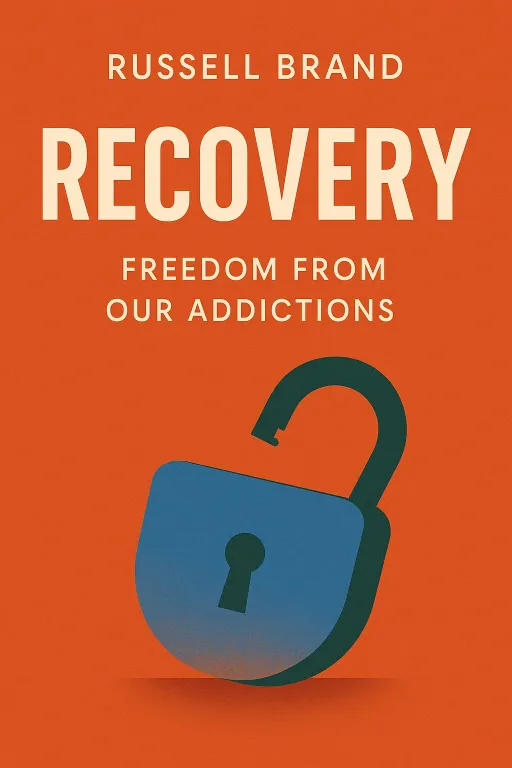
Nova: Exactly. And that brings us to the core of our conversation today, which is reclaiming mental sovereignty. We are looking at two very different, yet surprisingly complementary books. First, we have Recovery by Russell Brand. Now, people often associate Brand with his loud, chaotic comedy career, but this book is a surprisingly structured, rigorous adaptation of the 12-step program. He strips away the stigma and turns it into a universal framework for breaking free from destructive habit loops.
Atlas: Which is a fascinating pivot for him. He takes something that is often viewed as a medical or moral failure and turns it into a tool for anyone who feels stuck.
Nova: Precisely. And then, we are pairing that with The Universe Has Your Back by Gabrielle Bernstein. She moves in a different direction, focusing on the psychological and spiritual shift from fear-based control to receptive trust. It is the perfect counter-weight to the idea of just trying to force your way through life. Together, they offer a blueprint for how to stop managing the chaos and start owning your mental space.
The Trap of White-Knuckle Control
SECTION
Atlas: Let’s start with that idea of the habit loop, because I think a lot of people listening to this are high-achievers. We love the idea of "recovery" from things like addiction, but we don't always apply that logic to our daily habits—checking our phones, the constant need for validation, or the endless cycle of overworking. How does Brand actually frame this?
Nova: Brand’s central argument is that we are all addicted to something, even if it is just the distraction of our own thoughts. He argues that we have these "attachment" loops. We think that if we can just get this one thing—more money, more recognition, a different partner—we will finally be okay. But the loop is designed to keep us wanting. The moment we get it, the satisfaction evaporates, and we need another hit.
Atlas: That hits home. It is the hedonic treadmill, right? But what is the "sovereignty" part? Because if the loop is hardwired into our biology, how do we actually break it?
Nova: The breakthrough moment comes when you acknowledge that your current strategy is failing. Brand emphasizes that you cannot solve a problem with the same level of thinking that created it. He forces the reader to look at their destructive patterns not as character flaws, but as survival mechanisms that have outlived their usefulness. You are using these loops to manage anxiety, but the loops themselves are creating more anxiety.
Atlas: I see what you mean. It is like trying to put out a fire by throwing gasoline on it because the gasoline is the only thing you have in your hand. You feel like you are doing something, you are taking action, but the fire just gets bigger. So, for the person who is listening and thinking, "Okay, I have this habit, I know it is bad, but I cannot stop," what is the first step in his framework?
Nova: It is radical honesty. It is admitting that you are powerless over the loop. And that sounds counter-intuitive to the high-achiever. We are taught that willpower is the ultimate currency. If you are not succeeding, you just need more willpower. Brand argues the opposite. He says that the moment you admit you cannot control the outcome of the habit, you actually gain the power to stop participating in it.
Atlas: That is a tough pill to swallow. I imagine a lot of our listeners are thinking, "If I admit I am powerless, I am just going to spiral." How do you make that distinction between giving up and this specific type of surrender?
Nova: The key distinction is that surrender is an active choice, whereas giving up is a passive retreat. Surrender is acknowledging that the current strategy is broken and deciding to try a different approach. It is like a general realizing that a frontal assault is failing and deciding to change tactics. You aren't quitting the war; you are quitting the losing strategy.
Atlas: That makes sense. It is a tactical retreat, not a surrender of the mission. And that leads us perfectly into the second part of this equation, which is where Gabrielle Bernstein comes in. If Brand is about recognizing the loop, Bernstein seems to be about what you do once you step out of it.
From Fear-Based Control to Receptive Trust
SECTION
Nova: Exactly. While Brand focuses on the mechanics of the habit, Bernstein focuses on the emotional state that drives the habit in the first place: fear. She argues that most of our "control" behaviors—the micromanagement, the constant checking of stats, the worrying about the future—are just fear masquerading as productivity.
Atlas: Oh, I have definitely used "being productive" as a mask for "being terrified that everything will fall apart if I don't look at it."
Nova: We all have. Bernstein’s core premise is that we can systematically transition from a state of fear-based control to a state of receptive trust. And she uses this term, "The Universe," which can sound a bit esoteric, but if you strip away the branding, she is talking about shifting your locus of control from "I am the only one responsible for everything" to "I am a participant in a larger system."
Atlas: I am going to play the skeptic for a second, because I know some of our listeners are doing the same. When you say "trust the universe," that sounds passive. It sounds like sitting back and waiting for magic to happen. How does a high-achiever actually operationalize that without just becoming lazy?
Nova: That is the most common critique, and it is a fair one. The way to operationalize it is to view trust as an active, high-energy state. It is not about doing nothing. It is about doing the work without the attachment to the outcome. You show up, you do your best, you execute, but you let go of the mental burden of trying to force the result to be exactly what you imagined.
Atlas: So, it is about detaching from the outcome, not detaching from the effort.
Nova: Precisely. Think about it like a professional athlete. They train for years, they put in the hours, they are obsessed with the process. But when they are actually in the game, they aren't thinking, "If I don't score, my life is over." They are in a flow state. They are reacting. They are trusting their training. That is the state Bernstein is talking about. It is the difference between "I need this to happen" and "I am ready for whatever happens."
Atlas: That is a massive shift. I can see how that reduces the chronic anxiety that comes with high-stakes work. Because if you are constantly gripping the steering wheel, waiting for the crash, you are never actually driving. You are just waiting for the disaster.
Nova: And that is the tragedy of it. You spend all your mental energy scanning for threats rather than navigating the road. Bernstein suggests that when you choose trust, you are actually reclaiming that energy. You are taking the CPU cycles you were wasting on "what if" scenarios and putting them back into the task at hand.
Atlas: It is a massive efficiency hack, when you put it that way. You are basically freeing up bandwidth.
Nova: Absolutely. And she provides a simple, almost daily practice for this. When you feel that spike of anxiety—that "I need to control this" feeling—you pause. You acknowledge the fear. You say, "I am choosing to surrender this outcome." You aren't saying you don't care about the result; you are saying you are releasing the about the result.
Atlas: What happens next? Does the anxiety just vanish? I’ve tried the "just let it go" approach, and usually, it just comes back five minutes later.
Nova: It is a practice, not a switch. You will have to do it a hundred times a day. But the more you do it, the more you realize that the world didn't end because you stopped worrying about it. And that is the evidence your brain needs to start trusting the process. You start to see that you are actually more effective when you aren't terrified.
Synthesis & Takeaways
SECTION
Atlas: This is starting to look like a complete system. If I take Brand’s framework, I identify the loop—I see where I am addicted to the stress or the control. And then, if I take Bernstein’s framework, I replace that stress with a conscious, active trust in the process.
Nova: That is exactly it. You are replacing the "white-knuckle" grip with a "firm but flexible" hold. You are reclaiming your mental sovereignty because you are no longer a slave to the outcomes you cannot control.
Atlas: It’s interesting, because both books are essentially saying the same thing from different angles: you have to stop being the person who thinks they are the center of the universe, and start being the person who works in harmony with the reality of the universe.
Nova: That is a beautiful way to put it. Sovereignty isn't about dominion over everything; it is about dominion over yourself. It is about having the discipline to stay in your own lane.
Atlas: So, if someone is listening to this and wants to start today, what is the one question they should ask themselves?
Nova: I would go back to that deep question we touched on earlier: What is one worry or habit you are currently white-knuckling that you could actively choose to surrender and let go of today? Just one. Don't try to fix your whole life in an afternoon. Just pick one thing you are gripping too tightly, and practice the art of letting it go.
Atlas: That is a perfect, actionable challenge. Pick one. Let it go. See what happens. I think I know exactly which one I am going to pick, and it definitely involves my phone and my inbox.
Nova: We all have our version of that. The goal is to notice it, acknowledge it, and then choose a different path. It is a small shift, but it is the kind of shift that compounds over time.
Atlas: I love that. It is the ultimate productivity hack: stop managing the chaos, and start managing your reaction to it.
Nova: And that, my friend, is how you reclaim your sovereignty.
Atlas: Well, this has been an incredible deep dive. For everyone listening, remember that growth isn't about doing more; it is about being more present, more conscious, and more willing to let go of the things that don't serve you.
Nova: Exactly. Take that 15 minutes today, sit with that one habit, and see what happens when you decide to stop white-knuckling it.
Atlas: Thank you for joining us on this journey today. This is Aibrary. Congratulations on your growth!
Nova: We will see you in the next one.