The Campfire in the Classroom: Sparking Ideas and Human Connection with Angela Nketiah
Golden Hook & Introduction
SECTION
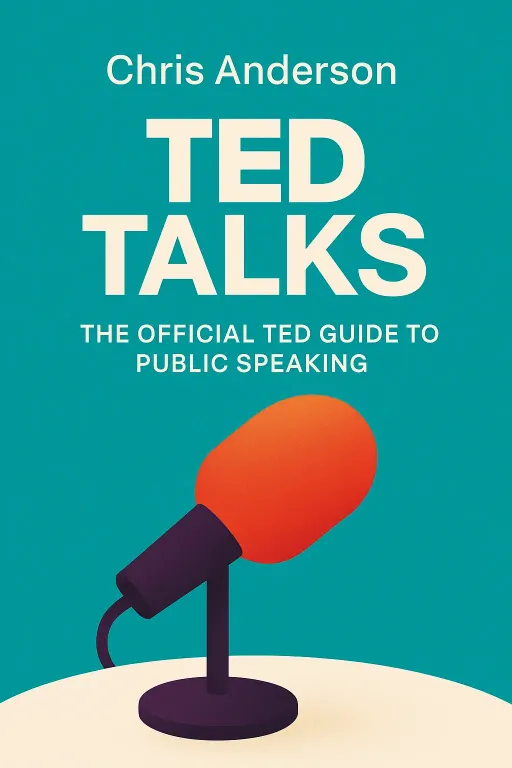
Nova: Picture this: hundreds of thousands of years ago, after nightfall, a prehistoric community gathers around a flickering campfire under a vast, starry sky. An elder rises, clears their throat, and begins to tell a story. As the storyteller speaks, something incredible happens. The listeners' brains begin to sync up. They imagine the same journey, feel the same fear, and share the same triumph. They act, for a moment, as a single, unified life form. Today, we have high-tech stages, panoramic screens, and a global internet audience, but that ancient campfire magic remains the most powerful tool for human connection we have ever invented. Welcome to the show! I'm Nova, and today we are joined by graduate student and educator Angela Nketiah to explore Chris Anderson's masterclass,. Angela, it is so wonderful to have you here with us!
Angela Nketiah: Oh, thank you, Nova! It is an absolute pleasure to be here. You know, when I read that campfire story in the prologue of Chris Anderson's book, it immediately struck a chord with me. As an educator, I couldn't help but think: isn't that exactly what a classroom should be? A campfire where we gather to share ideas, spark curiosity, and build a shared understanding of the world?
Nova: Oh, I love that! Yes, a classroom as a campfire. That is such a beautiful image, and it is the perfect setup for our conversation today. We're going to tackle this book from two different angles. First, we'll explore the cognitive magic of idea-building and how the human overlay transforms dry information into living inspiration. Then, we'll discuss why presentation literacy must become a foundational pillar in modern education, empowering every voice to share its unique gift. So, let's dive right in!
Deep Dive into Core Topic 1: The Pedagogy of the Campfire
SECTION
Nova: Chris Anderson writes that the primary goal of any speaker is to transfer a meaningful idea into the minds of the audience. He calls this "idea-building." But doing this successfully is actually a major cognitive challenge because of something called the "curse of knowledge." It's that sneaky cognitive bias where, once you know something, you literally forget what it felt like to know it. We see this all the time in public speaking, don't we? Speakers who just dump information on an audience without building the necessary scaffolding first.
Angela Nketiah: Yes, absolutely! In educational psychology, we talk about this constantly. If a teacher or a speaker starts at step ten instead of step one, the listeners' brains just shut down. They can't make the connection. Chris Anderson's antidote to this is so elegant: he says we have to start exactly where the audience is. We have to use their existing mental models as building blocks and guide them, step-by-step, using language and metaphors they already understand.
Nova: Exactly! And the book has this fantastic example of how to do this right. Think of Bonnie Bassler, the brilliant scientist who gave a TED Talk about how bacteria communicate with each other. Now, bacterial communication—or quorum sensing—sounds like a topic that could easily put a general audience to sleep, right? But Bonnie didn't start with complex chemical formulas or academic jargon. Instead, she started with. She made the topic immediately relevant by explaining that bacteria are essential for human health, and then she posed this unexpected, intriguing question: how can these tiny, single-celled organisms have such a massive impact on our environment? She built the explanation piece by piece, using the metaphor of a coordinated army, until the audience was so excited that they gave her a standing ovation!
Angela Nketiah: That is a perfect illustration of what we call Vygotsky's Zone of Proximal Development. Bonnie Bassler met the audience in their comfort zone—their own health—and then gently stretched their understanding to include this mind-blowing scientific discovery. She didn't just dump facts; she built a living idea. And as an analytical thinker, I love how the book backs this up with science. It mentions fMRI research showing that when a speaker describes a vivid experience, the listener's brain activity actually mirrors the speaker's brain. It's literal brain-to-brain coupling!
Nova: Isn't that wild? It's like telepathy is real, and we do it through words! And this brings us to what Chris Anderson calls the "human overlay." He argues that a live talk offers something a printed text never can. When we watch someone speak, we aren't just processing their words. We are unconsciously reading a massive stream of "metadata" through their voice and presence—their volume, pitch, pace, and the genuine conviction in their eyes.
Angela Nketiah: Yes! That metadata is the emotional glue of communication. It tells the listener: Think of George Monbiot, the environmentalist. In his TED Talk, he opened by describing his adventurous youth in the tropics and the crushing "ecological boredom" he felt upon returning home. If you read those words on a page, they are interesting. But when you him speak—when you hear the wistful longing in his voice, the sudden drop in pitch, the deliberate pauses—your mirror neurons fire. You don't just understand his boredom; you it. That emotional resonance is what turns information into inspiration.
Nova: It really is! And it's why a conversational tone is so much more powerful than old-school, theatrical oration. With modern microphones, we don't need to shout to be heard at the back of the room. We can speak intimately, like we're having a one-on-one chat over coffee. The book tells this funny story about a first-time speaker from South Asia who started his rehearsal by shouting at the top of his lungs. When the organizers asked why, he explained that in his culture, public speaking meant shouting so the people in the back could hear. But once he realized the microphone was his "automatic shouting device," he relaxed into a warm, conversational tone, and the talk became infinitely more powerful.
Angela Nketiah: That story is so endearing, and it highlights such an important point for educators. In the classroom, we often fall into the trap of "teacher talk"—that formal, authoritative lecture voice. But students respond so much better to authenticity. When we let down our guard, speak naturally, and show a little vulnerability, we give the students permission to do the same. It creates a safe space for learning.
Deep Dive into Core Topic 2: Presentation Literacy as an Educational Imperative
SECTION
Nova: That transition is perfect, Angela, because it leads us right into our second core topic: presentation literacy as an educational imperative. Chris Anderson makes a bold claim in the book. He says that in the 21st century, presentation literacy should be taught in every school alongside reading, writing, and arithmetic. It's not an optional extra for a select few; it's a core survival skill.
Angela Nketiah: I could not agree more, Nova! As an advocate for educational equity, this is where the book truly speaks to me. Historically, public speaking has been treated as a performance art, a talent you're either born with or you aren't. We praise the "natural orators" like Winston Churchill or Martin Luther King Jr. But Chris Anderson completely demystifies this. He says your goal is not to be a famous orator; your goal is simply to be. To share something you care about in your own unique way. When we teach presentation literacy as a learnable skill, we democratize the stage. We give quiet, analytical, or marginalized students the tools to reclaim their narratives and advocate for their communities.
Nova: Yes! It's about giving them a voice. And the book has the most inspiring story that proves can do this, regardless of their background. Think of Richard Turere, a twelve-year-old Maasai boy from Nairobi, Kenya. Richard's family was struggling to protect their cattle from lion attacks. Traditional methods weren't working, so Richard taught himself electronics and invented a system of flashing LED lights—built from scrap yard parts and an old motorcycle indicator—that successfully deterred the lions. When he was invited to give a TED Talk, he was incredibly shy and spoke very little English. He had never even seen a computer screen before! But he didn't need a polished, slick presentation. He just stood on that stage and told his story with raw, unvarnished authenticity. The audience was absolutely captivated because the was so valuable and the delivery was so genuine.
Angela Nketiah: Oh, Richard's story brings tears to my eyes every time. It is the ultimate proof that the substance of the idea is what matters most. In education, we often focus so much on the "mechanics" of speaking—eye contact, posture, hand gestures—that we lose sight of the message. But as Chris Anderson says, "Style without substance is awful." If you have a valuable idea and you share it authentically, the audience will forgive almost any technical imperfection.
Nova: They really will! In fact, audiences often lean in when a speaker shows vulnerability. But, of course, the biggest barrier to public speaking is fear. Many people fear standing on a stage more than they fear death! Chris Anderson acknowledges this fear, but he reframes it in a really empowering way. He says that fear is actually just a surge of adrenaline, and we can channel that energy into thorough preparation.
Angela Nketiah: Yes, reframing fear is a game-changer. The book shares Monica Lewinsky's experience preparing for her 2015 TED Talk. She was carrying immense past trauma and faced crippling anxiety. The night before her content rehearsal, she actually broke down in tears, doubting if she could even go through with it. But she used specific physical and mental techniques to manage her nerves. She did breathing exercises, used grounding visualizations, and repeated these powerful mantras: "This matters" and "I've got this." She shifted her focus away from her own insecurities and onto the importance of her message. And the result? A standing ovation and millions of views online.
Nova: It was an incredibly brave talk. And it shows that managing nerves isn't about being fearless; it's about having a backup plan and focusing on the gift you are giving the audience. I love that Chris Anderson says a talk is a. When you give a gift, you aren't thinking about yourself; you're thinking about the recipient. If we can teach students to view their presentations as a gift of knowledge to their peers, it takes the pressure off their ego.
Angela Nketiah: Exactly! It shifts the framing from "look at me" to "look at this idea." And that relates to another brilliant distinction in the book: the difference between "issue-based" talks and "idea-based" talks. June Cohen, a key TED executive, explained that an issue-based talk leads with morality and says, "Isn't this terrible?" It often leads to compassion fatigue. But an idea-based talk leads with curiosity and says, "Isn't this interesting? And here is a potential solution." In education, if we want to inspire students to become active citizens, we need to teach them to frame tough topics as ideas and solutions, just like Richard Turere did with his lion lights.
Nova: That is such a profound insight, Angela. Leading with curiosity instead of guilt. It's the difference between making an audience feel heavy and making them feel empowered.
Synthesis & Takeaways
SECTION
Nova: Well, we have covered some incredible ground today! From the ancient campfire to the modern classroom, we've explored how public speaking is fundamentally about building ideas, connecting through the human overlay, and empowering every voice through presentation literacy. Angela, as we wrap up, how can we practically bring these insights into our daily lives, especially for those of us in education?
Angela Nketiah: I think a wonderful starting point is to look at the "Learning Wednesdays" experiment that TED HQ implemented. They gave team members dedicated time to study a passion project, with the only condition being that they had to give a short talk to the rest of the organization about what they learned. We can easily adapt this in our classrooms, workplaces, or even among friends! Imagine creating low-stakes, supportive "campfire spaces" where people can practice sharing their ideas without the pressure of a formal grade or evaluation. It builds confidence, fosters a culture of lifelong learning, and helps us discover our own unique throughlines.
Nova: Oh, I love that idea! A weekly campfire space. That is a practical, actionable step that anyone can start. And it perfectly aligns with what the philosopher Dan Dennett said at a TED conference, which Chris Anderson highlights as the ultimate secret to happiness: "Find something more important than you are, and dedicate your life to it." When we find that passion, sharing it with others becomes a joy, not a chore.
Angela Nketiah: Yes! Public speaking, at its best, is an act of generosity. It's about finding that spark of truth or beauty and passing it on to keep the fire burning for the next generation.
Nova: Beautifully said, Angela. Thank you so much for sharing your warmth, your analytical insights, and your passion with us today. This has been an absolutely inspiring conversation!
Angela Nketiah: Thank you, Nova! It was a joy to be part of it.
Nova: And to our listeners, thank you for gathering around our campfire today. We leave you with this question to ponder: what is the one valuable idea inside that the world is waiting to hear, and how can you start building it in the minds of others today? Until next time, keep sharing your stories, keep listening with empathy, and keep the fire burning. Bye for now!