Structural Disruptions: Empires, Economics, and Power Dynamics
Golden Hook & Introduction
SECTION
Nova: The most successful startup in human history didn't have a headquarters in Silicon Valley, a venture capital backer, or even a formal office. It was built on horseback across the Eurasian steppe. We often look to modern tech giants for lessons on scaling, but the blueprint for the ultimate agile network was actually written by a nomadic leader who understood that speed and meritocracy were the only currencies that mattered.
Atlas: That is a wild way to frame it. You are talking about Genghis Khan, right? Because when most people think of the Mongol Empire, they think of conquest and chaos, not agile management theory or innovative team structures.
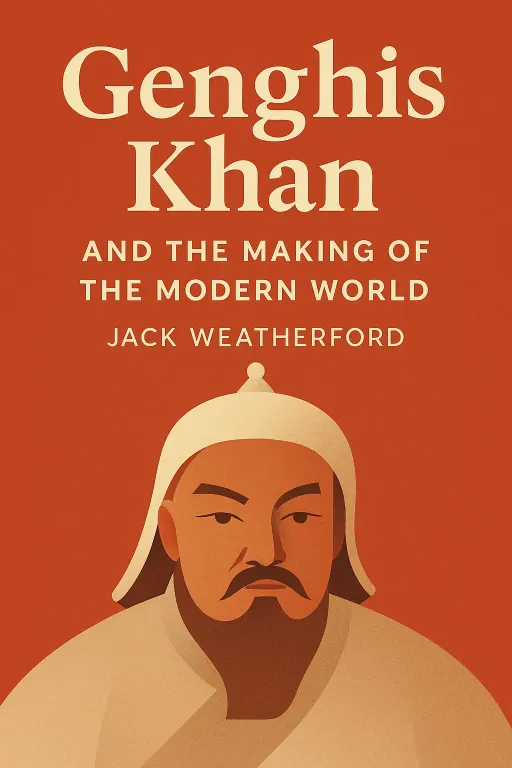
Nova: Exactly. That is the surface-level view. But if we dig into Jack Weatherford’s book, Genghis Khan and the Making of the Modern World, we see something entirely different. Weatherford makes a compelling case that Khan wasn't just a conqueror; he was a master of organizational design. He took a fractured, tribal society and turned it into the most efficient, meritocratic machine the world had ever seen.
Atlas: I can see why that would grab the attention of a strategist. But if we are talking about structures, we have to look at the other side of the coin. You also wanted to bring in Karl Marx and Friedrich Engels. Putting Genghis Khan and The Communist Manifesto in the same conversation feels like a massive pivot. How do we reconcile a nomadic conqueror with the founders of systemic economic critique?
Nova: It is a pivot, but it is a necessary one. If Weatherford shows us how to build an agile, meritocratic network, Marx and Engels show us why those networks eventually calcify into rigid, top-down structures. The Communist Manifesto is essentially a deep dive into how economic systems—what Marx calls the base—dictate the social reality and the power dynamics of the people living within them.
Atlas: So, we are looking at the tension between the agile, meritocratic ideal—the Khan model—and the inevitable pull toward rigid, industrial-style bureaucracy—the Marx model. For anyone listening who is trying to build a team or an organization, this is the fundamental tension. How do we stay agile without becoming a rigid, static institution?
Nova: That is the core question. Let us break this down.
The Meritocratic Engine
SECTION
Nova: Let’s start with the Mongol model. Weatherford highlights something that feels incredibly modern: the total elimination of aristocratic privilege in favor of raw talent. In the Mongol army, you did not get promoted because your father was a general. You got promoted because you could shoot, ride, and lead.
Atlas: That sounds great on paper. Everyone loves the idea of a meritocracy. But in the real world, meritocracies are notoriously hard to sustain. As soon as a group gets successful, the founders start protecting their turf, the politics creep in, and suddenly, who you know starts mattering more than what you can do. How did they actually maintain that standard?
Nova: That is the brilliant part of the Mongol system. They institutionalized it. They created a system where the leader’s own survival depended on the competence of the people around him. It wasn't just a philosophy; it was a survival mechanism. If your lieutenant fails, you die. That creates a very different incentive structure than a modern corporate review cycle.
Atlas: Right. The stakes were life and death, not just a bonus or a promotion. That forces a level of honesty that most companies can only dream of. But let’s play devil’s advocate. In a business context, we can’t exactly fire people by leaving them on the battlefield. How does a strategist in a modern company—maybe someone leading a tech team—create that same level of accountability without the, you know, existential threat?
Nova: The key is information speed. Weatherford talks about the Mongol Yam system, which was essentially an ancient version of a high-speed data network. Riders could cover hundreds of miles in a day. The leader had near-instant visibility into what was happening across his empire. In a modern team, the equivalent of that is radical transparency. When information flows freely and everyone knows exactly what is happening, performance becomes visible. You cannot hide incompetence when the metrics are clear and the data is accessible to everyone.
Atlas: So, you are saying that the meritocracy wasn't just about the culture; it was about the infrastructure. If you have a clear, fast feedback loop, meritocracy happens naturally because you cannot fake results when the data is right there for everyone to see.
Nova: Precisely. Rigid, top-down structures often rely on information hoarding. Managers keep data at the top to maintain control. The Mongol model was the opposite. They distributed information to the edges, to the commanders on the field, which allowed them to make decisions in real-time. That is the definition of agility.
The Systemic Friction
SECTION
Atlas: Okay, that makes sense. But let’s look at the other side of the ledger. We have this agile, meritocratic ideal, but then we have the reality of how these things turn into institutions. That’s where the Marx and Engels perspective comes in. They argue that history is essentially a struggle of economic structures. When I read the Manifesto, I see a warning about what happens when a system becomes more important than the people inside it.
Nova: That is a sharp reading. Marx and Engels were looking at the Industrial Revolution, where the machine—the factory, the capital—started dictating the rhythm of human life. In their view, the structure of the economy forced people into specific roles: the owners and the workers. The system created the friction.
Atlas: And that feels like the death of the agile team. In a startup, you have that Mongol-style, all-hands-on-deck, meritocratic energy. But as the company grows, it inevitably starts to resemble the industrial model Marx was critiquing. You get departments, silos, layers of management, and suddenly, the goal isn't the mission anymore; the goal is the preservation of the system.
Nova: That is the trap. Marx and Engels called this the alienation of the worker. When you are just a cog in a massive machine, you lose connection to the outcome. You are no longer an agile rider on the steppe; you are a factory worker pulling the same lever for twelve hours a day. The structure becomes so rigid that it cannot adapt to change because the system is designed for stability and control, not for innovation.
Atlas: So, the transition from a high-growth, agile team to a stable, industrial-style organization is actually a shift in the power dynamic. It is the moment where the system starts prioritizing its own survival over the talent of the individuals inside it.
Nova: Exactly. And that is why so many companies fail to innovate as they age. They stop being networks and start being factories. They replace meritocracy with hierarchy because hierarchy is easier to manage. It is safer. But it is also where the innovation goes to die.
Atlas: This is a sobering thought for a builder. If the natural evolution of an organization is toward this rigid, industrial, Marx-style structure, is it even possible to fight it? Or are we destined to eventually become the very thing we are trying to disrupt?
The Strategist's Challenge
SECTION
Nova: That is the million-dollar question. I don't think it is inevitable. I think it is a choice. The strategist’s job is to constantly fight the entropy of the organization. You have to actively build the "Mongol" network inside the "Marxist" structure.
Atlas: That sounds like a paradox. How do you build a nomadic, agile network inside a rigid, industrial corporation? That sounds like a recipe for getting fired.
Nova: You have to be a structural subversive. You don't have to change the entire company, but you can build pockets of agility. You create a team that operates on the principles of the Mongol model: high information flow, radical transparency, and promotion based on actual output rather than tenure or title.
Atlas: So, you are saying we need to create a "cell" of agility. A team that ignores the traditional hierarchy and focuses entirely on the mission. But how do you protect that cell? Because the rest of the organization—the rigid structure—is going to see that as a threat.
Nova: You protect it by being undeniably valuable. The Mongol empire didn't just survive because of its structure; it survived because it delivered results that no one else could match. When your team is the one hitting the targets, solving the unsolvable problems, and moving at a speed that makes the rest of the company look like it’s standing still, the organization will tolerate your weird, agile ways.
Atlas: I like that. It is not about fighting the system from the outside; it is about outperforming the system from the inside. You make your pocket of agility the standard that everyone else wants to emulate.
Nova: Exactly. And you have to keep the mindset of a builder. Don't fall in love with the process; fall in love with the outcome. That is the lesson from both books. Weatherford shows us that when the process becomes more important than the outcome, the empire falls. Marx and Engels show us that when the structure becomes more important than the people, the system becomes unsustainable.
Atlas: It comes back to the user profile we are talking about today. The Strategist, the Builder, the Visionary. They aren't looking to create a bureaucracy. They are looking to create impact. And to do that, they have to constantly balance these two forces: the need for a structure that can scale, and the need for the agility that keeps the spirit of the team alive.
Synthesis & Takeaways
SECTION
Nova: That balance is everything. If you are listening to this and feeling the weight of your own organization—if you feel like you are stuck in a factory when you want to be on the steppe—my advice is to look for the friction points. Where is the information flow being blocked? Who is being promoted based on politics rather than performance? Those are your levers.
Atlas: And don't just complain about the system. That is the Marxian critique, right? Analyzing the system is fine, but it doesn't change it. You have to act. You have to be the one who opens up the data, who clarifies the goals, and who rewards the people who actually get things done.
Nova: That is the path to true leadership. It is about creating an environment where the best ideas win, regardless of where they come from in the hierarchy. It is about building a network of people who are connected by a shared mission, not by a chain of command.
Atlas: It is a high bar, but it is the only way to build something that lasts. We have the history of the Mongols to show us what’s possible with speed and merit, and we have the history of industrial capitalism to show us what to avoid. The rest is up to us.
Nova: Precisely. Your time is precious. Don't spend it managing a system that doesn't work. Spend it building a team that does.
Atlas: I think that is a perfect place to leave it. Build the network, defy the inertia, and keep your focus on the outcome.
Nova: This is Aibrary. Congratulations on your growth!