Navigating the Economic Architecture of the Cognitive Era
Golden Hook & Introduction
SECTION
Nova: The most dangerous assumption we make about the future of technology is that automation is the endgame. We tend to view progress as a straight line toward letting machines do everything for us, thinking that if we just offload enough tasks, we’ll finally be free. But the data tells a much more complicated story. Every time we automate a task, we don't necessarily get free time. We get a more complex set of problems that require even more cognitive effort.
Atlas: That is such a sharp way to frame it. It feels like we are living through the paradox of productivity. We have more tools than ever to clear our plates, yet our plates are fuller than they have ever been. It is like the more we delegate to the machine, the more the machine demands we manage it.
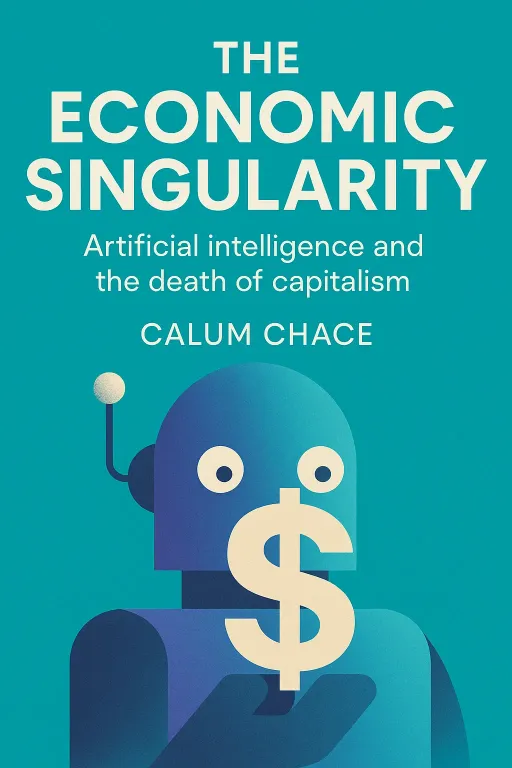
Nova: Exactly. And that is precisely why we need to look at the work of people like Calum Chace and Max Tegmark. Chace, in his book The Economic Singularity, maps out this inevitable transition toward a post-work economy, but he does it with a warning about how we design our systems to handle market restructuring. Then you layer that with Max Tegmark’s Life 3.0, which dives into the systemic pathways of human-level AI. Tegmark isn't just talking about the tech; he is presenting frameworks for aligning that capability with human flourishing.
Atlas: Right, and when you put those two together, you stop looking at AI as just a series of features or a list of efficiencies. You start looking at it as an architecture.
Nova: That is the goal today. We are asking a deep question: As we build out the product architecture for something like Aibrary, how do we move past the simplistic goal of just automating tasks? How do we design features that actively elevate and amplify human cognitive agency?
The Trap of Efficiency and the Post-Work Horizon
SECTION
Atlas: I want to pull on that thread of efficiency you mentioned. When I look at most modern software, the pitch is always about saving time. Save five minutes here, automate that report there. But if we follow Calum Chace’s logic in The Economic Singularity, that efficiency might be a trap. If the ultimate destination is a world where work as we know it changes fundamentally, does optimizing for speed actually hurt us in the long run?
Nova: That is the central tension. Chace argues that we are heading toward a world where the link between human labor and economic survival is going to be severed. If you build a product that focuses entirely on automating current tasks, you are building for a reality that is fading. You are essentially teaching your users how to be better at tasks that might not exist in a few years.
Atlas: That makes me think about the early days of word processors. People thought the goal was just to type faster. But the real shift wasn't speed; it was the ability to edit, rearrange, and restructure thought. The speed was secondary to the agency the tool gave the writer.
Nova: That is a perfect analogy. If you look at the architecture of a tool like Aibrary, the temptation is to build a "speed machine"—something that summarizes, categorizes, and files things automatically. But if you do that, you are treating the user as a passenger. You are saying, "I will do the thinking for you."
Atlas: And that feels like a dangerous path. If the user becomes a passenger, they lose the ability to drive. They lose the nuance, the context, and the critical thinking that only a human can bring to the table. I imagine a lot of our listeners who are building products feel this pressure. They think, "If I don't make this faster and more automated, I'm failing."
Nova: It is a natural reaction, but it is a short-term one. Chace points out that we are moving toward a period of radical market restructuring. In that kind of environment, the winners won't be the ones who can do the old tasks fastest. The winners will be the ones who can synthesize new information and make high-level decisions. So, instead of a product that just clears the inbox, you want a product that acts as a cognitive bicycle.
Atlas: I love that image. A bicycle doesn't walk for you; it amplifies your ability to travel. It keeps the human in the loop, providing the power, but it changes the scope of what is possible.
Nova: Exactly. If we apply that to product design, we stop asking, "How can I automate this task for the user?" and we start asking, "How can I give the user better visibility and better control over the variables that matter?"
Alignment and the Architecture of Agency
SECTION
Atlas: That leads us right into the territory Max Tegmark explores in Life 3.0. I’ve read his work on alignment, and it’s usually discussed in the context of global, existential AI risk. But I’m curious how that translates to the micro-level—to the way we design a user interface or a workflow. How do we apply the concept of alignment to a product?
Nova: Tegmark’s core thesis is about keeping the AI’s goals aligned with human flourishing. If you bring that down to the product level, alignment means the tool should never prioritize its own "efficiency" over the user's "understanding."
Atlas: That is fascinating. Can you give me an example of where that breaks down? Because I think we see it all the time.
Nova: Think about recommendation algorithms in social feeds. The "alignment" in those systems is often optimized for engagement—time on screen. That is the goal the AI is pursuing. But it is not aligned with the human user’s goal of learning, connecting, or resting. The tool is efficient at its goal, but it is misaligned with the user’s flourishing.
Atlas: So, for a product like Aibrary, if I design an AI that summarizes a library of documents, and I prioritize speed over everything else, I might strip out the complexity. I might give the user a clean, simple answer that is actually wrong or misses the crucial nuance. I am optimizing for the "answer" rather than the "insight."
Nova: That is the danger. If you want to amplify cognitive agency, you have to embrace the friction. Sometimes, the most valuable thing a tool can do is slow the user down.
Atlas: Wait, hold on. That sounds counterintuitive in the tech world. We are always told to reduce friction. Why would you want to add it?
Nova: Because cognitive agency requires engagement. If you are reading a complex report, and the AI just gives you a three-bullet-point summary, you haven't engaged with the material. You’ve just consumed a digest. Your agency is bypassed. But if the tool highlights the contradictory points, shows you the source material, and asks you, "How does this align with your previous notes?", that is a conversation. That is cognitive amplification.
Atlas: I see what you are doing. You are talking about moving from a "black box" model, where the AI just spits out an answer, to a "co-pilot" model, where the AI exposes its reasoning.
Nova: Precisely. Tegmark talks about the importance of transparency and control. In product terms, that means the user should always be able to trace the AI’s logic. They should be able to see why the AI surfaced a particular insight. That way, the user remains the final arbiter of truth.
Designing for the Future User
SECTION
Atlas: I can see how this works in theory, but let’s get practical. If I am an architect of Aibrary, and I have these two principles—Chace’s warning against passive automation and Tegmark’s call for alignment—what does my feature roadmap look like? How do I change the way I build?
Nova: You start by auditing your features. Take a look at every automated action your product performs. Ask yourself: Does this action reduce the user's need to think, or does it enhance their ability to think?
Atlas: That is a tough filter. Most features are designed to reduce the need to think. That is usually sold as a "frictionless experience."
Nova: And that is exactly where you can differentiate. Instead of a "one-click summary," you build a "collaborative exploration mode." You don't just give the answer; you give the user the tools to interrogate the data. You provide pathways for them to dive deeper, to challenge the AI, to reframe the inputs.
Atlas: It sounds like you are suggesting we build products that act more like mentors than secretaries.
Nova: That is a beautiful way to put it. A secretary does the work for you. A mentor teaches you how to do the work better, helps you see the blind spots, and encourages you to synthesize the information yourself.
Atlas: I am thinking about the "Cognitive Optimization" aspect from our user profile. If our goal is to help the user sustain peak performance, then a "secretary" tool might actually make them intellectually lazy over time. But a "mentor" tool keeps their brain sharp.
Nova: Exactly. And this connects back to the broader societal shift Chace talks about. As the nature of work changes, the most valuable skill will be the ability to handle complexity. If your product is designed to hide complexity from the user, you are actually doing them a disservice. You are making them dependent on the tool. But if your product is designed to help them navigate complexity, you are building a tool that will be indispensable in the future economy.
Atlas: That is a profound shift in perspective. It makes me realize that "user experience" shouldn't just be about comfort. It should be about empowerment. We need to measure our success not by how much time the user saves, but by how much more "agency" they feel when using the product.
Nova: Yes. And how do you measure agency? You measure it by the quality of the decisions the user makes. Are they more informed? Are they more aware of the nuances? Are they asking better questions?
Synthesis & Takeaways
SECTION
Atlas: This has completely changed how I think about product architecture. I was focused on the "what"—what tasks can we automate? Now I see it is about the "how"—how do we structure the interaction to keep the human in the driver's seat?
Nova: It is the difference between building a tool that replaces the user and building a tool that extends them. When you read through the frameworks in Life 3.0, you realize that the future isn't about AI versus human; it's about AI plus human. But that "plus" only works if the human remains the architect of the process.
Atlas: And that is why we need to be so intentional. As we move toward the economic structures Calum Chace describes, where the traditional labor market is in flux, the products we build today are going to define whether people are left behind or whether they are empowered to thrive. We have a responsibility to design for the latter.
Nova: That is the core takeaway. We need to stop building for the "average" user who wants to do less, and start building for the "agentic" user who wants to do more, see more, and understand more. The goal of Aibrary, or any forward-thinking product, should be to amplify that cognitive agency. We want to build the bicycle, not the self-driving car.
Atlas: I love that. It’s about keeping our hands on the handlebars. This conversation has been such a great reminder that our technical choices are actually philosophical choices. We are choosing what kind of humans we want our users to become.
Nova: And that is the most important design decision anyone can make. Thank you for diving into this with me. It is clear that the path forward isn't just about more power or more speed; it is about more alignment, more transparency, and ultimately, more agency.
Atlas: I couldn't agree more. For everyone listening, take a look at your current workflow or your current project. Ask yourself: Am I being a passenger, or am I the pilot? And if you are building the product, ask: Am I handing the user a remote control, or am I giving them a cockpit?
Nova: That is the right question to end on. This is Aibrary. Congratulations on your growth!