The Dawn of Automation: Work, Life, and the Robot Revolution
Golden Hook & Introduction
SECTION
Nova: What if the robots aren't just coming for job, but are fundamentally redefining what "work" even means for humanity? The future is here, and it's not quite what the movies told us.
Atlas: Whoa, that's a bold claim, Nova. Are we talking about a sci-fi dystopia or a new golden age of leisure? Because my email inbox certainly hasn't gotten any lighter.
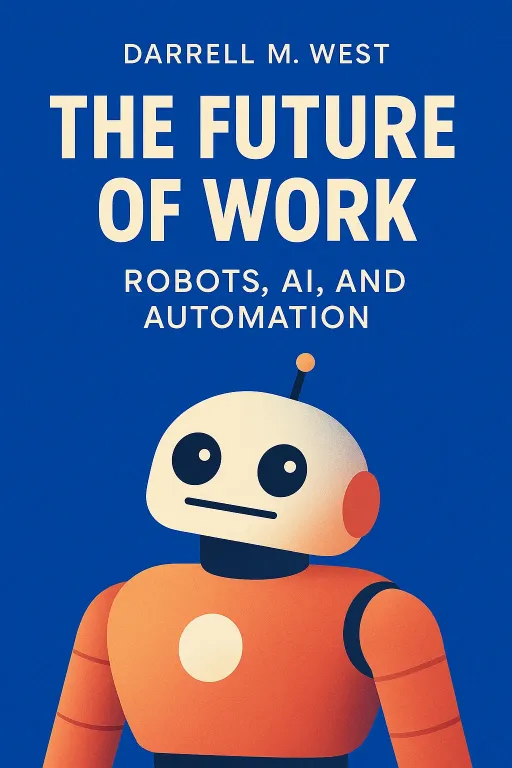
Nova: Exactly! That's the tension at the heart of our discussion today. We're diving deep into the dawn of automation, guided by two pivotal works: Darrell M. West’s incisive "The Future of Work," and Andrés Oppenheimer’s urgent, journalistic "THE ROBOTS ARE COMING!"
Atlas: Ah, West, known for his keen policy analysis, and Oppenheimer, a Pulitzer-winning journalist bringing that boots-on-the-ground reality. I like that combo. It feels like we're getting both the macro-strategic view and the immediate, human impact.
Nova: Absolutely. West gives us the comprehensive "what" – how industries are transforming, the new skill demands, the policy implications. Oppenheimer, on the other hand, zeroes in on the "how to respond," offering a compelling, almost visceral look at what individuals and governments do to prepare. They really complement each other, painting a holistic picture of this seismic shift.
Atlas: So, basically, we're exploring the biggest economic and social upheaval since the Industrial Revolution, but with algorithms instead of steam engines?
Nova: Precisely. And it's happening at an unprecedented pace. Today, we'll dive deep into this from two perspectives. First, we'll explore the monumental shifts automation is bringing to our job markets and industries, then we'll discuss the critical human response needed, from individual skill development to government policy.
The Inevitable Transformation: Macro Shifts & Job Displacement/Creation
SECTION
Nova: Let's start with the sheer scale of this transformation. West highlights how AI and automation are reshaping every corner of our economy. It’s not just about factory floors anymore. Think about a farmer in Iowa. For decades, their day involved driving a tractor, manually checking crop health, making decisions based on experience.
Atlas: Right, traditional, hands-on work. That’s what most people picture when they think of "labor."
Nova: Now, imagine a modern farm. Drones fly overhead, equipped with AI-powered cameras, analyzing soil moisture, identifying pests, even predicting yield with incredible accuracy. Autonomous tractors plant and harvest. Sensors in the ground communicate data directly to a central AI system.
Atlas: That sounds incredibly efficient. But where does the farmer fit into that picture? Is their job just… gone?
Nova: That’s the core question, isn't it? The traditional role of the farmer, the one who spent hours physically inspecting fields, might diminish. But new roles emerge: drone operators, data analysts who interpret the AI's findings, agricultural robotics technicians, even ethicists designing the AI's decision-making processes. Oppenheimer emphasizes that it’s not always about outright job destruction, but profound job.
Atlas: So you’re saying the tractor driver might become the drone pilot? Or the field hand becomes the data specialist? That's a huge leap for many people, especially those without advanced tech skills.
Nova: It is. Consider the shipping industry. Massive container ships now navigate largely autonomously. Ports use AI-driven cranes to unload and sort cargo with minimal human intervention. This dramatically increases efficiency and safety, but it fundamentally alters the jobs of dockworkers, logistics coordinators, even customs agents. Their roles are shifting from manual labor and routine data entry to oversight, troubleshooting complex systems, and strategic planning.
Atlas: That’s a powerful example. I can see how that would create a lot of anxiety. For those whose jobs are being redefined, it must feel like the ground is shifting beneath their feet. It’s not just about losing a job; it’s losing a.
Nova: Exactly. Oppenheimer captures that urgency. He speaks to people whose livelihoods are directly impacted, from truck drivers facing autonomous vehicles to radiologists whose diagnostic capabilities are being augmented—or even surpassed—by AI. The "cause" is clear: technological advancement. The "process" is the gradual, or sometimes sudden, integration of these tools into existing workflows. And the "outcome" is a workforce that needs to be fundamentally different.
Atlas: It’s like the industrial revolution, but this time, the "machines" can think, or at least process information, in ways we couldn't have imagined a century ago. The complexity feels exponentially higher.
Nova: It absolutely is. And this isn't just about blue-collar jobs. West points out that even highly skilled professions, like legal research or financial analysis, are seeing AI take over repetitive, data-intensive tasks. Lawyers now use AI to sift through millions of documents in minutes, something that used to take teams of paralegals weeks.
Atlas: So the legal assistant isn't just doing busy work anymore, they're becoming the strategic architect of the search? That sounds like an upgrade for some, but also potentially a barrier for others who can't adapt.
Nova: Precisely. The goal isn't to replace humans entirely, but to augment human capabilities, allowing us to focus on higher-level, more creative, and interpersonal tasks. The challenge, and this is where both authors converge, is how we manage this transition so that it lifts society up, rather than creating a deeper divide.
The Human Response: Skill Adaptation & Policy Imperatives
SECTION
Nova: This brings us directly to our second core topic: the human response. If the nature of work is changing so dramatically, what do individuals and governments need to do to prepare? Oppenheimer is particularly vocal about this.
Atlas: I've been thinking about this. For individuals, it must feel like a race against the machines. What skills are actually future-proof, if any? Should we all just learn to code?
Nova: Not necessarily just coding. West emphasizes what he calls "uniquely human skills." Think critical thinking, creativity, complex problem-solving, emotional intelligence, and collaboration. These are the domains where humans still far outshine AI. It’s like shifting from being a calculator to being a mathematician – the calculator handles the arithmetic, but the mathematician poses the questions, interprets the results, and invents new theories.
Atlas: That’s a great analogy. So, instead of memorizing facts, we need to learn how to ask better questions? How to innovate? That makes sense, but how do you teach that on a societal scale? Our education systems aren't exactly set up for radical creativity.
Nova: That’s where the policy imperatives come in. Oppenheimer argues that governments have a crucial role. We need to rethink our education systems, moving away from rote learning towards fostering these "21st-century skills" from an early age. Lifelong learning initiatives become paramount, making it accessible and affordable for adults to reskill and upskill throughout their careers.
Atlas: That sounds like a massive undertaking. And expensive. What about the people who are displaced in the meantime? The truck driver whose job is taken by an autonomous vehicle next year?
Nova: That’s a critical point, and one both authors address. West talks about the need for robust social safety nets. This could include things like universal basic income, or UBI, which provides a regular, unconditional income to all citizens, or expanded unemployment benefits coupled with comprehensive retraining programs. The idea is to cushion the blow of displacement and provide a runway for individuals to adapt.
Atlas: Universal Basic Income is a pretty radical idea. Some might argue it removes the incentive to work. What's the counter-argument there? How do you ensure people still contribute if they're receiving a basic income?
Nova: That’s a common and valid concern. The argument for UBI isn't that it eliminates work, but that it frees people from the of doing soul-crushing, repetitive jobs that AI can do better. It allows them to pursue education, care for family, engage in creative endeavors, or contribute to their communities in ways that aren't purely economic, but are incredibly valuable. It’s a policy designed to foster human flourishing, not just survival.
Atlas: I like that framing: fostering human flourishing. But it also sounds incredibly complex to implement. Beyond UBI, what other policy levers are critical?
Nova: Regulation of AI itself is huge. Establishing ethical guidelines for AI development, ensuring transparency in algorithmic decision-making, and addressing issues of bias are all essential. We also need investments in infrastructure, like universal broadband access, to ensure everyone can participate in the digital economy. Oppenheimer highlights countries that are already experimenting with these policies, from Finland’s UBI trials to Singapore’s aggressive national upskilling programs.
Atlas: So, it’s a two-pronged approach: individuals need to embrace continuous learning and develop uniquely human skills, and governments need to create the supportive infrastructure and safety nets. It feels like a massive collaborative effort, not just a personal one.
Nova: Exactly. The shift isn't just technological; it's cultural, educational, and political. It requires a fundamental rethinking of our social contract. The challenge isn't just about preventing job loss, but about reimagining a future where technology serves humanity, creating new forms of prosperity and purpose.
Synthesis & Takeaways
SECTION
Nova: So, bringing it all together, what West and Oppenheimer reveal is a future that’s both daunting and incredibly promising. The robots are coming, yes, but they're also bringing with them the potential for a more creative, fulfilling, and equitable human experience – we respond intelligently.
Atlas: That’s a huge "if." For our listeners trying to navigate this, what’s the single most crucial takeaway? If they could only do one thing to prepare, what would it be?
Nova: It’s not about fearing the machines, but understanding them, and more importantly, understanding ourselves. The most critical takeaway is to cultivate radical adaptability and continuous learning. Embrace curiosity, hone your distinctly human skills – empathy, creativity, critical thinking – and view every new technology not as a threat, but as an invitation to evolve. The future won't be about working harder, but working and.
Atlas: That gives me chills in a good way. It shifts the focus from being replaced to being redefined and elevated. It’s about leaning into what makes us uniquely human.
Nova: Indeed. The future of work isn't just about robots and algorithms; it's ultimately about the future of humanity itself. How we choose to adapt, innovate, and collaborate will define our era.
Atlas: What if we embrace this transformation not as a threat, but as the greatest opportunity for human reinvention we've ever known?
Nova: That’s the question we should all be asking ourselves. This is Aibrary. Congratulations on your growth!