Navigating Anxiety and Reclaiming Self-Belief
Golden Hook & Introduction
SECTION
Nova: You know that feeling when you are staring at your bathroom mirror in the morning, and the person staring back looks like they are already losing the day? It is that specific kind of exhaustion where the to-do list hasn't even started, but you are already behind.
Atlas: That is the universal signal for a morning that is about to go sideways. I have definitely spent my fair share of time in that exact stare-down. It feels like the brain is running a thousand browser tabs, and half of them are frozen.
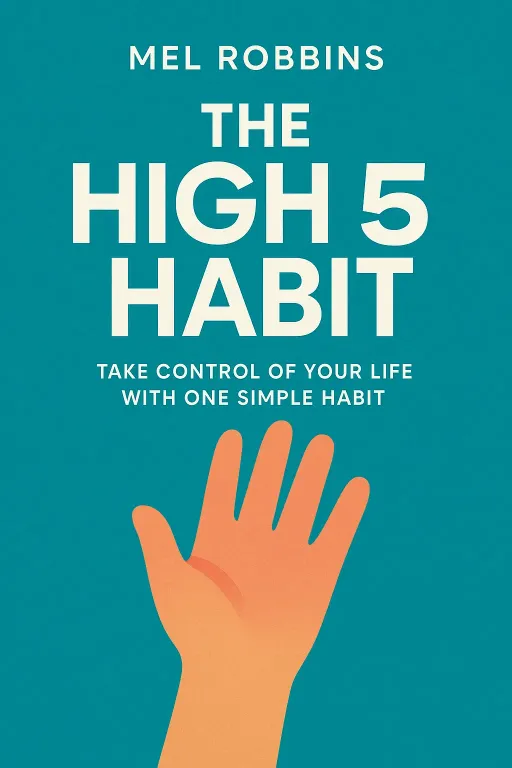
Nova: Exactly. And the fascinating thing is that we have two powerful, though very different, blueprints for fixing that exact moment. Today, we are looking at the work of Sarah Knight and her approach in Calm the Fuck Down, alongside the neurological insights from Mel Robbins in The High 5 Habit.
Atlas: I love that pairing. One is about the mental math of what we actually have the power to change, and the other is about the physical act of showing up for yourself. It feels like we are covering both the operating system and the hardware.
Nova: That is the perfect way to frame it. Sarah Knight, who gained a massive following for her no-nonsense, anti-perfectionist approach, gives us a way to declutter the mind. And Mel Robbins, who has built a massive career on turning neurological research into actionable habits, gives us a way to bypass the internal critic. We are going to explore how to stop burning mental fuel on things that don't matter, and how to actually like the person you see in the mirror.
The Mental Bandwidth of Control
SECTION
Atlas: Let’s start with the mental fuel part. Sarah Knight’s NoWorries Method sounds almost too simple to be effective. She basically says to separate things you can control from things you cannot. But I imagine people hear that and think, obviously, I know the difference between the weather and my own work. Why is it so hard to actually do?
Nova: It is hard because we are wired to try to solve everything. We treat uncontrollable events like they are problems waiting for a solution. Think about the last time you were stuck in traffic. You get angry, you check the map, you tense up, you maybe even yell at the dashboard. You are trying to control the traffic. But the traffic is a non-controllable event.
Atlas: I am definitely guilty of that. I treat a traffic jam like a personal insult from the universe.
Nova: We all do. And that is where the mental bandwidth drain happens. Knight argues that every time you stress over something outside your control, you are effectively burning energy you need for the things you can actually influence. If you spend your morning worrying about whether your boss is going to be in a bad mood, you are wasting the focus you could be using to prepare for the meeting itself.
Atlas: That makes a lot of sense. It is like trying to charge a phone with a dead battery. You are just spinning the wheels. But how do you actually catch yourself in that loop? Because in the moment, it feels like I am being productive. It feels like I am thinking through all the angles.
Nova: You are identifying the classic trap. We mistake worrying for planning. The fix here is a constant, almost mechanical, categorization process. When you feel that spike of anxiety, you have to pause and ask one question: Is this actionable? If the answer is no, the task is to let it go. Not just ignore it, but actively acknowledge that it falls into the bucket of things that do not require your limited processing power.
Atlas: I can see how that would be a relief, but what about the middle ground? There are things that are partially in my control. Like, I can’t control if a client accepts a proposal, but I can control how I write it. That seems like a gray area.
Nova: That is where the nuance comes in. You focus entirely on the input, not the output. You can control the quality of the proposal, the tone of the email, the preparation for the call. You cannot control the client’s internal state or their budget. When you make that distinction, you stop trying to force the outcome and start focusing on your own performance. It is a shift from being a spectator of the outcome to being the architect of your own actions.
Atlas: That is a liberating distinction. It moves you from a state of helplessness to a state of agency. You are saying that by letting go of the outcome, you actually gain more control over the process.
Nova: Exactly. And that is the core of the NoWorries Method. It is about reclaiming that mental bandwidth. When you stop trying to influence the uncontrollable, you suddenly have a massive surplus of energy. You aren't just less stressed; you are actually more effective at the things that are within your reach.
The Neurological Bypass
SECTION
Atlas: Okay, so I have cleared the mental deck. I have stopped worrying about the traffic and the client’s moods. But now I am standing in front of the mirror, and my internal voice is still whispering that I am not doing enough. This is where Mel Robbins comes in, right? Because just knowing I should focus on what I can control doesn't always stop the self-criticism.
Nova: You hit the nail on the head. That is the genius of The High 5 Habit. Robbins realized that our brains are often wired for self-criticism. We are conditioned to look for flaws. When you look in the mirror, your brain is scanning for what is wrong—the tired eyes, the messy hair, the mistake you made yesterday. It is a habit of judgment.
Atlas: That sounds exhausting just thinking about it. How does a high-five change that? It sounds like such a strange, almost childish thing to do.
Nova: It is strange, but that is exactly why it works. Robbins points to neurological evidence showing that when you physically high-five your reflection, you are doing something that your brain cannot easily categorize as criticism. You are performing a gesture that is universally associated with celebration and support. It is a positive physical act.
Atlas: So you are basically forcing your brain to interrupt the pattern of judgment.
Nova: Precisely. You are bypassing the conscious self-criticism. When you raise your hand to the mirror, you are making a physical decision to be your own ally. It is hard to look at yourself and say, you look terrible, while your hand is raised in a gesture of celebration. The brain struggles to hold those two conflicting ideas at once.
Atlas: That is fascinating. It’s like a neurological circuit breaker. You are physically overriding the negative software with a positive input.
Nova: That is a great way to put it. Robbins suggests that this habit isn't just about feeling good in the moment. It is about training your brain to support you rather than judge you. Over time, that becomes a default setting. You start to see yourself as a teammate rather than an adversary.
Atlas: I am thinking about how this connects to what we talked about with Sarah Knight. If Knight gives us the strategy to organize our focus, Robbins gives us the emotional fuel to execute that strategy. You need both. You need the clarity to know what to work on, but you also need the self-belief to actually sit down and do it.
Nova: That is the synthesis. Imagine the power of that combination. You have the NoWorries Method to keep your mental bandwidth clear of junk, and you have the High 5 Habit to ensure that when you look at yourself, you are looking at someone you are rooting for. You aren't just managing your time; you are managing your mindset.
Synthesis & Deep Integration
SECTION
Atlas: It really changes the way I think about productivity. I used to think productivity was just about systems and calendars and apps. But this is deeper. It is about the relationship I have with my own mind.
Nova: It is fundamentally about self-leadership. Most of us spend our lives waiting for someone else to tell us we are doing a good job, or waiting for the circumstances to be perfect before we can feel calm. But Knight and Robbins are both saying the same thing: the power is already inside you. You are the one who decides what to worry about, and you are the one who decides to support yourself.
Atlas: I think the most challenging part for a lot of people is going to be the consistency of it. It is easy to understand these concepts, but it is much harder to do them when you are actually in the middle of a high-stress week. How do we keep this front of mind?
Nova: You start small. Do not try to overhaul your entire life overnight. Just pick one thing that you are currently stressing about—something that is completely outside your control. Maybe it is the news, or a distant deadline, or someone else's opinion. Practice letting that go. That is the Knight method in action. And then, tomorrow morning, just try the high-five. Don't overthink it. Don't wait until you feel like doing it. Just do it.
Atlas: I like that. It is low stakes, high reward. It is not about being perfect; it is about being intentional. It is about choosing to be a better ally to yourself.
Nova: That is the key. You are building a system that honors your energy. When you stop wasting your time on the uncontrollable and you start fueling yourself with positive support, you aren't just getting more done. You are changing the way you experience your life. You are moving from a state of reactive stress to a state of purposeful achievement.
Atlas: That is a powerful shift. It turns the day into something you are shaping, rather than something that is happening to you.
Nova: Exactly. And that is the ultimate goal of all of this. It is not just about being more productive. It is about reclaiming your own belief in yourself. When you realize that you have the tools to manage your mind and your emotions, you stop being a victim of your circumstances. You become the pilot.
Atlas: I feel like I have a much clearer roadmap now. It is not about doing more; it is about doing the right things with the right mindset.
Nova: And that is the secret to sustainable growth. It is not about the hustle; it is about the alignment. When your mind is clear and your self-belief is high, the work doesn't just get done—it gets done with a sense of purpose and clarity that you cannot find anywhere else.
Atlas: This has been such a great conversation. I feel like I have a couple of solid, actionable tools to take into the rest of my week.
Nova: I am glad to hear that. That is exactly what we are here for. We have explored the strategy of letting go and the power of showing up for yourself. The rest is up to you. Take these lessons, try them out, and see how they change your own daily rhythm.
Atlas: I am going to start with the mirror tomorrow. It might feel weird, but I am curious to see what happens.
Nova: That curiosity is the first step. Let us know how it goes. And remember, you have more control and more capacity for self-belief than you think. You just need the right tools to unlock it.
Atlas: Couldn't have said it better myself. Thanks for walking through this with me.
Nova: It was a pleasure. This is Aibrary. Congratulations on your growth!