** Scaling from Within: How Inner Work Drives Strategic Leadership
Golden Hook & Introduction
SECTION
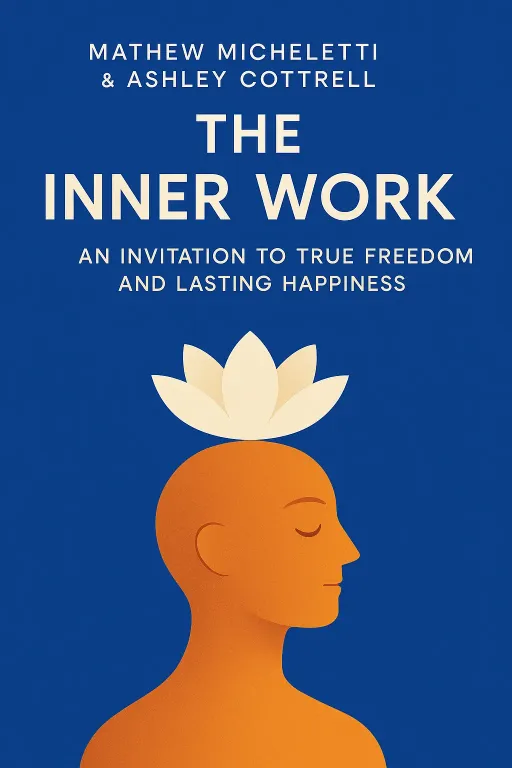
Nova: Imagine finally landing that dream promotion, scaling your business to seven figures, or securing that prestigious consulting contract, only to sit at your desk and feel an overwhelming sense of... emptiness. Why is it that the peak of external success so often triggers our deepest internal slumps? Today, we are diving into the transformative book, by Mathew Micheletti and Ashley Cottrell. We are going to tackle this profound guide from three distinct angles. First, we will look at the illusion of external achievements and why our minds are wired to resist true happiness. Second, we will explore the science of consciousness frequencies and how our inner state literally shapes our outer reality. And finally, we will discuss practical, strategic tools to dismantle the ego's defense mechanisms so you can lead and scale your life from a place of absolute alignment. Joining me today is Kehinde Olayiwola, a business administration professional who is passionate about leadership, strategy, and helping organizations grow. Kehinde, it is so wonderful to have you here with us!
Kehinde Olayiwola: Thank you, Nova! It is absolutely fantastic to be here. You know, when I first picked up this book, I was immediately struck by how deeply these spiritual concepts connect to the practical world of business and leadership. In consulting and strategy, we talk so much about scaling systems, optimizing processes, and hitting targets. But we rarely talk about scaling the behind those systems. This book really challenges us to look at the ultimate foundation of any enterprise, which is our own consciousness.
Nova: Oh, I love that so much! "Scaling the leader." That is such a powerful way to frame this. Because, let's be honest, we have all been on that roller coaster, right? We think, "Once I get this certification, or once we hit this revenue milestone, then I will finally be happy and secure." But the book argues that this is actually the ultimate spiritual trap.
Kehinde Olayiwola: It really is. In business terms, we might call it a flawed KPI—a key performance indicator that is measuring the wrong thing entirely. We are measuring external outputs to try and fix an internal input problem. The authors point out that when we rely on external achievements for our joy, we are setting ourselves up for a constant come-down. The elation passes, the pendulum swings back, and we are left chasing the next high. It is an unsustainable business model for the soul!
Deep Dive into Core Topic 1
SECTION
Nova: An unsustainable business model for the soul! That is brilliant, Kehinde. And the book actually shares a really poignant perspective on this. They talk about how, throughout history, some of the wealthiest, most famous, and highly decorated figures have publicly admitted to experiencing profound loneliness and sadness at the very top of their careers. They achieved everything society told them to strive for—wealth, fame, titles, exotic travel—yet the inner void remained. It is like they climbed the ladder of success, only to realize it was leaning against the wrong wall.
Kehinde Olayiwola: Exactly. And as an analytical thinker, I look at the cause-and-effect chain there. The cause is the belief that happiness is a commodity to be acquired from the outside. The process is the relentless pursuit of these external markers, which does give us a temporary dopamine hit. But the outcome is inevitably a crash, because external circumstances are inherently volatile and temporary. If your self-worth is tied to your market share or your job title, what happens when the market shifts? You lose your sense of self. The book is inviting us to build a recession-proof inner economy.
Nova: A recession-proof inner economy! I am writing that down, that is gold! But here is the tricky part, and the book goes deep into this in Chapter One: our minds actually this shift. It is almost like our brains have a built-in defense mechanism against feeling genuinely peaceful and worthy. Have you ever noticed how, when you try to practice positive affirmations or tell yourself "I am worthy of success," a little voice inside immediately starts arguing with you?
Kehinde Olayiwola: Oh, absolutely. The mind is a master debater! The book explains that the ego-mind has created an identity that is actually attached to suffering and limitation. It is comfortable playing small because playing small feels safe and predictable. When we introduce optimistic affirmations like "I am pure love" or "I am completely secure," the mind reacts defensively. It dismisses them as silly or irrelevant, or it distracts us. It is trying to protect the old, familiar operating system, even if that system is full of bugs and causing us to crash.
Nova: Yes! It is like the mind is terrified of losing control. It wants to keep playing the role of the victim or the stressed-out overachiever because it knows how to navigate those roles. If we suddenly accept that our peace and joy do not depend on external factors, the ego loses its job! It doesn't know what to do with itself if it isn't constantly putting out fires or striving for the next thing.
Kehinde Olayiwola: That is a crucial point for leaders and consultants to understand. We often pride ourselves on being problem solvers. But if our entire identity is wrapped up in "the problem solver," we might unconsciously create or seek out problems just to maintain our sense of worth. We become addicted to the stress and the chaos because it makes us feel important. The inner work is about stepping back and realizing, "I am the observer of these thoughts, not the thoughts themselves."
Nova: That is such a radical shift in perspective. It reminds me of that wonderful quote by Carl Jung that the authors highlight: "Who looks outside, dreams; who looks inside, awakes." When we are constantly looking outside, we are essentially walking through life in a dream state, reacting to every market fluctuation, every email, every minor delay as if it is a matter of life and death. But when we look inside, we wake up to our true power.
Kehinde Olayiwola: And that awakening is where true strategic clarity comes from. When you are not operating from a place of fear, lack, or the need for constant validation, you can make decisions based on objective reality and long-term vision, rather than short-term ego gratification. You stop reacting and start responding.
Deep Dive into Core Topic 2
SECTION
Nova: That transition from reacting to responding is the perfect bridge to our second core topic: the science of consciousness and how these different states actually function. The book introduces this fascinating idea that our thoughts and emotions are not just abstract concepts; they are actually vibrating energy frequencies. And they bring in some really cool scientific and medical concepts to back this up. For instance, they talk about Dr. Masaru Emoto's famous water crystal experiments. Kehinde, did you find that as mind-blowing as I did?
Kehinde Olayiwola: Yes, the water crystal study is a beautiful, visual representation of this concept. For those who might not be familiar, Dr. Emoto exposed water samples to different vibrational frequencies—things like positive words, classical music, and loving thoughts, as well as negative words, heavy metal music, and angry thoughts. He then froze the water and photographed the crystals under a microscope.
Nova: And the results were just stunning, right?
Kehinde Olayiwola: Absolutely. The water exposed to high-frequency, positive intentions formed incredibly beautiful, symmetrical, and complex geometric crystals. But the water exposed to low-frequency, negative intentions formed completely distorted, asymmetrical, and chaotic shapes. Now, if you think about the fact that the human body is made up of about sixty percent water, and our planet is covered in it, the implications of this are staggering. Our dominant thoughts and emotional frequencies are literally structuring the physical matter of our bodies and our environments.
Nova: It is just incredible to think about. If we are constantly vibrating at the frequency of fear, worry, or anger, we are literally creating disharmony within our own physical systems. And the book connects this to neuroscience as well, showing how our emotional states trigger specific neurochemical responses.
Kehinde Olayiwola: Right, this is where the science gets very concrete. When we dwell on fearful, stressful, or aggressive thoughts, our brain releases stress hormones like cortisol and adrenaline. Over time, our bodies can actually become addicted to these high-stress chemical cocktails. We get a strange sort of comfort from feeling stressed because it is what our neurochemistry is used to. On the flip side, cultivating gratitude, optimism, and peace releases endorphins and oxytocin, which promote healing, creativity, and resilience.
Nova: It is like we have to literally rewire our brains to crave peace instead of stress! And this ties in so beautifully with another medical phenomenon mentioned in the book: the placebo effect. We have all heard of it, but when you really think about what it represents, it is mind-boggling. A patient is given a simple sugar pill or a saline injection, but because they they are receiving a powerful medication, their body actually triggers a physiological healing response and their symptoms improve.
Kehinde Olayiwola: It is the ultimate proof of the mind-body connection. The turning point in the placebo effect is not the physical pill; it is the patient's belief and faith. Their consciousness shifts from a state of "I am sick and helpless" to "I am receiving help and I am healing." That internal shift in belief completely alters their physical reality. In business and consulting, we often talk about the power of mindset, but this shows that mindset isn't just a motivational concept—it is a biological and physical force.
Nova: Exactly! It is a force that we can consciously direct. But to do that, we have to understand the different "themes of consciousness" that the book outlines. They describe these themes as lenses through which we view the entire world. And they use a brilliant, practical example to show how this works: the concept of debt and credit. I thought this was such a clever way to illustrate how our inner frequency changes our outer experience of the exact same situation.
Kehinde Olayiwola: Yes, this example is incredibly relevant for anyone managing finances or running a business. The authors show how a financial situation like being in debt is experienced completely differently depending on your dominant theme of consciousness. For instance, if someone is operating in the frequency of, they view debt as proof of their absolute worthlessness, which can lead to devastating feelings of hopelessness. If they are in, they become obsessed with blame, projecting anger onto credit card companies or the economy.
Nova: Right, and if they are in, they are paralyzed by worst-case scenarios, imagining bankruptcy and ruin. But look at how that shifts as we move up the scale of consciousness!
Kehinde Olayiwola: Exactly. When you reach the frequency of, the entire dynamic changes. Instead of feeling like a victim, you take accountability. You look at the debt objectively and say, "Okay, this is the current reality. What is my strategic plan to repay this?" And if you elevate even further, to a state of, you actually view credit with gratitude. You appreciate that these funds were available to support you, and you maintain faith and focus on abundance, trusting that the resources to repay it will flow to you. The debt itself hasn't changed, but your relationship to it has transformed from a source of suffering into an opportunity for growth and responsibility.
Nova: That is such a powerful shift! It shows that we are never truly victims of our circumstances; we are only ever victims of our state of consciousness. If we can change the frequency we are operating from, the entire problem-solving process becomes lighter, more creative, and infinitely more effective.
Kehinde Olayiwola: It really does. And it highlights why the mind is, as the saying goes, "a wonderful servant, but a terrible master." When we let our unexamined thoughts and fears run the show, we are trapped in low-frequency cycles. But when we use our awareness to observe our thoughts, we reclaim our power. We can choose which thoughts to feed and which ones to let go of.
Synthesis & Takeaways
SECTION
Nova: Oh, absolutely. This has been such a rich conversation, Kehinde. As we start to wrap up, let's synthesize some of these major takeaways. If you had to boil down the core message of for someone who is looking to grow, scale their business, or step into a higher level of leadership, what would that be?
Kehinde Olayiwola: I think the ultimate takeaway is that true, lasting success and happiness can never be achieved by manipulating external circumstances. It is an inside-out job. As leaders, consultants, and professionals, we must commit to the daily practice of self-inquiry and self-compassion. We need to become vigilant observers of our own minds, identifying when we are operating from fear, pride, or the need for validation, and consciously choosing to realign with courage, acceptance, and peace. When we scale our inner capacity, our outer success naturally scales to match it.
Nova: That is beautifully put. The hero's journey is truly an internal one. The book reminds us that every challenge, every trigger, and every setback we face in our professional or personal lives is not a punishment, but an invitation to awaken. It is a mirror showing us where we are still holding onto limiting beliefs and where we have the opportunity to grow.
Kehinde Olayiwola: Absolutely. And for our listeners today, I would challenge you to take one practical step. The next time you feel triggered—whether it is a delayed project, a difficult client, or a financial stressor—don't immediately rush to fix the external problem. Take a pause. Step back and ask yourself: "What frequency am I operating from right now? What is the limiting belief my mind is trying to protect?" Start there. Address the internal state first, and then take strategic action from a place of clarity and peace.
Nova: What a powerful, actionable challenge! Thank you so much, Kehinde, for sharing your incredible insights and your strategic perspective with us today. This has been an absolutely elevating conversation.
Kehinde Olayiwola: Thank you, Nova. It has been an absolute pleasure. Remember, everyone, the greatest service you can render to the world, and to your business, is your own self-realization.
Nova: Beautifully said. And to all our listeners, thank you for tuning in. Remember to look within, embrace the journey, and we will see you in the next episode!