The Art of Reclaiming Your Time and Boundaries
Golden Hook & Introduction
SECTION
Nova: The most expensive thing you are currently buying is not the subscription service you forgot to cancel or the takeout you ordered last night. It is the time you are spending on tasks that do not move the needle for your life, your career, or your happiness. We have reached a point where being busy is treated as a badge of honor, but most of that activity is just noise masking a lack of direction.
Atlas: That is a brutal way to start the conversation, but I cannot argue with it. We live in this culture where if you are not drowning in emails or back-to-back meetings, people assume you are not working hard enough. It is almost like we are addicted to the feeling of being overwhelmed because it validates our existence.
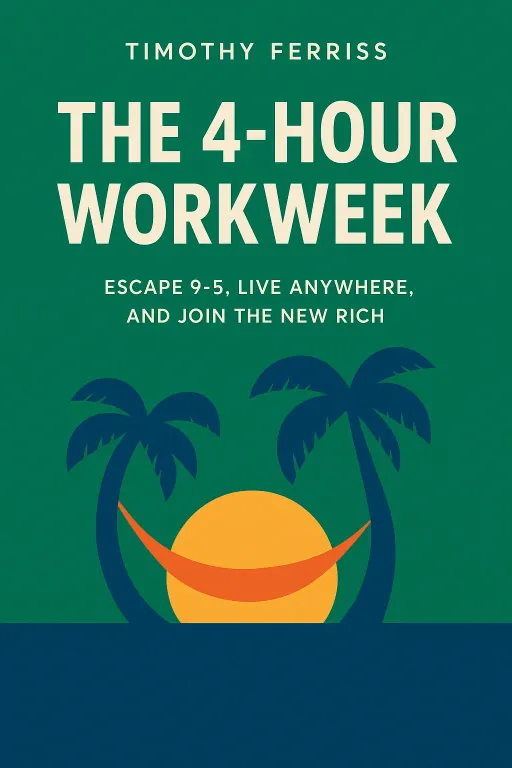
Nova: Exactly. And that is why today we are looking at two very different, but deeply complementary, approaches to fixing this. We are diving into the strategies from The 4-Hour Workweek by Tim Ferriss, which is all about ruthless efficiency, and pairing that with the psychological insights from The Joy of Saying No by Natalie Lue.
Atlas: Those feel like two different worlds. One sounds like a high-octane manual for hacking your life, and the other sounds like a gentle guide to therapy. How do those even fit together in the same conversation?
Nova: That is the best part. You see, Tim Ferriss burst onto the scene back in 2007 with this concept that felt almost radical at the time, arguing that we should be designing a life that allows for freedom rather than just grinding until retirement. It became the bible for the digital nomad movement and remote work culture. But you can build all the systems you want to automate your life, and you will still be miserable if you cannot say no to the wrong things. Natalie Lue’s work fills that gap by addressing the emotional wiring—the people-pleasing—that keeps us trapped in those busy-work cycles to begin with.
Atlas: I see where you are going. You can have the most efficient, automated, streamlined schedule in the world, but if you are psychologically incapable of turning down a request, you will just fill that efficiency with more obligations.
Nova: Precisely. Let’s break down how we can actually reclaim our autonomy.
The Efficiency Trap and the DEAL Framework
SECTION
Atlas: Okay, so let’s start with the hard-hitting stuff. Ferriss and his DEAL framework. I have heard the title thrown around for years, but people usually misunderstand it. They think it is literally about working four hours a week. What is the core reality behind that?
Nova: It is not about working four hours; it is about the end of the industrial-age mindset where time equals money. DEAL stands for Definition, Elimination, Automation, and Liberation. The most transformative piece of that puzzle is the Elimination phase. Ferriss argues that most of what we do is actually a waste of time, and he uses the Pareto Principle—the 80/20 rule—to prove it.
Atlas: Remind me how that applies to a regular workday. Most people feel like every email and every meeting is essential. If I start deleting 80 percent of my tasks, I am pretty sure my boss will fire me by noon.
Nova: That is the fear, right? But the Pareto Principle suggests that 80 percent of your results come from 20 percent of your efforts. When you look at your to-do list, most of those items are just filler. They are tasks you do to feel productive, not to be effective. Ferriss suggests identifying the few things that actually drive your biggest outcomes and then ruthlessly cutting, delegating, or ignoring everything else.
Atlas: I have seen this happen in practice. Think about a project manager who spends three hours a day updating a spreadsheet that no one reads, versus the one hour they spend actually unblocking their team. If they cut the spreadsheet, they save two hours. But why is it so hard to just stop doing the low-value stuff?
Nova: Because of the psychological weight. That is where we hit the first roadblock. We equate activity with productivity. If I am typing, if I am in a meeting, if I am responding to a Slack notification within ten seconds, I feel like a "good" worker. Stopping that activity feels like stopping progress. It feels dangerous.
Atlas: That resonates. It is the fear of being seen as lazy. But what about the "Automation" part of the DEAL framework? Is that realistic for someone who isn't a tech entrepreneur?
Nova: It is more accessible than people think. Automation is about creating rules or processes so that a task doesn't require your brain power. It could be as simple as an email template for questions you get asked every day, or a calendar filter that auto-declines meetings without an agenda. The goal is to remove the need for your active decision-making. If you are deciding whether to reply to an email, you have already lost. The system should decide for you.
Atlas: Okay, but let’s play devil’s advocate. If I automate my email and delegate my tasks, I am just pushing that work onto someone else or ignoring people who might be important. Does this approach not eventually lead to a sense of isolation or just being seen as difficult to work with?
Nova: That is a fair critique, and it is a common concern. But look at it this way: the goal is not to be a ghost. The goal is to maximize your contribution. If you are constantly distracted by low-value tasks, you are not actually serving the people you work with, because your work is diluted. By focusing on the high-value areas, you are actually more present and more effective when it matters.
Atlas: So, it is about quality over quantity. That makes sense. But there is a missing link here. Even if I know what my 20 percent is, and I know I should automate the rest, I still have to look my manager or my client in the eye and say, "I am not doing that." And that brings us to the second part of our discussion.
The Psychology of Saying No
SECTION
Nova: Exactly. And that is why Natalie Lue’s The Joy of Saying No is the perfect counterpart to Ferriss. You can have the best efficiency strategies, but if your internal wiring tells you that saying "no" makes you a bad person, you will never use them.
Atlas: I have always been fascinated by why we struggle with this. We act like saying "no" is a moral failure. Where does that come from?
Nova: Lue dives deep into what she calls the "Good Girl" or "Good Boy" syndrome. It is this deeply ingrained belief that our value is tied to our helpfulness. If we are not helping, if we are not absorbing someone else’s problem, then we are not valuable, or worse, we are selfish. We start to equate boundaries with being mean.
Atlas: That is a powerful distinction. We think boundaries are a wall meant to keep people out, but they are actually just a fence that defines where we end and someone else begins. But how does that manifest in a professional setting? It is not just about being "nice."
Nova: It shows up as "chronic availability." It is the person who answers emails at 9:00 PM because they are terrified that if they don't, they are failing. It is the person who agrees to take on an extra project they don't have the capacity for, just because they are afraid to disappoint. Lue argues that this isn't kindness; it is actually a form of people-pleasing that eventually leads to resentment.
Atlas: Wait, let’s unpack that. How is people-pleasing a form of resentment? That sounds counterintuitive.
Nova: Think about it. You say yes to a request you don't want to do. You do it, but you are exhausted, irritated, and maybe you do a mediocre job because you are spread too thin. You are now resentful toward the person who asked, and they are getting a stressed-out version of you. If you had just said "no" at the start, you could have maintained a healthy relationship. By saying "yes" to keep the peace, you actually damage the relationship in the long run.
Atlas: That is a harsh reality check. We think we are preserving the peace, but we are actually just delaying the conflict and making it worse. But how do you actually say "no" without burning bridges? Especially if you are in a position where you have to answer to someone else?
Nova: The key is shifting from a "defensive" no to a "value-driven" no. A defensive no is "I can't do this, I'm sorry." It sounds like an excuse. A value-driven no is "I would love to help, but given my current priorities on Project X, I won't be able to give this the attention it needs." You are not rejecting the person; you are protecting the quality of the work.
Atlas: I like that framing. It turns the "no" into a professional decision rather than a personal rejection. But what about the guilt? You can know the strategy, but when you are sitting there about to hit send on that email, the guilt is still there.
Nova: The guilt is just a signal. It is your conditioning talking. Lue suggests that you have to sit with the discomfort. The first time you say "no" to a request you would have normally accepted, you will feel anxious. Your brain is essentially having a withdrawal reaction from the dopamine hit of being a "helper." You have to recognize that the anxiety is temporary, but the relief you get from having your time back is lasting.
Atlas: It sounds like we are talking about two different types of freedom. Ferriss is talking about freedom from, and Lue is talking about freedom from.
Nova: That is a perfect synthesis. One gives you the map, and the other gives you the courage to walk the path. If you use the DEAL framework to identify what you should be doing, and you use boundary-setting to protect that space, you are not just managing your time—you are reclaiming your life.
Synthesis & Takeaways
SECTION
Atlas: This brings us back to the question we posed at the beginning. "Which task or commitment are you currently keeping solely out of a sense of obligation, and how would freeing yourself from it change your energy levels this week?" I have been thinking about that while we were talking. I think for a lot of people, it is those recurring meetings that have no clear purpose. We go because we were invited, and we feel like we have to be there to be "seen."
Nova: That is the perfect example. It is a dual failure. It is an inefficiency because you are losing an hour of deep work, and it is a boundary failure because you are too afraid to ask, "Do I really need to be here?"
Atlas: So, for our listeners, the challenge is to take one thing—just one—this week. A task, a meeting, a commitment. And apply the DEAL framework to it. Eliminate it, or delegate it, or automate it. But more importantly, use the boundary-setting mindset to communicate that change.
Nova: And remember what we discussed about the "Good Girl/Boy" syndrome. If you feel that spike of guilt when you say "no," acknowledge it, but don't let it dictate your actions. That guilt is just a habit. It is not an objective truth about your worth as a person.
Atlas: It is about moving from being a "fixer" for everyone else to being an "architect" of your own time. I think that is the real takeaway here. Efficiency without boundaries is just a faster way to burnout.
Nova: That is beautifully put. Efficiency without boundaries is just a faster way to burnout. You can optimize your life all you want, but if you don't know how to protect your energy, you will just find more efficient ways to exhaust yourself.
Atlas: I am definitely going to look at my calendar differently tomorrow. I have a few recurring meetings that are definitely going to get the "Elimination" treatment.
Nova: Give it a try. The worst thing that happens is you find out you were not as indispensable as you thought, which—let’s be honest—is actually quite liberating.
Atlas: I love that. It takes the pressure off to realize that the world keeps spinning even if I don't attend that status update meeting.
Nova: Exactly. And that is the freedom we are all looking for. Thank you for diving into this with me. It is a constant practice, not a one-time fix.
Atlas: Absolutely. It is a muscle that you have to keep building. Thanks for the breakdown, Nova.
Nova: My pleasure. This is Aibrary. Congratulations on your growth!