Personalized Podcast
Golden Hook & Introduction
SECTION
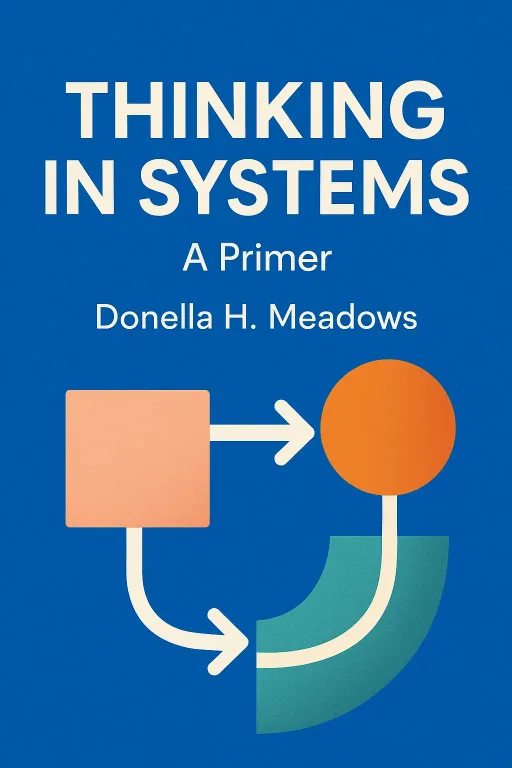
Nova: If you hold a Slinky in your hand, stretch it out, and then let go of the bottom... what makes it bounce? Your hand, right? Well, actually, no! Your hand just released the energy. The bouncing behavior is entirely built into the Slinky’s internal structure. Now, think about your business. When a market crisis hits, is the chaos caused by the external shock, or was it already waiting to happen, built right into your organizational structure? Welcome to the show! Today, we are diving into Donella Meadows' groundbreaking masterpiece,. And we are incredibly excited to have a world-class entrepreneur and leadership expert with us today. He manages a gold sales company, is an alumnus of the Aspire Institute leaders program at Harvard, and is deeply passionate about networking and leadership. Welcome, Aboubacar Bald!
Aboubacar Baldé: Thank you, Nova! It is an absolute pleasure to be here. You know, that Slinky example really hits home for me. In the gold industry, we often see massive price fluctuations or supply chain disruptions, and the immediate reaction for most managers is to blame the market. They say, "Oh, the market is volatile, it's out of our hands!" But Meadows' book challenges us to look inward. It asks: how is our internal system structured to handle that volatility? Are we built like a Slinky that bounces uncontrollably, or have we designed a system that absorbs the shock?
Nova: Oh, I love that! It's like we're shifting from being reactive victims of our environment to active designers of our destiny. Today, we're going to tackle this book from three key angles. First, we'll explore why your business's internal structure—not external forces—determines your success, using the classic Slinky and car dealer examples. Second, we'll look at the dangerous trap of escalation and how information flow can be your secret leverage point. And finally, we'll focus on what it means to truly "dance" with a system as a modern leader. So, Aboubacar, let's start with this idea of "messes." Russell Ackoff, whom Meadows quotes, says that managers don't solve isolated problems; they manage "messes"—complex systems of changing, interacting problems. How does that resonate with your experience running a gold sales company?
Aboubacar Baldé: It resonates completely. In entrepreneurship, you never have a single, isolated problem. If sales are down, it’s not just a "sales problem." It’s interconnected with your marketing, your supply chain, your team's morale, and even global macroeconomic trends. If you try to solve it by just pushing the sales team harder, you might end up burning them out, which worsens customer service, which then drops sales even further! That is a classic "mess." Systems thinking teaches us to stop looking at the parts in isolation and start looking at the relationships between them.
Deep Dive into Core Topic 1: Structure Dictates Behavior
SECTION
Nova: Exactly! And to understand those relationships, Meadows introduces us to the fundamental building blocks of any system: stocks, flows, and feedback loops. Think of a stock as a bathtub. The water in the tub is the stock. The faucet pouring water in is the inflow, and the drain letting water out is the outflow. Your goal as a leader is to keep the water level—your inventory, your cash flow, your talent pool—at a stable level. But here is where it gets tricky: feedback loops. Meadows shares this incredible case study about a car dealer managing inventory. Let's paint a picture of this. Imagine a car dealer who has a steady demand of, say, twenty cars a week. They keep a stock of sixty cars on the lot. Suddenly, demand jumps to twenty-two cars a week. A tiny, ten percent increase. What happens next?
Aboubacar Baldé: Well, naturally, the dealer notices the inventory dropping. But there's a delay, right? It takes time to perceive the change, order new cars, and have them delivered. This is where the "learning person" in the system tries to adjust. The dealer wants to get back to that sixty-car buffer. But because of the delays, they might overcompensate. They order more cars to make up for the shortfall. But by the time those cars arrive, demand might have shifted again, or they suddenly find themselves flooded with too many cars.
Nova: Yes! And Meadows shows that if the dealer tries to fix this by simply "acting faster"—like shortening their reaction time, trying to order and replenish in two days instead of three—the system actually goes wild! The oscillations in the inventory level become much more severe. The graph in the book shows the inventory swinging wildly from near zero to over five hundred cars! Acting faster actually makes the oscillations worse. Isn't that completely counterintuitive?
Aboubacar Baldé: It is incredibly counterintuitive, but it makes perfect sense when you understand feedback loops. When you speed up your reaction time without addressing the underlying delays in the rest of the system—like delivery times or customer perception—you end up overreacting to short-term noise. In my gold business, if we react to every single daily fluctuation in gold prices by instantly changing our purchasing or sales strategies, we would create absolute chaos for our team and our clients. We would be constantly chasing our tails.
Nova: Right! It's like oversteering a car on an icy road. You slide a bit to the left, so you violently yank the wheel to the right, and suddenly you're spinning out of control. The problem isn't the road; it's your delayed and exaggerated feedback response.
Aboubacar Baldé: Exactly. And as a leader, you have to ask: "What is the delay in my system?" Is it a perception delay—the time it takes to get accurate data? Or is it a response delay—the time it takes to execute a decision? If you don't understand these delays, your attempts to "optimize" will actually destabilize the business. You have to change the structure of the system, not just push the buttons faster.
Deep Dive into Core Topic 2: Escalation Traps and Information Leverage
SECTION
Nova: That is such a powerful insight. And speaking of system structures that go out of control, let's talk about one of the most common and dangerous system traps Meadows outlines: the Escalation Trap. This happens when the state of one stock is determined by trying to surpass the state of another stock, and vice versa. It creates a reinforcing feedback loop that spirals upward exponentially. Meadows uses several examples, like a kids' fight where each hit gets harder, or peacekeeping in violence-prone areas. But for business leaders, the classic example is the Advertising War. Let's say we have two competing soda companies, ColaCo and FizzUp.
Aboubacar Baldé: Ah, yes. The classic marketing arms race. ColaCo launches a new TV ad campaign to grab market share. FizzUp sees their sales dip slightly, so they respond with an even more expensive Super Bowl ad. ColaCo feels threatened, so they launch a series of aggressive attack ads. Before you know it, both companies are spending millions of dollars on advertising just to maintain their original market share! Their profit margins are eroded, and neither is actually better off. It’s a race to the bottom.
Nova: It really is! And Meadows points out that if nothing is done, this spiral will only stop when one of the players collapses, because exponential growth cannot go on forever. So, Aboubacar, as a business leader, how do we get out of this trap? What does systems thinking suggest?
Aboubacar Baldé: Meadows offers two main ways out. The first is unilateral disarmament. You simply refuse to compete in that specific loop. You say, "We are not going to play this game." Now, in business, that sounds terrifying. It sounds like giving up. But in reality, it frees up your resources to invest in a completely different system—like product quality, customer experience, or a niche market where the competitor can't follow. You break the loop by stepping out of it.
Nova: That takes immense courage and strategic clarity. What's the second way?
Aboubacar Baldé: The second way is negotiated disarmament. This is a structural change where you design a new system with balancing loops to control the escalation. Think of government regulations on advertising, or in sports, salary caps. In the business world, it could be an industry agreement or a shared standard. It’s about creating boundaries so the competition doesn't destroy the entire ecosystem.
Nova: That is fascinating. It's about designing the rules of the game so that the system itself remains healthy. And that brings us to one of the most exciting concepts in the book: leverage points. These are places within a system where a small shift in one thing can produce big changes in everything. Meadows lists several leverage points, but one of the most surprisingly powerful ones is the flow of information. She tells this amazing story about the Toxic Release Inventory in the United States back in 1986.
Aboubacar Baldé: Oh, this is a brilliant example of information leverage. The US government passed a law requiring companies to report the exact amount of hazardous air pollutants their factories emitted every year. This data wasn't a tax, and it didn't come with immediate fines or new emission limits. It was simply made public.
Nova: Right! It was just information. But local newspapers started publishing lists of the "top ten local polluters." Suddenly, the CEOs of these companies saw their names in the paper associated with toxic waste. The public was outraged. And what happened? Within just two years of the data release, chemical emissions nationwide decreased by forty percent! Some companies even launched policies to reduce their emissions by ninety percent, purely to protect their public image. No new laws were passed, no fines were levied—just the flow of information was redirected.
Aboubacar Baldé: That is the power of a high-leverage intervention. By simply introducing a new feedback loop—making the information transparent and direct to the people who cared—the system self-organized to solve the problem. In business leadership, we often try to fix problems by adding more rules, more managers, or more punishments. But often, the highest leverage lies in simply making information transparent. If you want to improve customer service, don't just write a manual; make customer feedback visible to everyone in the company in real-time. If you want to improve sales, make the pipeline data transparent. Information is a catalyst for self-organization.
Deep Dive into Core Topic 3: Dancing with Systems
SECTION
Nova: Yes! "Information is a catalyst for self-organization." That is a quote-worthy insight, Aboubacar! And it leads us beautifully into our final section. Meadows concludes her book not with rigid formulas or mathematical models, but with a philosophy she calls "Dancing with Systems." She writes, "We can’t control systems or figure them out. But we can dance with them!" This is such a humble and beautiful way to look at leadership. She shares the story of Nathan Gray, an aid worker in Guatemala.
Aboubacar Baldé: Yes, Nathan Gray's story is a masterclass in systems wisdom. Many aid agencies were coming into Guatemala trying to create jobs by bringing in outside investors and building big factories. They were trying to impose an external structure on the community. But Nathan Gray did something different. He sat down in the local market, talked to the people, and actually observed the existing system. He realized the community didn't need a massive, foreign-owned factory. They already had a thriving entrepreneurial spirit! What they lacked were small loans at reasonable interest rates, and basic classes in literacy and accounting. By supporting the existing, self-organizing local system rather than trying to force a new one, he created sustainable, long-term economic growth.
Nova: That is so beautiful. He listened to the wisdom of the system. He didn't try to be the "hero" who fixes everything; he became a partner who empowers the system to run itself. Meadows also talks about the danger of centralizing control, and she uses the hilarious example of the Dartmouth College thermostats.
Aboubacar Baldé: Haha, yes! Dartmouth decided to save energy by removing individual thermostats from offices and classrooms, putting all temperature control under a single, centralized computer. So, if a professor was freezing, they couldn't just turn a dial. They had to call an administrative office across campus. The office would log the request, send it to the computer, and hours—sometimes days—later, the temperature would adjust, often overcorrecting and making the room boiling hot!
Nova: It's the car dealer inventory problem all over again! By centralizing control, they introduced massive delays and broke the local feedback loop. The people experiencing the problem had no power to fix it, and the people with the power had no immediate feedback on the consequences of their actions.
Aboubacar Baldé: Exactly. It completely destroyed intrinsic responsibility. As a business leader, this is a massive warning. When you grow your company, the temptation is to centralize everything—to make every decision go through the CEO's office. But when you do that, you create a bottleneck. You introduce delays, and you disempower your team. Systems thinking teaches us to locate responsibility where the feedback is most direct. Give the people on the front lines the information and the authority to make adjustments. That is how you build a resilient, agile organization.
Synthesis & Takeaways
SECTION
Nova: This has been such an incredibly rich conversation, Aboubacar. We've journeyed from the bouncing Slinky to the wild swings of the car dealer's inventory, escaped the clutches of the Escalation Trap, unlocked the power of information leverage, and learned how to dance with systems rather than trying to dominate them. If you had to synthesize all of this into one core piece of advice for business leaders who want to be at the top of their game, what would it be?
Aboubacar Baldé: I would say: embrace humility and become a continuous learner. Meadows has this wonderful quote: "'Stay the course' is only a good idea if you’re sure you’re on course." In a complex, fast-changing world, our mental models are always incomplete. The best leaders are not the ones who claim to have all the answers and try to force their will on the market. The best leaders are the ones who stay curious, who expose their own assumptions, who honor and distribute information, and who are willing to listen to the system and adapt. Leadership is not about control; it's about stewardship. It's about designing healthy structures and then learning to dance with them.
Nova: "Leadership is not about control; it's about stewardship." What a perfect note to end on. Aboubacar, thank you so much for sharing your incredible insights and entrepreneurial wisdom with us today. This has been an absolute joy.
Aboubacar Baldé: Thank you, Nova. It was an honor. I hope everyone listening goes out and starts dancing with their own systems!
Nova: And to our listeners, we leave you with this question to ponder: Where in your business or your life are you trying to force control, when you should really be listening, learning, and redesigning the system? Until next time, keep thinking in systems, and keep dancing!