Debugging the World: Why Systems Thinking is the Ultimate Developer Mindset
Golden Hook & Introduction
SECTION
Dr. Celeste Vega: Imagine you are debugging a complex piece of code. You find an error, patch it, and celebrate. But five minutes later, three new bugs pop up in a completely different module. You patch those, and suddenly the database crashes. You are not dealing with isolated errors here. You are trapped in what systems theorist Russell Ackoff called a mess, an interconnected web of dynamic problems. Today, we are looking at how to stop chasing symptoms and start understanding the underlying architecture of our systems and our lives. Welcome to the podcast. I am Dr. Celeste Vega, and joining me today is Jayasree, a software engineer who is looking to upgrade her problem-solving mindset. Welcome, Jayasree.
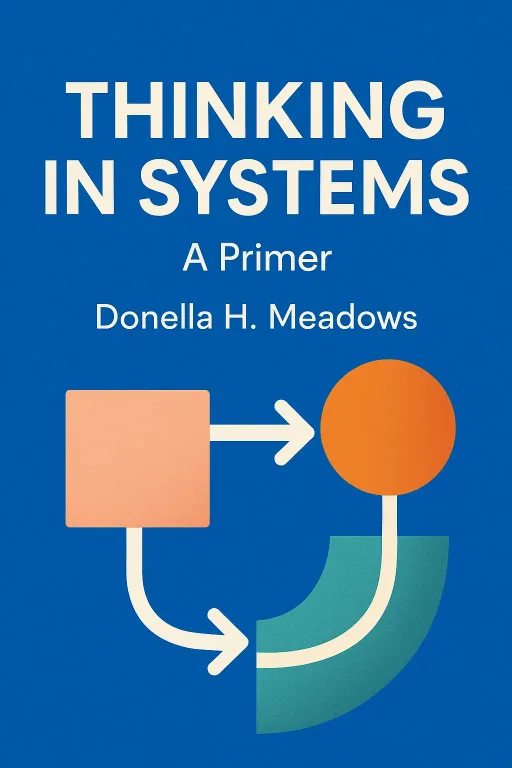
Jayasree: Thanks, Celeste. I am so excited to be here. Honestly, that debugging scenario you just described is my actual life. As a junior developer, it is so easy to get caught in this loop of just memorizing syntax or trying to fix individual lines of code without seeing how everything connects. When I read Donella Meadows' Thinking in Systems, it felt like a light bulb went off. I realized I need to stop looking at code as just a list of instructions and start seeing it as a living, breathing system.
Dr. Celeste Vega: That is exactly the shift Meadows is advocating for. Today, we are going to tackle this book from three different angles. First, we will explore why a system's internal structure dictates its behavior, using a simple toy and an ancient parable. Then, we will look at the counterintuitive danger of reacting too quickly to problems, illustrated by a car dealership's inventory crisis. And finally, we will focus on how distributing information and localizing control can help us dance with complex systems instead of trying to dominate them. Ready to dive in?
Jayasree: Absolutely. Let us do it.
The Structure is the Code
SECTION
Dr. Celeste Vega: Let us start with a classic demonstration that Meadows uses in her classes. Imagine I am holding a Slinky, you know, that coiled metal toy, from the top. If I let go of the bottom, what happens?
Jayasree: Well, it bounces. It stretches out and then bounces up and down.
Dr. Celeste Vega: Right. Now, if I ask you, what made the Slinky bounce? What would you say?
Jayasree: Most people, including me, would probably say your hand. You let go of it, so you caused the bounce.
Dr. Celeste Vega: Exactly. That is our default, event-oriented way of thinking. We look for an external cause for every effect. But now, imagine I take a wooden box of the same weight, hold it the same way, and let go. What happens?
Jayasree: It just falls to the floor. It does not bounce at all.
Dr. Celeste Vega: Precisely. So, did my hand make the Slinky bounce? No. My hand merely released the Slinky. The bouncing behavior is inherent to the Slinky's internal structure, its coiled steel. The external event, releasing it, just unleashed that behavior. Meadows' core point here is that the system, to a large extent, causes its own behavior.
Jayasree: Wow. That is a really profound way to look at it. In software terms, we talk about inputs and outputs all the time. We think, if I send this API request, the system behaves this way because of the request. But what you are saying is that the request is just the trigger. The actual behavior, whether the system scales smoothly or crashes under load, is entirely determined by the internal architecture, the database schemas, the memory management, the interconnections we built into the backend.
Dr. Celeste Vega: Yes, you nailed it. The interconnections are key. Meadows defines a system as an interconnected set of elements organized to achieve something. If you only look at the elements, the individual lines of code or the individual servers, you miss the system. She illustrates this with the famous Sufi story of the blind men and the elephant. Have you heard that one?
Jayasree: I have, but remind me how she applies it to systems.
Dr. Celeste Vega: Well, the story takes place in a city where all the inhabitants are blind. A king arrives with a massive elephant. The blind men go to touch it to understand what it is. One touches the ear and says, this is a large, rough thing, wide and broad, like a rug. Another touches the trunk and says, no, it is a straight and hollow pipe, dread and destructive. A third touches the leg and says, it is a mighty pillar. They all argue, completely convinced they are right, but they are all wrong because they are only looking at isolated parts. Meadows uses this to show that the behavior of a system cannot be known just by knowing the elements of which it is made. You have to understand how those elements interact.
Jayasree: That resonates so deeply with how tech teams operate. You have the frontend team, the backend team, the database administrators, and the security team. Each team is like one of those blind men. They are looking at their own module, their own element. When a system-wide bug occurs, everyone says, well, my part is working perfectly, so the problem must be somewhere else. We fail to see the elephant, which is the end-to-end user experience and the data flow between our services.
Dr. Celeste Vega: That is a perfect application of the concept. When we debug in silos, we are using reductionist thinking. We try to break the system down into its smallest parts to fix it. And while reductionism is incredibly useful for understanding how individual components work, it is completely blind to the emergent properties of the whole system. You cannot understand a forest just by studying a single tree, and you cannot understand a complex software application just by looking at individual functions.
Jayasree: So, how do we start seeing the whole? How do we train ourselves to look at the interconnections instead of just the elements?
Dr. Celeste Vega: It starts by mapping out the stocks and flows. Meadows describes stocks as the memory of the system, the accumulations of physical or non-physical things over time, like water in a bathtub, inventory in a warehouse, or even self-esteem in a person. Flows are the inputs and outputs that change those stocks. By focusing on how stocks and flows are regulated by feedback loops, we can start to see the underlying structure that drives the behavior.
The Paradox of Fast Reactions
SECTION
Jayasree: That makes sense. But speaking of feedback loops, one of the most surprising parts of the book for me was the discussion on delays and how we react to them. I always thought that in software, and in life, the faster you react to a problem, the better. But Meadows shows that this is not always true, right?
Dr. Celeste Vega: Oh, absolutely. This is one of the most counterintuitive lessons in systems thinking, and she illustrates it beautifully with the story of a car dealer managing inventory. Let us walk through it step-by-step. Imagine a car dealership. The dealer likes to keep a steady stock of, say, one hundred cars on the lot. This is the stock. The inflow is the deliveries from the factory, and the outflow is the sales to customers. Now, let us say there is a sudden, unexpected ten percent increase in demand. Sales go up, and the inventory drops.
Jayasree: Okay, so the stock is decreasing. The dealer needs to order more cars to get back to that baseline of one hundred.
Dr. Celeste Vega: Exactly. But here is the catch: there are delays in the system. First, there is a perception delay. The dealer does not order a new car the second one is sold. They wait to see if this is a temporary fluke or a real trend. Let us say it takes them ten days to perceive the change. Second, there is a delivery delay. Once they place the order, it takes time for the factory to manufacture and ship the cars. Let us say that takes another twenty days.
Jayasree: So, there is a thirty-day delay between the sales spike and the new cars actually arriving on the lot.
Dr. Celeste Vega: Yes. Now, what happens if the dealer gets anxious about the empty lot and tries to fix the problem by reacting faster? Meadows ran simulations on this. If the dealer shortens the perception delay, meaning they react almost instantly to any change in inventory, it actually has very little impact on the system's stability. But, if the dealer tries to shorten their reaction time, meaning they try to aggressively make up for the shortfall by ordering massive batches of cars all at once to get back to one hundred in, say, two days instead of ten, the system goes wild.
Jayasree: Wait, why? Why does reacting faster make it worse?
Dr. Celeste Vega: Because of the delivery delay. The dealer orders a huge batch of cars. But because of the twenty-day delivery delay, those cars do not arrive immediately. The inventory keeps dropping in the meantime. The dealer panics and orders even more cars. Then, suddenly, the first massive order arrives, followed by the second massive order. Now, the lot is completely overflowing with five hundred cars. The dealer panics again, stops all orders, and waits. The inventory slowly depletes, drops below one hundred, and the cycle repeats. The system begins to oscillate wildly, swinging from zero cars to five hundred cars. Meadows literally wrote, acting faster makes the oscillations worse.
Jayasree: That is mind-blowing. The data from her simulation shows these massive, unstable waves. It is a complete systemic failure caused not by external forces, but by the dealer's own well-intentioned, rapid reactions.
Dr. Celeste Vega: Exactly. The external force was just a one-time, ten percent increase in demand. But the system's internal structure, specifically the combination of delays and aggressive feedback responses, turned that minor bump into a chaotic roller coaster.
Jayasree: This is so relevant to software engineering, especially when we talk about auto-scaling in cloud computing. Imagine you have a web server. Suddenly, there is a spike in traffic. The CPU usage goes up. If your auto-scaling policy is set to react too quickly, it might spin up ten new virtual machines immediately. But there is a boot-up delay. Those machines take a few minutes to become active. In the meantime, the CPU is still high, so the system spins up ten more. Once they all boot up, you suddenly have way too much capacity, your costs skyrocket, the traffic spike ends, and the system aggressively shuts them all down, causing the remaining servers to overload again. We call this thrashing. It is the exact same dynamic as the car dealer.
Dr. Celeste Vega: That is a brilliant connection, Jayasree. Thrashing is the perfect word for it. In both cases, the actor is trying to correct a discrepancy between the actual state and the desired state, but they are ignoring the inherent delays in the system. When you ignore delays, your corrective actions end up reinforcing the problem, creating these destructive feedback loops.
Jayasree: So, what is the solution? If acting faster makes it worse, how do we stabilize a system with delays?
Dr. Celeste Vega: You have to design buffers into the system, or you have to slow down your reaction rate to match the delay. In the car dealer's case, having a larger buffer of inventory, a larger safety stock, can absorb the temporary fluctuations in demand without triggering panic orders. Or, the dealer can accept that it takes thirty days to replenish stock and make smaller, more gradual adjustments. In software, this is why we use rate limiting, request queues, and cool-down periods in our auto-scaling algorithms. We intentionally introduce a delay in our reaction to match the physical reality of the system.
Designing Better Feedback Loops
SECTION
Jayasree: That makes so much sense. It is about understanding the rhythm of the system, or as Meadows says, getting the beat of the system before you try to change it. This leads perfectly into the third part of the book, which is about how we actually create change. Meadows talks about leverage points, places in a system where a small shift can produce big changes. And she emphasizes that the most powerful leverage points are often not what we expect.
Dr. Celeste Vega: Yes, she lists twelve leverage points, and near the top of the list, meaning they are highly effective but often resisted, are rules and information flows. Let us look at a story she tells about Dartmouth College, where she taught. The college wanted to save energy, so they decided to implement a centralized temperature control system. They removed the individual thermostats from offices and classrooms and put everything under the control of a central computer.
Jayasree: That sounds like a classic top-down management decision. How did it work out?
Dr. Celeste Vega: It was a disaster. Professors in one building would be freezing, while professors in another would be sweating. Because they had no local control, they could not adjust the temperature themselves. Instead, they had to call an office across campus to request an adjustment. That request would get delayed, and when the central computer finally reacted, it would often overcorrect, causing the rooms to swing from freezing to boiling. They created a system with massive delays and zero local responsiveness.
Jayasree: They broke the local feedback loop. In software, we see this all the time when organizations try to build massive, monolithic systems with centralized databases and tight coupling. If every single microservice has to go through a central coordinator for every decision, the whole system slows to a crawl, and you get these wild performance oscillations. It is much better to have decentralized, autonomous services that can react locally to their own environment.
Dr. Celeste Vega: Exactly. By centralizing control, Dartmouth removed the intrinsic responsibility of the people in the rooms. They distanced the decision-makers from the consequences of their actions. Meadows argues that we should locate responsibility in the system by designing feedback loops that provide direct, quick, and accurate information to the people making the decisions. She contrasts the Dartmouth failure with a massive success story: the Toxic Release Inventory, or TRI, enacted by the US government in 1986.
Jayasree: Oh, I remember reading about that. That was a fascinating case. Can you explain how that worked?
Dr. Celeste Vega: Yes, it is a beautiful example of using information as a leverage point. The law did not tell chemical companies how much pollution they could emit, nor did it impose fines or complex regulations. It simply required companies to report the exact amounts of hazardous chemicals they released into the environment each year, and made that data public.
Jayasree: Just reporting the data? No mandates?
Dr. Celeste Vega: Just reporting. But here is what happened: local newspapers started publishing lists of the top ten local polluters. Suddenly, the public, the customers, and the employees of these companies had access to this information. The feedback loop was completed. The companies, wanting to avoid negative publicity and protect their brand image, immediately started self-organizing to reduce their emissions. Within two years of the first data release, chemical emissions nationwide decreased by forty percent. Some companies launched policies to reduce their emissions by ninety percent, purely driven by public pressure.
Jayasree: That is incredible. They did not have to write complex laws or hire thousands of inspectors. They just restored the flow of information, and the system self-corrected. As a developer, this makes me think about the power of observability. If we do not have good logging, monitoring, and alerting in our applications, we are flying blind. But when we build dashboards that show real-time error rates and latency to the development teams, they naturally start optimizing the code. You do not need a manager telling them to fix it; the feedback loop itself drives the improvement.
Dr. Celeste Vega: Yes. Thou shalt not distort, delay, or withhold information. Meadows calls this the eleventh commandment of systems thinking. Information is the currency of feedback loops. When you withhold it, the system degrades. When you distribute it, the system self-organizes and heals.
Synthesis & Takeaways
SECTION
Jayasree: This has been such an eye-opening conversation, Celeste. It really changes how I view my role as a software engineer. I am not just writing lines of code; I am designing feedback loops and shaping system structures.
Dr. Celeste Vega: You really are, Jayasree. And that brings us to the ultimate lesson of the book, what Meadows calls dancing with systems. She writes that we cannot fully control or understand complex systems. Our mental models will always be incomplete. But we can interact with them with humility, curiosity, and adaptability.
Jayasree: I love that metaphor of dancing. It is so different from the traditional engineering mindset of control and predictability. In software, we often try to write perfect specifications and control every variable. But with complex, distributed systems and AI, that is impossible. We have to learn to experiment, monitor the feedback, and adapt. We have to stay humble and stay learners.
Dr. Celeste Vega: Exactly. Meadows says, stay the course is only a good idea if you are sure you are on course. In a dynamic world, we must be willing to change direction when the feedback tells us we are off track.
Jayasree: This is definitely going to change how I approach my learning goals. Instead of just memorizing frameworks or syntax, I am going to focus on understanding the underlying architecture and the feedback loops of the technologies I use. I want to build that deep, structural curiosity.
Dr. Celeste Vega: That is the best way to become a world-class problem solver, Jayasree. For our listeners out there, we want to leave you with a question to ponder: What is a persistent mess in your life or work that you have been trying to fix with quick, superficial patches? How might you shift your focus to the underlying structure and the feedback loops to find a true leverage point?
Jayasree: Thank you so much, Celeste. This was amazing.
Dr. Celeste Vega: Thank you, Jayasree. And to everyone listening, keep dancing with the systems around you. Until next time.