The Quantum Leap: Outlearning the Machines with abhi
Content
Content
Albert Einstein: -
Albert Einstein: -
Golden Hook & Introduction
SECTION
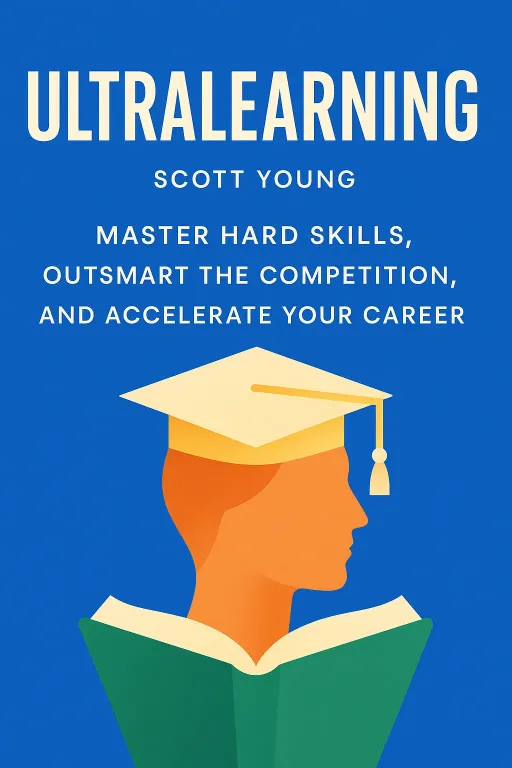
Albert Einstein: Imagine you are standing before a library that is expanding faster than the speed of light. Every single second, new shelves of artificial intelligence, quantum computing, and complex systems materialize out of thin air. How do you, a human being with a finite biological brain, avoid being buried under this avalanche of information? Today, we are cracking open Scott Young's masterpiece, Ultralearning, to discover how to build our own cognitive warp drives. We are going to tackle this book from three distinct angles. First, we will explore how to map out complex domains using metalearning and directness. Second, we will discuss how to debug our own learning bottlenecks through targeted drills and aggressive feedback. And finally, we will focus on building deep, intuitive mastery through the Feynman technique and relentless experimentation. Joining me today is abhi, a veteran software engineer who knows a thing or two about navigating rapidly shifting technological landscapes. Welcome, abhi!
abhi: Thanks, Albert! It is fantastic to be here. You know, that expanding library analogy hits incredibly close to home for anyone in tech right now. With generative AI moving at a breakneck pace, software engineers are constantly asking themselves: How do I keep up? Do I need to learn a new framework every weekend? Scott Young's book feels less like a self-help guide and more like a survival manual for the modern intellect. It is about shifting from passive consumption to active, high-intensity mastery.
Albert Einstein: Ah, yes! Passive consumption is like watching a train go by and believing you are traveling. To truly understand the universe—or a codebase—you must jump onto the tracks! Scott Young defines ultralearning as a self-directed, intense strategy for acquiring skills and knowledge. It is not about being a born genius; it is about having a superior strategy. It is like curving the space of learning to find a shorter path.
abhi: Exactly. As an INFJ, I love looking at the big picture and finding the underlying patterns. What struck me about the book is how it systematizes curiosity. It takes something that feels abstract—like "talent"—and breaks it down into a repeatable, engineered process.
Deep Dive into Core Topic 1
SECTION
Albert Einstein: Let us begin with the first drawing of our map: Metalearning. Before we write a single line of code, or study a single formula, we must learn to learn the subject. Scott tells a marvelous story about his own MIT Challenge. Imagine attempting to learn the entire four-year MIT undergraduate computer science curriculum in just twelve months, without actually attending the university! No lectures, no professors, just OpenCourseWare and used textbooks. How did he do it? He did not just start reading page one of a textbook. He spent months researching the curriculum, mapping out the exact concepts, facts, and procedures he needed to master. He drew a map before he took a single step.
abhi: That MIT Challenge is legendary in tech circles, Albert. What is fascinating from an engineering perspective is that Scott treated his learning journey like a system design problem. He broke the curriculum down into its core components. In software, we talk about "tutorial hell"—that trap where you watch endless video tutorials, feel like you are learning, but the moment you open a blank text editor, your mind goes completely blank. That happens because of a failure of "Directness," which is Scott's third principle.
Albert Einstein: Yes! The problem of transfer! Psychologists have shown for over a century that learning something in an abstract, passive environment rarely transfers to the real world. If you want to speak French, you must speak French, not just play with a vocabulary app. If you want to build a system, you must build the system!
abhi: Right. Scott realized that to pass the MIT exams, he did not need to spend hundreds of hours passively watching recorded lectures at normal speed. Instead, he watched them at double speed just to get the high-level concepts, and then poured almost all his energy into solving the actual problem sets. The problem sets were the "direct" context. He was practicing the exact skill that would be tested. For a software engineer today trying to learn artificial intelligence, this means instead of just reading academic papers on neural networks, you should immediately start building a toy model, debugging the weights, and seeing where it breaks.
Albert Einstein: It is the difference between studying the physics of a bicycle and actually balancing on two wheels while gravity pulls you down! You must feel the resistance of the medium. Scott mentions Dan Everett, the linguist who would walk into a remote jungle, sit down with a native speaker of an completely unknown language, and start deciphering it within minutes using "monolingual fieldwork." He did not have a dictionary. He pointed to a stick, heard the word, wrote it down phonetically, and immediately tried to use it in a sentence. He was learning in the wild, directly.
abhi: That is such a powerful image. In our field, we are seeing a massive shift because of AI. Syntax is becoming a commodity. You can ask an AI to write a basic script in seconds. But the high-value skill is understanding the architecture, the integration, and the system design. If you do not have a "metalearning map" of how the system works, you cannot direct the AI effectively. You are just copy-pasting code you do not understand. Metalearning gives you the architectural blueprint, and Directness ensures you can actually execute it.
Deep Dive into Core Topic 2
SECTION
Albert Einstein: But what happens when we run into a wall? Our code compiles, but our brain does not! This brings us to our second core topic: Drills and Feedback. If metalearning is the blueprint, how do we handle the structural weaknesses in our own cognitive code? Scott introduces the concept of the "Drill"—ruthlessly attacking your weakest point. He shares the story of Eric Barone, the creator of the wildly successful video game Stardew Valley. Barone spent five years developing this massive game entirely by himself. He had to do the programming, the music, the story, and the pixel art. Now, most people would just practice by making the game over and over. But Barone did something different. When he realized his pixel art was holding him back, he did not just keep drawing randomly. He isolated the skill. He studied color theory, practiced specific shading techniques, and ran targeted drills on just that one bottleneck until his art matched his high standards.
abhi: As an engineer, this resonates deeply. It is exactly like code refactoring. You do not rewrite the entire application when there is a performance bottleneck; you profile the system, find the single slow function—the rate-determining step—and optimize it. If you are learning a new programming language and you struggle with asynchronous programming, you do not just keep building basic "Hello World" apps. You stop, isolate asynchronous patterns, and write twenty different micro-programs focusing solely on that concept. You drill the bottleneck.
Albert Einstein: Yes! You must isolate the variable! In physics, we call this reducing the noise to see the signal. If you try to practice everything at once, your cognitive load is too high. Your working memory overflows, like a cup filled with too much tea. By drilling a specific sub-skill, you free up mental bandwidth. But drilling alone is not enough. You need the mirror of truth: Feedback. Scott talks about Roger Craig, who gamed the quiz show Jeopardy! by downloading tens of thousands of past questions, using text-mining to categorize them, and using spaced-repetition software to test himself. He did not just read trivia books; he got immediate feedback on whether he knew the answer or not. He won seventy-seven thousand dollars in a single day because his feedback loop was incredibly tight.
abhi: That is the key, Albert. The speed and quality of the feedback loop. In software engineering, we have compilers, unit tests, and continuous integration pipelines. If I write a bug, the system tells me almost instantly. It is brutal, but it is honest. But when we learn, we often "dodge the punches," as Scott puts it. We prefer passive review because it feels comfortable. Rereading a textbook makes us feel smart because of the "illusion of competence." Active recall—testing yourself without looking at the answers—is painful. It feels clunky. But that "desirable difficulty" is exactly where the learning happens.
Albert Einstein: Ah, the ego! The great enemy of truth. We must love our errors, for they are the only signposts to progress. If you do not get punched in the mouth by your own ignorance, you are not fighting in the real ring. Scott categorizes feedback into three types: outcome feedback, which tells you if you succeeded or failed; informational feedback, which tells you went wrong; and corrective feedback, which tells you to fix it. In learning, we must actively seek out corrective feedback, even when it bruises our pride.
abhi: Absolutely. For an engineer, seeking corrective feedback might mean putting your code up for a rigorous peer review by senior architects, or contributing to an open-source project where strangers will ruthlessly critique your pull requests. It is uncomfortable, but it accelerates your growth exponentially. You have to treat your mind like a system under test. You want to find the bugs early, before they get compiled into permanent, bad habits.
Deep Dive into Core Topic 3
SECTION
Albert Einstein: This brings us beautifully to our third core topic: Intuition and Experimentation. How do we move past brittle, superficial knowledge to build a deep, intuitive understanding of complex systems? I am reminded of my brilliant colleague, Richard Feynman. People often thought Feynman had a magical, almost supernatural intuition for physics. But if you looked closely, his genius was built on a foundation of extreme simplification and relentless questioning. He had this wonderful habit of asking "dumb" questions. When he was lecturing in Brazil, he realized the students could recite complex physics formulas perfectly, but when he asked them a simple, practical question about how light reflects off water, they were completely lost. They had memorized the words, but they had no intuition for the physical reality.
abhi: That is what we call "brittle knowledge" in software. Someone might know all the buzzwords and design patterns, but if you ask them to debug a live production outage under pressure, they freeze. The Feynman Technique is the ultimate antidote to this. You take a complex concept—say, how a distributed consensus algorithm like Raft works—and you try to explain it in the simplest possible terms, as if you were teaching it to a ten-year-old. The moment you hit a roadblock where you have to use jargon or hand-waving, you have identified a gap in your own understanding. You go back to the source material, patch the bug, and simplify again.
Albert Einstein: It is beautiful because it forces you to build the concept from the ground up, using concrete examples. Feynman once said he could not understand an abstract theorem unless he constructed a specific, concrete example in his mind. If the speaker said "vector space," Feynman would think of a specific three-dimensional coordinate system. If the theorem did not hold true for his simple example, he would immediately shout, "False!" He was not being rude; he was testing the system in real-time!
abhi: I love that. In software, we call that "rubber duck debugging." You explain your code line-by-line to a literal plastic duck on your desk. Often, halfway through the explanation, you realize where the logic fails. It is the act of externalizing your thought process that forces clarity. And once you have that solid foundation of intuition, you have to push beyond it through Experimentation. This is Scott's ninth principle. He uses Vincent van Gogh as a prime example. Van Gogh did not start as a genius painter. He started late, had very little natural talent, and his early drawings were quite clumsy. But he experimented relentlessly. He tried home-study courses, copied French masters, experimented with different media, and eventually developed his unique, vibrant style by exploring outside his comfort zone.
Albert Einstein: Yes! One must be willing to make mistakes to find originality. In physics, we call this exploring the phase space. If you only walk the well-trodden paths, you will only see what others have seen. For a software engineer, once you master the basics of a language, you must experiment. Write code with extreme constraints. What if you wrote a program without using any "if" statements? What if you tried to optimize a database query to run ten times faster using an unconventional indexing strategy? This is where true mastery and innovation are born.
abhi: It is about moving from being a consumer of technology to a creator. In the age of AI, this is more important than ever. Since AI can generate standard solutions, the human engineer's value lies in the creative, non-standard solutions—the architectural breakthroughs that require deep intuition and bold experimentation. We have to become "explorers of the latent space," using our human curiosity as the compass.
Synthesis & Takeaways
SECTION
Albert Einstein: What a magnificent journey we have taken today, abhi! We have traveled from the structured maps of Metalearning to the direct battlegrounds of practice, through the refining fires of Drills and Feedback, and finally into the open, creative oceans of Intuition and Experimentation. It seems to me that ultralearning is not just a method for career advancement; it is a way of living dynamically, of keeping the mind young and elastic.
abhi: I completely agree, Albert. It is about taking agency over your own mind. In a world where technology is changing at an exponential rate, the most valuable skill you can possess is the meta-skill of learning how to learn. If you can master hard skills quickly, you never have to fear obsolescence. You become adaptable, resilient, and endlessly curious.
Albert Einstein: So, let us leave our listeners with a thought experiment—and a call to action. Do not let this conversation be passive noise in your ears. Pick one skill, one complex domain you have been avoiding because it felt too daunting. Spend just ten percent of your time mapping it out. Draw your metalearning map. And then, take one direct, messy step. Build a prototype, speak a broken sentence, write a clumsy line of code. What is your final piece of advice for our audience, abhi?
abhi: My advice is to embrace the discomfort. If your learning feels easy, you are probably just reviewing what you already know. Seek out that "desirable difficulty." Run a diagnostic on your own learning habits, find your bottlenecks, and drill them. Treat your mind like the beautiful, complex, upgradable system that it is. The future belongs to the ultralearners.
Albert Einstein: Wonderfully said, abhi! And remember, my friends, information is not knowledge. The only source of knowledge is experience. Go out there, run your experiments, and leap into the unknown! Thank you for joining us on The Quantum Leap. Until next time, keep wondering!