Adapting to the Invisible Shift
Golden Hook & Introduction
SECTION
Nova: The most dangerous place to be today is in a comfort zone that no longer exists. We often talk about stability as if it is a destination we can reach and then set up camp, but the reality of our current economic and technological landscape is that the ground is constantly shifting beneath our feet.
Atlas: That is an unsettling thought, but it rings true. We spend so much energy trying to optimize our lives, trying to build systems that last, only to find that the very tools we built those systems with are becoming obsolete faster than we can learn them. It feels less like building a foundation and more like trying to assemble furniture while the room is spinning.
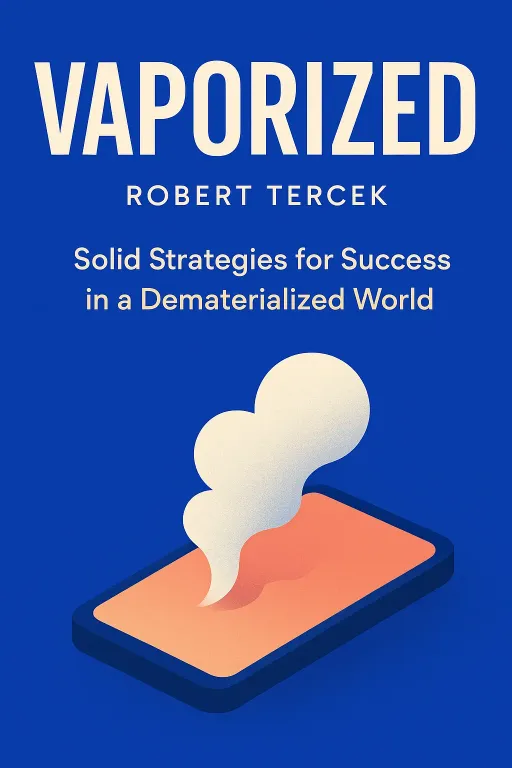
Nova: That is exactly the friction point we are tackling today. We are looking at two essential texts that, when read together, provide a roadmap for the modern era. We have Vaporized by Robert Albin Tercek, which explains the brutal, inevitable transition of physical industries into software-driven ones. And we are pairing that with the classic psychological framework from Dr. Spencer Johnson’s Who Moved My Cheese, which gives us the emotional intelligence to actually survive that transition.
Atlas: Bringing those two together is a brilliant move. Tercek gives us the diagnosis of the world, and Johnson gives us the prescription for our own mindset. It is one thing to know that the world is changing, but it is a completely different challenge to stay calm while your personal "cheese" is being moved.
Nova: Exactly. Tercek, who has a fascinating background in the entertainment and technology sectors, essentially argues that we are living through a period of massive dematerialization. He saw how the digital revolution didn't just add to existing industries, it dissolved them. Johnson, on the other hand, was a physician and psychologist who understood that our resistance to change is not a moral failing, but a biological one. By synthesizing these two, we can move from being victims of change to architects of our own adaptation.
The Invisible Shift and the Vaporization of Value
SECTION
Atlas: Let’s start with that "Vaporization" concept. When I hear that, I think of things disappearing. But Tercek isn't saying industries are just vanishing into thin air, right?
Nova: Not at all. He is saying they are losing their physical weight. Think about the music industry, the retail sector, or even transportation. A decade or two ago, if you wanted to dominate any of those, you needed massive physical infrastructure. You needed record stores, warehouses, fleets of vehicles. You needed capital-intensive assets. Tercek’s insight is that software has stripped away the need for those physical anchors. The value has migrated from the tangible asset to the digital interface.
Atlas: That makes sense. It is the difference between owning a bookstore and owning an algorithm that recommends books. One is a pile of paper and a lease; the other is a scalable piece of logic.
Nova: Precisely. And that is where the anxiety comes in for the professional, for the leader, or for anyone trying to build a legacy. If you have spent your career becoming an expert in managing physical assets—whether that is supply chains, office spaces, or traditional service models—you are suddenly looking at a world where those assets are becoming liabilities. They are too heavy, too slow, and too expensive compared to the digital-first competitors that are eating the market share.
Atlas: I can see why that keeps people up at night. It feels like the rules of the game changed while we were busy playing it. But what does this actually mean for someone who is deep in a career? Does it mean we all have to become coders?
Nova: Not everyone needs to write code, but everyone needs to understand the logic of software. The shift Tercek describes is about speed, iteration, and, most importantly, the ability to decouple value from physical constraints. If you are a leader, you have to ask yourself: what part of my current workflow is actually a physical bottleneck? Is it the weekly in-person meeting? Is it the manual data entry? Is it the way we physically archive our projects?
Atlas: That is a practical way to look at it. It is about identifying the "friction" that software can dissolve. But here is the pushback: when you remove the physical, do you lose the human element? Does the "vaporization" of an industry also lead to the vaporization of culture, or the quality of the work itself?
Nova: That is a profound question. Some critics of this rapid digital transformation argue that we are losing the "craft" of work. When everything becomes instant, frictionless, and automated, do we lose the nuance that comes with manual, thoughtful processes? Tercek would argue that the efficiency gain allows us to focus on higher-level problems, but you are right to be skeptical. There is a danger of mistaking "fast" for "good."
Atlas: Exactly. And that brings us to the other side of this coin. Even if I accept that the world is moving this way—even if I agree that digitizing my workflow is the smart move—I still feel that internal "no." I still want to hold onto the old way of doing things because, well, it worked for me for years. It is comfortable.
The Psychology of Resistance and the Maze
SECTION
Nova: And that is the perfect pivot to Spencer Johnson’s work. You are describing the exact state of the characters in Who Moved My Cheese. For those who need a refresher, the book is a simple parable about two mice, Sniff and Scurry, and two little people, Hem and Haw, all living in a maze looking for cheese.
Atlas: I remember the premise. The mice are simple—they react to changes instantly. The little people, Hem and Haw, are complex. They overthink, they analyze, they resist. They treat the cheese station as their permanent home, and when it disappears, they go into a tailspin.
Nova: It is a brilliant metaphor for the modern professional. We are all Hem and Haw. We find a system that works, we get comfortable, and we start to believe that this system is a law of nature. We think, "This is how we do marketing," or "This is how we manage our team," or "This is how I structure my day." When that "cheese" moves—when the market shifts, when a new technology renders our expertise secondary—we don't just adapt. We get angry. We deny. We wait for the cheese to come back.
Atlas: I have definitely been Hem. I have sat there waiting for the cheese to return, convinced that if I just wait long enough, the old reality will reassert itself. It is the ultimate form of denial. But what Johnson illustrates so well is that the "maze" is always changing. The environment is indifferent to our comfort.
Nova: That is the key. The maze is the market, the technology, the global economy. It has no obligation to cater to our preferred way of doing business. The "Vaporized" world Tercek talks about is the reality of the maze. The "Cheese" is the comfort we derive from our current expertise. The friction most of us feel is the gap between the two.
Atlas: So, if I am listening to this and I feel that resistance—that "I don't want to learn this new software" or "I don't want to change this process"—that is not a sign of laziness. It is a sign of a very human, very predictable psychological reaction.
Nova: Absolutely. It is a survival mechanism. We are wired to conserve energy, and changing our mental models is incredibly energy-intensive. But here is the insight: the resistance is not the problem. The problem is staying in the resistance. Johnson’s characters who succeed are the ones who eventually accept that the old cheese is gone and decide to go into the maze to find new cheese.
Atlas: I love that distinction. It is not about feeling fear. It is about moving the fear. But let’s get into the "how." If I am an architect of my own legacy, and I know I need to be more "vaporized" in my approach—meaning, more digital, more agile—but I am also human and prone to clinging to my "cheese," how do I bridge that gap?
Synthesis and Actionable Adaptation
SECTION
Nova: This is where we bring the two ideas together. Tercek gives you the map of the maze; Johnson gives you the mindset to navigate it. The "Tiny Step" takeaway we mentioned earlier is the bridge. You don't have to overhaul your entire life overnight. That is how you trigger the "Hem" in you to panic. Instead, you look for one legacy workflow—one thing you do because "that is just how we do it"—and you find a modern digital tool to automate or simplify it.
Atlas: Give me an example. What does that look like for someone in a traditional role?
Nova: Let’s say you are a project manager who spends three hours every Friday manually compiling status updates from a dozen people via email. That is your "Cheese." You have been doing it that way for years; you know the rhythm of it. But it is a manual, physical-style workflow in a digital world.
Atlas: Okay, so the "Vaporized" perspective would look at that and say, "This is a waste of human energy. The data should be flowing automatically into a dashboard."
Nova: Exactly. And the "Who Moved My Cheese" perspective would look at your hesitation—"But I like checking in with everyone, I like the human connection"—and say, "That is a valid feeling, but you are clinging to the manual labor, not the connection." You can automate the data collection so you have time for the actual human conversation.
Atlas: That is a great way to reframe it. It is not about replacing the human; it is about replacing the chore. It is about using the technology to clear the deck so you can do the work that actually matters.
Nova: That is the goal of the Sage, the Architect, the Legacy Builder. You are not building a legacy by being the most efficient data-entry clerk in the world. You are building it by creating value, by leading, and by innovating. If you are spending your time on manual, legacy processes, you are essentially paying a tax on your own potential.
Atlas: I think that is the most powerful insight here. We often think that "hard work" means doing things the way we have always done them, because that is what feels like "work." But if that work is just maintaining a legacy process that could be vaporized, then you are actually just spinning your wheels.
Nova: It goes back to the idea of "The Invisible Shift." We are all participating in it, whether we acknowledge it or not. The world is becoming more digital, more abstract, and more efficient. You have a choice: you can be the person who is constantly surprised by the shifts, constantly chasing the cheese that has already moved, or you can be the person who looks at the maze, accepts the shift, and uses the new tools to build something even better.
Atlas: It sounds like we need to cultivate a kind of "comfortable discomfort." We need to get used to the idea that our favorite tools and processes are temporary.
Nova: "Comfortable discomfort"—I like that. It is the realization that the only permanent thing is the ability to adapt. When you look at the most successful leaders, the ones who leave a lasting mark, they aren't the ones who cling to the "Cheese" of 1995. They are the ones who were the first to see the "Vaporization" happening and used it to their advantage.
Atlas: So, for the listener who is feeling that pressure—who is looking at their daily routine and seeing a lot of "legacy" stuff that needs to go—what is the first step they take tomorrow morning?
Nova: It is simple, but it requires discipline. Tomorrow, when you sit down to work, observe your tasks. Don't just do them. Watch yourself doing them. Ask, "If I were a software company, would I be doing this manually?" If the answer is no, you have found your first piece of cheese to move. You don't need to automate the whole company. Just find that one, small, irritating, repetitive task and find a digital tool to handle it.
Atlas: I love that. It is not a massive, scary transformation. It is a series of small, intentional upgrades. It is about being the architect of your own efficiency.
Nova: And remember, the fear you feel when you decide to change that process? That is just the "Hem" in you. Acknowledge it, thank it for trying to keep you safe, and then move into the maze anyway. The new cheese is almost always better.
Atlas: That is a fantastic note to end on. We are not just surviving the shift; we are leaning into it. Thank you for this, Nova. It feels like the right mindset to carry into the week.
Nova: It is a pleasure. Let’s keep building. This is Aibrary. Congratulations on your growth!