The Philosophy of Adaptability and Inner Peace
Golden Hook & Introduction
SECTION
Nova: The average Fortune 500 company has a lifespan that has dropped from sixty years in the 1950s to less than twenty years today. We are living in a period of unprecedented corporate and personal volatility. The ability to pivot is no longer a soft skill; it is the primary survival metric for the modern professional.
Atlas: That statistic is a wake-up call. It shifts the conversation from how to succeed to how to endure. We are constantly told to adapt, but nobody gives us a map for the internal friction that happens when the world shifts beneath our feet. We are caught between the desire for stability and the reality of constant flux.
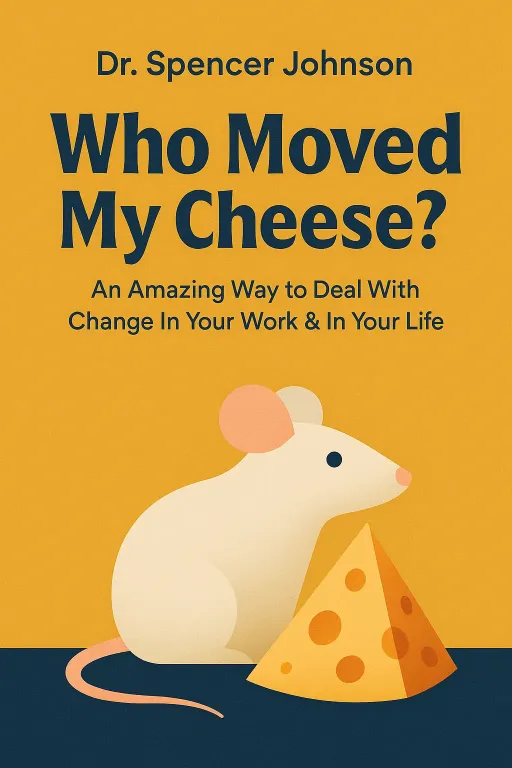
Nova: Exactly, and that is why we are looking at two foundational texts today that, when combined, create a complete strategy for navigating transition. We are diving into Who Moved My Cheese by Dr. Spencer Johnson and The Four Agreements by Don Miguel Ruiz.
Atlas: I know these books. They feel like they belong on every executive’s bookshelf, but I have always wondered if they hold up when the pressure is actually on. Who Moved My Cheese is legendary for its simplicity. Spencer Johnson, a medical doctor, turned a complex corporate parable into a global phenomenon. It is essentially the story of four characters trapped in a maze, and it became the go-to manual for navigating change in the corporate world.
Nova: And Don Miguel Ruiz brings a completely different energy. He draws from ancient Toltec wisdom to offer a set of personal agreements. While Johnson gives us the map for the maze, Ruiz gives us the internal compass to keep from losing our minds while we navigate it.
Atlas: That is a compelling pairing. Let’s see if we can bridge the gap between corporate adaptation and personal resilience.
The Anatomy of Change
SECTION
Nova: Let’s start with the maze. In Johnson’s parable, the characters—Sniff and Scurry, the mice, and Hem and Haw, the little people—all rely on a steady supply of cheese. When the cheese disappears, the mice adapt immediately. They do not analyze the situation or blame the universe. They just move on to find new cheese.
Atlas: The little people, Hem and Haw, are the ones who struggle. They stay in the empty station, waiting for the cheese to return. They are looking for a logical explanation for why the world changed, which is exactly what happens in professional settings. We get a new management team, or a product launch fails, or a market shifts, and we spend weeks analyzing why it happened instead of just accepting that the landscape has changed.
Nova: That is the trap. The "Old Cheese" is the comfort zone. It is the belief that our past success is a guarantee of future results. When Johnson wrote this, he was tapping into a very specific kind of corporate anxiety. He wanted to show that the fear of change is almost always worse than the change itself.
Atlas: That hits home. I see this in high-stakes environments all the time. Someone builds a system or a team structure that works perfectly for two years. Then the external environment shifts, and they keep trying to apply the old system to the new problem. They are waiting for the cheese to reappear in the same spot.
Nova: They are paralyzed by the assumption that the rules of the game are static. But the core lesson from Johnson is that the most dangerous thing you can do is hold onto the idea that things should be the way they used to be. The faster you let go of the old cheese, the sooner you find the new.
Atlas: I am curious about the emotional cost of that, though. It is easy to say, just move on. But for a high-performing professional, that old cheese represents identity. It is not just about a job or a project; it is about who they are. How does someone let go of that identity without feeling like they are abandoning their own legacy?
Nova: That is where the transition happens. You have to reframe the identity. Instead of being the person who manages the old system, you become the person who is capable of building the new one. The mice do not have an ego attached to the location of the cheese. They have a biological imperative to survive. We have to adopt that same biological imperative for our careers.
Atlas: So, the goal is to detach from the location of the cheese and attach to the act of hunting.
Nova: Precisely. The joy is in the search, not the storage. If you can move your identity from the outcome to the process of adaptation, you become antifragile. You no longer fear the change because you are the one driving it.
Atlas: That makes sense, but it is easier said than done. When the ground shifts, the human instinct is to freeze, not to explore. We need a way to regulate that internal panic.
The Architecture of Inner Peace
SECTION
Nova: And that is exactly where we pivot to the second part of our discussion. If Johnson gives us the strategy for the maze, Don Miguel Ruiz gives us the mental armor to keep moving without being consumed by the anxiety of the search.
Atlas: I have always found The Four Agreements to be deceptively simple. Be impeccable with your word, don't take anything personally, don't make assumptions, and always do your best. It sounds like something you would see on a motivational poster, but I suspect there is more depth to it when you actually try to apply it to a high-pressure, professional life.
Nova: It is a profound psychological framework. Take the first agreement: Be impeccable with your word. In a professional context, this is not just about honesty. It is about integrity between your internal state and your external output. If you are going through a massive transition, being impeccable with your word means you are not spreading panic or gossip. You are speaking with clarity and purpose, even when you are uncertain.
Atlas: That is a great reframe. Most people treat communication as a way to vent frustration during a crisis. If you treat your words as a tool for stabilization, you actually change the team culture. What about the second one? Don’t take anything personally. That is the one I see people struggle with the most.
Nova: It is the ultimate shield. When a project is canceled or a strategy is rejected, the immediate reaction is to view it as a judgment on your worth. But if you follow this agreement, you recognize that decisions are often driven by factors you cannot see—budgetary constraints, political shifts, or market timing. It has nothing to do with you.
Atlas: I can see how that changes the game. If I don't take the rejection of my idea as a rejection of me, I can iterate faster. I can treat the feedback as data, not as an attack. It removes the emotional weight that slows down the adaptation process.
Nova: Exactly. And that links directly to the third agreement: Don’t make assumptions. This is where most strategic failures happen. We assume we know what the market wants, or we assume we know what our boss is thinking, and we build entire projects on those assumptions.
Atlas: The cost of that assumption is often months of wasted effort. If you are, say, an architect or a builder, you don’t build a foundation on an assumption. You test the soil. Applying this to communication means asking questions instead of filling in the blanks with your own narrative.
Nova: It requires the humility to say, I do not know. That is a massive act of courage in a corporate world that demands absolute certainty.
Atlas: I agree. It is a radical act to admit, I am assuming this is the case, but I need to verify it. It stops the guessing game. And the fourth agreement, always do your best, seems like the glue that holds it all together.
Nova: It is the sustainable pace. Your best is going to change from day to day. Some days you have the energy to overhaul the entire system; other days, your best is just keeping the team calm. If you are always doing your best, you have no regrets. You are not holding back, and you are not burning out by trying to do more than what is possible.
Atlas: That is a critical distinction. It is not about perfection. It is about consistency. If I am operating at my maximum capacity for the current conditions, I can sleep at night, even if the project fails.
Synthesis & Actionable Wisdom
SECTION
Nova: When you put these two together, you get a powerful operating system. You use Johnson’s mindset to accept that the cheese has moved and that you need to go find more. You use Ruiz’s agreements to ensure that while you are searching, you are not poisoning your own environment with assumptions, ego, or panic.
Atlas: It creates a feedback loop. The more you use the Four Agreements, the easier it becomes to let go of the old cheese. Because you are not taking things personally, you are not clinging to the old way of doing things just because it was your idea. You are detached from the outcome, which makes you incredibly agile.
Nova: You are effectively lowering your resistance to reality. Most of the suffering in our professional lives comes from the gap between what we want to be true and what is actually true. Johnson’s work closes that gap on the external side, and Ruiz’s work closes it on the internal side.
Atlas: I think the most dangerous thing for a high-achiever is to think they are above this. We often think, I am smart, I am strategic, I don't need a parable or a set of agreements. But the smartest people are the ones who are most susceptible to the trap of the old cheese because they have the most invested in it.
Nova: That is a vital point. The more successful you are, the more "cheese" you have accumulated, and the more you have to lose. The challenge is to maintain the hunger of a beginner even after you have built the empire.
Atlas: So, for the listener who is feeling that pressure right now—maybe they are in a role that is changing, or a project that is failing—what is the first step they should take today?
Nova: Start with the "Tiny Step." Next time you feel that surge of panic or resistance when a plan changes, take five deep breaths. Do not react. Instead, ask yourself: What old cheese am I holding onto? Am I trying to force a solution that no longer fits the problem?
Atlas: And then, apply one of the agreements to the situation. If you are angry at a colleague, ask yourself: Am I making an assumption about their motives? If you are feeling discouraged, ask yourself: Am I taking this project’s failure personally? It turns a moment of crisis into a moment of diagnostic clarity.
Nova: That is the key. You are moving from a state of reactive stress to a state of proactive navigation. You are not just surviving the change; you are using the change as a catalyst to upgrade your own internal software.
Atlas: It is about building a legacy that serves both society and yourself. You cannot lead effectively if you are constantly in a state of internal turmoil. This framework provides the anchor you need in high-pressure seasons.
Nova: It is the difference between being a victim of circumstance and being an architect of your own future. The maze is always going to change. The question is whether you are going to be the one who waits for the cheese to come back, or the one who is already out there finding the next opportunity.
Atlas: I love that. It takes the fear out of the equation and puts the focus back on agency. We have the power to decide how we respond, regardless of what the market or the world throws at us.
Nova: And that, ultimately, is where the peace is found. Not in the absence of change, but in the confidence that you are capable of navigating it with integrity.
Atlas: This has been a great synthesis. We have moved from the external reality of the maze to the internal reality of our own agreements.
Nova: It is a complete toolkit for the modern builder.
Atlas: This is Aibrary. Congratulations on your growth!