

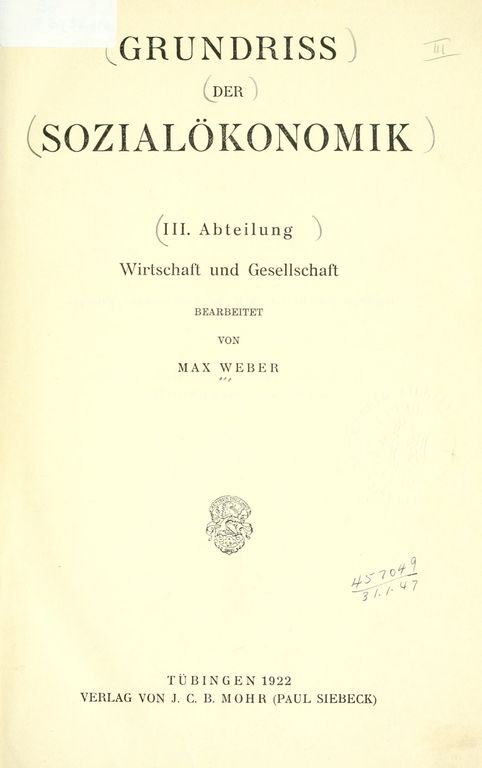
Wirtschaft und Gesellschaft
an outline of interpretive sociology
Introduction
Nova: Welcome back to the podcast. I'm Nova.
Nova: Let me ask you something. Have you ever had that moment where you're sitting in a DMV waiting room, watching the slow machinery of government turn, and you think to yourself — who invented this? Who decided that human life should be organized through numbered tickets, standardized forms, and chains of command?
Nova: Well, there is an answer, and it comes from a book so monumental that it basically laid the foundation for an entire academic discipline. The book is called Wirtschaft und Gesellschaft — Economy and Society — and the author is Max Weber. He wrote it in the early twentieth century, and when it was published posthumously by his wife Marianne in 1921 and 1922, it changed the way we understand power, organizations, law, religion, and capitalism itself.
Nova: Imagine trying to answer the biggest possible question: why did modern capitalism and the modern bureaucratic state emerge in the West and not elsewhere? Weber's answer spans thousands of pages, covering everything from ancient Roman law to Confucian ethics. Along the way, he gives us concepts we now take for granted — the three types of authority, the definition of the state, the idea of social action, and the role of rationalization in modern life. If you want to understand how the modern world got built, this is the blueprint.
Nova: So here's the plan. We're going to explore Weber's four types of social action, his famous triad of legitimate authority, his analysis of bureaucracy and class, and finally the big picture: rationalization and the fate of modern life. Let's go.
Four Ways We Make Sense of What We Do
The Architecture of Human Action
Nova: Alright, let's start at the very foundation. Weber opens Economy and Society with a deceptively simple question: what makes an action social? His answer is that social action is behavior to which the actor attaches subjective meaning and which takes account of the behavior of others.
Nova: Exactly. And then Weber does something remarkable. He constructs four pure types of social action — what he calls ideal types — that help us understand the different motivations behind why people do things.
Nova: It's one of his key methodological tools. An ideal type is not a moral ideal, not something desirable. It's a conceptual construct, a kind of analytical exaggeration that isolates the pure logic of a phenomenon. Real life is always messier, but ideal types help us see patterns. So let's walk through the four.
Nova: First, zweckrational action — instrumentally rational action. This is when you calculate the most efficient means to achieve a given end. You want to get across town, so you check traffic, compare routes, and pick the fastest one. It's the logic of the engineer, the strategist, the cost-benefit calculator.
Nova: Weber would agree, and we'll come back to that. Second is wertrational action — value-rational action. Here, you act not because of calculated outcomes but because your values, your beliefs, your sense of duty demand it. A captain going down with his ship, a whistleblower risking their career to expose wrongdoing, a monk devoting their life to prayer — the outcome isn't the primary calculus. The act is its own justification.
Nova: Right. Third is affective action — driven by emotion. You lash out in anger, you embrace someone in joy, you weep at a funeral. The meaning is embedded in the emotional state itself.
Nova: Traditional action — behavior guided by habit, by custom, by the way things have always been done. You bow to elders because that's what your culture does. You follow a ritual because that's how it's been for generations. You don't calculate it, you don't choose it from a set of values, you simply inhabit it.
Nova: Weber uses them as a diagnostic toolkit. In any society, in any historical period, you can ask: which types of action predominate? In a traditional agrarian society, traditional and affective action dominate. In a modern capitalist society, zweckrational action increasingly takes over. That shift is the story of rationalization, which is really the master narrative of the entire book.
The Three Types of Legitimate Authority
Why People Obey
Nova: Let's move to what is arguably the most influential section of Economy and Society: Weber's theory of legitimate domination, or Herrschaft. The question is simple but profound. Why do people obey commands? Why does one person accept that another has the right to tell them what to do?
Nova: Weber's answer is that domination always requires a belief in legitimacy. Pure coercion — a gun to your head — is unstable. Durable power requires that the governed believe, at some level, that the ruler has the right to rule. And he identifies three pure types of legitimate authority.
Nova: Weber loved his triads. First, traditional authority. This rests on the sanctity of age-old customs. The authority of the patriarch, the feudal lord, the monarch — it's legitimate because it has always been this way. There's no written constitution, no formal rules. You obey the person, not the office. The ruler's will is bounded by tradition — a king who flagrantly violates custom risks rebellion — but within those bounds, his command is personal and arbitrary.
Nova: Exactly. Second, charismatic authority. This rests on the extraordinary qualities attributed to an individual leader — their heroism, their revelation, their magnetic personal force. The prophet, the revolutionary leader, the warrior hero. Charismatic authority is inherently revolutionary because it breaks with tradition. Jesus saying you have heard it said, but I say unto you — that's charismatic authority directly challenging traditional norms.
Nova: Very much so. Charisma cannot be inherited or institutionalized, at least not in its pure form. When the charismatic leader dies, the movement faces what Weber calls the routinization of charisma. It either collapses or transforms into something else — traditional or legal-rational authority. The disciples become priests; the revolutionary party becomes a bureaucracy.
Nova: Legal-rational authority. This is the authority of the modern state and the modern corporation. Here, people obey not a person but a set of impersonal rules. The official who gives you a parking ticket or approves your loan — you obey not because of their personal qualities or their lineage, but because they occupy a legally defined office with legally defined powers. Authority resides in the system, not the individual.
Nova: It is. Weber writes, and I'm paraphrasing, that the purest type of legal-rational authority is that which employs a bureaucratic administrative staff. And that takes us to his next great contribution.
Bureaucracy, Class, and the Machinery of Modern Life
The Iron Cage
Nova: Weber's analysis of bureaucracy is one of the most famous passages in all of sociology. He describes it with almost clinical precision. A bureaucracy has a clear hierarchy of offices, each with fixed jurisdictional areas. There are written rules, standardized procedures, and files — mountains of files. Officials are appointed based on technical qualifications, not elected or inherited. They receive a fixed salary, pursue a career with promotions, and their work is separated from their private life.
Nova: That's exactly the point. Weber saw that bureaucracy is, from a purely technical standpoint, the most efficient form of organization ever devised. He famously compares it to a machine. Precision, speed, unambiguity, knowledge of the files, continuity, discretion, unity, strict subordination, reduction of friction and of material and personal costs — these are raised to the optimum point in bureaucratic administration.
Nova: Oh, a very large but. Weber was deeply ambivalent about bureaucracy's triumph. He saw that once established, bureaucracy becomes nearly impossible to destroy. It transforms from a tool into a cage. He writes that the individual bureaucrat is forged into a single cog in an ever-moving mechanism which prescribes to him an essentially fixed route of march. The mechanism is in full charge of him, not he of it.
Nova: That phrase — actually translated by Talcott Parsons as iron cage, though the German stahlhartes Gehäuse more literally means a shell as hard as steel — captures Weber's vision of modern life. We have built systems of incredible efficiency, but those systems increasingly dictate the terms of our existence.
Nova: This is crucial. Weber explicitly engages with Marx throughout Economy and Society, and while he shares Marx's concern with economic inequality, he broadens the picture considerably. For Weber, class is about your market situation — your ownership of property and your marketable skills determine your life chances. But class is only one dimension of stratification.
Nova: Status and party. Status is about social honor, prestige, lifestyle. A university professor and a successful plumber might have similar class positions in terms of income, but very different status positions. Status groups form around shared consumption patterns, education, and social circles. Status distinctions can be more powerful than class ones — think of old-money families looking down on nouveau riche.
Nova: Party refers to organized groups that strive for power within a political community. Parties cut across both class and status lines. A political party can unite wealthy industrialists and working-class voters around shared policy goals. So class, status, and party represent three different axes of social power, three different ways inequality is structured and contested.
Nova: It is, and it's one of Weber's lasting contributions. He didn't reject Marx's insights — he supplemented and complicated them.
Monopoly, Law, and the Spirit of Rationalization
The State and the Geist of Capitalism
Nova: Let's talk about Weber's definition of the state, which might be the most quoted line in all of political sociology: a state is a human community that successfully claims the monopoly of the legitimate use of physical force within a given territory.
Nova: And what's remarkable is how carefully constructed it is. Notice every word. The monopoly — not just more force than others, but exclusive right. Legitimate — violence that is accepted as rightful, not merely imposed. Within a given territory — the spatial dimension. This definition emerged from Weber's historical analysis of how the modern state slowly disarmed private warriors, feudal lords, and rival power centers to concentrate violence in a single institutional apparatus.
Nova: Deeply. For Weber, the development of rational law was essential to the rise of capitalism. Predictable, calculable law — administered by trained legal specialists according to general rules — creates the stability that capitalist investment requires. If you don't know whether your contract will be enforced, whether your property rights will be respected, you won't invest. Weber traces the emergence of this kind of rational-legal system through centuries of Western legal history.
Nova: Yes, and while the Protestant Ethic and the Spirit of Capitalism is Weber's most famous treatment of that question, Economy and Society deepens the analysis enormously. It's not just religion. It's the combination of multiple factors: rational law, the bureaucratic state, the separation of household from enterprise, double-entry bookeeping, the free market in labor, and widespread rational bookeeping and calculation. Weber calls this methodological rationalization of economic life.
Nova: A unique historical constellation. Weber was deeply opposed to monocausal explanations. For him, the Protestant ethic was one crucial factor among many. In Economy and Society, he explores other factors: the nature of the Western city, which had a degree of political autonomy unknown elsewhere; the rationalization of Roman law and its reception in medieval Europe; the development of rational accounting methods. All these streams converged.
Nova: They're vast — covering Confucianism, Hinduism, Buddhism, ancient Judaism, Islam, and Christianity. Weber's comparative method is on full display. He's asking: why did the kind of systematic, methodical rationalization of life that capitalism requires emerge in the Protestant West? And his answer involves analyzing the economic ethics of each world religion, showing how they shaped — or failed to shape — the kind of inner-worldly asceticism that drove capitalist accumulation.
Nova: It is, and it's key. The Puritan worked methodically in a worldly calling not to enjoy wealth but as a sign of election by God. That systematic discipline, separated from consumption, produced capital accumulation on an unprecedented scale. Then, over time, the religious roots withered, and what remained was pure instrumental rationality — the iron cage.
Rationalization, Meaning, and Weber's Prophetic Warning
Disenchantment and the Fate of Our Time
Nova: Let's zoom out and talk about the overarching theme that ties Economy and Society together: rationalization.
Nova: It's Weber's master concept. Rationalization means the increasing dominance of zweckrational action — means-ends calculation — in more and more domains of life. Religion becomes systematized theology. Law becomes codified and procedurally formal. Music becomes mathematically harmonized. Economic life becomes double-entry accounting. Government becomes bureaucracy. Even love and intimacy become subject to rational analysis.
Nova: Weber called it the disenchantment of the world. The German is Entzauberung — literally, the de-magification. In a disenchanted world, there are no mysterious incalculable forces. Everything, in principle, can be mastered by calculation. The forest is no longer haunted by spirits; it's a timber resource. The thunder is no longer the voice of Zeus; it's atmospheric electricity. Life becomes more predictable, more controllable, more efficient — and also, Weber feared, more meaningless.
Nova: Weber closes Economy and Society with a darkly prophetic vision. He imagines a future of specialists without spirit, sensualists without heart — this nullity imagines that it has attained a level of civilization never before achieved. He saw the possibility that bureaucratic rationalization would produce not liberation but a new kind of servitude, a serfdom of obedience to the machine.
Nova: Exactly. The questions Weber raised are more urgent than ever. Is efficiency the only value? What happens to human meaning when every domain of life is optimized? Can we recover enchantment without abandoning the genuine gains of rationalization?
Nova: He was famously reluctant to prescribe. He believed that science could tell us what is and what means are available to achieve given ends, but it could not tell us what ends we should choose. That's the distinction between facts and values, and it's foundational to modern social science. Weber believed each individual must choose their own gods and demons, must wrestle with the meaning of their existence without recourse to a single authoritative answer.
Nova: It is. And it makes Economy and Society not just a work of analysis but a kind of existential challenge. Here's how the modern world works, Weber seems to say. Now: how will you live in it?
Conclusion
Nova: So as we wrap up, let's reflect on what makes Wirtschaft und Gesellschaft, a century after its posthumous publication, still essential reading.
Nova: And they remain remarkably sharp analytical tools. When you're frustrated with some Kafka-esque bureaucratic process, you're living inside Weber's analysis. When you hear politicians debate the legitimacy of state power, you're in Weber's territory. When tech companies promise to optimize your life through data and algorithms, Weber's ghost is asking: at what cost?
Nova: Right. Weber didn't simplistically condemn bureaucracy or rationalization. He recognized their extraordinary power and even their beauty as technical achievements. But he insisted we see clearly what we are gaining and what we are losing. The efficiency of bureaucracy comes at the cost of personal spontaneity. The calculability of rational law comes at the cost of substantive justice in the individual case. The disenchantment of the world gives us mastery but risks emptying life of ultimate meaning.
Nova: To meet the demands of the day — that was one of his famous phrases. To do your work with integrity while knowing that the ultimate meaning of it all remains contestable and uncertain. That's a mature, difficult stance, and it's perhaps why Weber's work continues to resonate in a world that has only become more rationalized, more bureaucratic, more disenchanted than the one he described.
Nova: Precisely. Thank you for joining us on this journey through one of the great monuments of social thought.