Personalized Podcast
Golden Hook & Introduction
SECTION
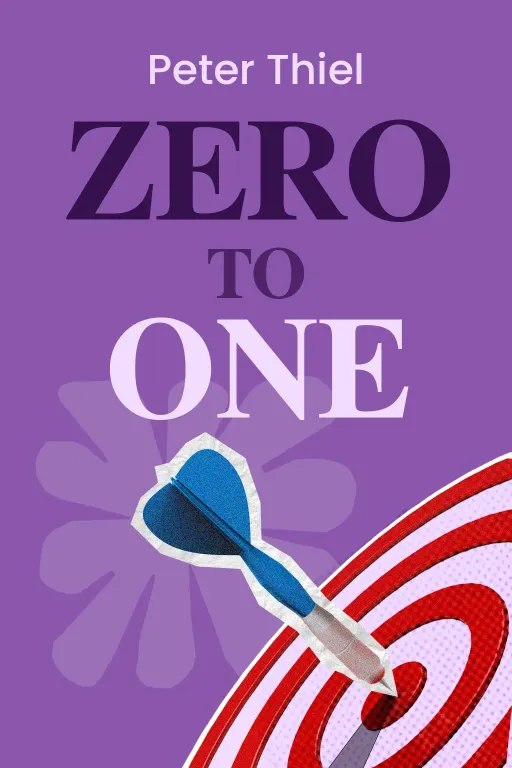
Socrates: If everyone is building with the exact same foundational AI models, are we actually creating a different future, or are we just racing to see who can package the same commodity the fastest? Welcome to the show. Today, we are dissecting Peter Thiel's classic, Zero to One, but we are doing it with a very specific focus. We are looking at it through the eyes of someone right in the thick of the action. Joining me is Charvi Kashyap, an emerging AI entrepreneur who is, frankly, cool as hell and ready to build something meaningful. Charvi, welcome.
Charvi Kashyap: Hey, Socrates. Honestly, I am so excited to be here. I feel like this book is exactly what I need to hear right now, you know? The AI space is moving so fast, and it is incredibly easy to get caught up in the noise. I want to make sure I am not just building another cool-looking project that disappears in six months. I want to build something that actually lasts.
Socrates: That is the ultimate challenge, isn't it? To build something that lasts. Today, we are going to tackle this from three distinct angles. First, we will look at how to escape the trap of building copycat AI wrappers and achieve a true ten-times breakthrough. Second, we will challenge the fear of automation by exploring why the most valuable AI companies will complement human agency rather than replace it. And finally, we will look at why the popular advice to stay lean and constantly pivot might actually be keeping you from building a real monopoly. Charvi, let us start with the core premise of the book. Thiel talks about going from zero to one, which is vertical progress, versus going from one to n, which is horizontal progress. How does that distinction feel to you when you look at the current AI landscape?
Charvi Kashyap: Oh, it hits right where it hurts, honestly. I feel like ninety-nine percent of what we see on Twitter and Product Hunt right now is just horizontal progress. It is people taking an existing model, like GPT-4, putting a slightly different user interface on it, and calling it a startup. That is going from one to n. You are just copying and distributing. Going from zero to one means actually creating a new capability, something that did not exist before. But it is hard, you know? It is so much easier to just build a wrapper.
Socrates: It is easier, yes, but is it valuable in the long run? Thiel argues that creating value is not enough; you must also capture that value. If you build a business that anyone else can copy in a weekend, how do you expect to capture any profit?
The AI Illusion - Moving from 1-to-n to 0-to-1
SECTION
Socrates: Let us look at a story from the book to illustrate this. In the late 1990s, when online commerce was just starting to take off, people were struggling with payments. If you bought something on eBay, you had to mail a paper check or a money order. It took seven to ten days for the seller to get the money, and then they had to wait for the check to clear before shipping the item. It was slow, clunky, and incredibly frustrating. Then came PayPal. They did not just make checks slightly faster. They created a system where you could send money instantly via email. It was a massive, fundamental shift. It was at least ten times better than the closest substitute. Thiel says that to have a real monopolistic advantage, your proprietary technology must be at least ten times better than anything else out there. Charvi, when you look at your own AI ideas, or the projects you see around you, are they ten times better, or are they just ten percent better?
Charvi Kashyap: That is a really tough question to face, but it is the right one. I feel like a lot of us are lying to ourselves. We build something that is maybe twenty percent faster or has a slightly cleaner design, and we think we have a business. But in reality, we are just competing on the margins. If I am being completely honest, some of the ideas I have been playing with are definitely in that ten percent improvement zone. They are wrappers. They rely on someone else's infrastructure, and if that infrastructure changes, or if the model providers decide to release the same feature natively, we are just wiped out. It is like building a house on sand, you know?
Socrates: It is a fragile existence. But let us think about how to escape that. If a simple wrapper is a one-to-n business, what does a zero-to-one AI business actually look like? How do you achieve that ten-times improvement when you do not own the underlying foundational model?
Charvi Kashyap: Hmm. That is the puzzle, right? If I do not have a hundred million dollars to train a base model from scratch, how do I get that ten-times advantage? I feel like the answer has to be in the application of the technology to a highly specific, underserved domain. It is not just about the model itself; it is about the proprietary data you feed it, the workflow integration, and how deeply you solve a unique problem for a specific group of people. Like, if you can automate a complex, multi-step process that used to take a professional three days, and now they can do it in ten minutes with high accuracy, that is a ten-times improvement. You are not just giving them a chat box; you are giving them a complete solution.
Socrates: Exactly. You are starting small and monopolizing a niche. Thiel points out that every successful startup starts with a very small market. PayPal started with eBay PowerSellers, a highly concentrated group of users who had an acute need for instant payments. They did not try to acquire all internet users at once. They dominated that one niche first. If you try to build a general AI assistant for everyone, you are competing with Google and Microsoft. But if you build a highly specialized tool for, say, forensic accountants or solar panel installers, you can actually own that market. What is a niche that you feel is completely overlooked by the mainstream AI hype?
Charvi Kashyap: That is a great way to frame it. I feel like everyone is focusing on the obvious stuff, like writing marketing copy or generating images. But what about the unsexy industries? Like, think about compliance in local government, or managing supply chains for small manufacturing businesses. Those areas are incredibly complex, highly regulated, and still rely on spreadsheets and paper. If you can build an AI system that understands those specific regulations and automates the compliance workflow, you are not just a wrapper anymore. You are the operating system for that niche. You have high switching costs, and you can actually capture the value you create.
Socrates: Now we are thinking from first principles. But to build that operating system, you have to understand the relationship between the technology and the people using it. This brings us to our second major topic.
Symbiosis Over Substitution - AI and Human Agency
SECTION
Socrates: There is a massive fear today that AI is going to replace human workers, leading to widespread unemployment. But Thiel has a very different view. In Chapter 12, he argues that computers are complements for humans, not substitutes. He writes that humans and computers excel at fundamentally different things. Humans possess intentionality, judgment, and the ability to make decisions in complex, novel situations. Computers, on the other hand, excel at efficient data processing and pattern recognition at scale. The most valuable businesses of the future will not try to replace humans; they will empower them. Let us look at how PayPal solved its fraud problem. In the early days, PayPal was losing over ten million dollars a month to credit card fraud. They tried to write automated software to detect and cancel fraudulent transactions, but the fraudsters adapted too quickly. The software could not keep up with the creative tactics of human criminals. So, Max Levchin and his team built a hybrid system called Igor. The software did not make the final decision; instead, it analyzed millions of transactions, flagged the most suspicious ones, and presented them to human analysts who made the final judgment. It was a perfect symbiosis. The computer did the heavy lifting of data processing, and the humans provided the critical judgment. That system turned PayPal profitable. Charvi, how does this concept of complementarity change how you design your AI products?
Charvi Kashyap: This is actually a huge unlock for me. I feel like the default mindset right now is to try and automate the human completely out of the loop. We want to build 'autonomous agents' that do everything. But when you do that, you run into this massive wall of edge cases and reliability issues. If the AI makes a mistake, the whole system breaks, and the user loses trust. But if you design the system as a complement, where the AI acts as a super-powered assistant that handles the tedious, repetitive parts of the job, and then hands it off to the human for the final creative decision or quality check, it is so much more robust. It is like, you are not trying to replace the doctor; you are giving the doctor X-ray vision.
Socrates: Yes. You are elevating the human, not erasing them. And from a business perspective, which model do you think is easier to sell? A tool that promises to replace an employee, which creates fear and resistance, or a tool that makes that employee three times more productive and less stressed?
Charvi Kashyap: Oh, absolutely the productivity tool. If you try to replace people, you face massive organizational resistance. The people who are supposed to adopt your software will actively fight against it because they are afraid for their jobs. But if you build something that makes them look like superstars to their bosses, they will champion your product. It is a completely different sales dynamic. Plus, from a product design standpoint, it is just more realistic. AI is amazing at generating drafts, summarizing data, and finding patterns, but it still lacks that human touch, that deep contextual understanding of relationships and ethics. By keeping the human in the loop, you actually get a better outcome.
Socrates: It is a win-win. But to execute this, you cannot just rely on luck or random experimentation. You need a plan. And this is where we run into a major conflict with modern startup culture.
The Definite AI Blueprint - Escaping the Lean Trap
SECTION
Socrates: In Chapter 6, Thiel challenges the popular 'lean startup' methodology. The conventional wisdom today is that the future is fundamentally unknowable, so you should not make long-term plans. Instead, you should stay lean, build a minimum viable product, launch it quickly, and 'pivot' based on customer feedback. You iterate your way to success. But Thiel calls this 'indefinite optimism.' You expect the future to be better, but you have no specific plan for how to make it so. He argues that this approach leads to incrementalism and mediocrity. He advocates for 'definite optimism,' where you have a specific, grand vision of the future and a detailed plan to build it. Think of Elon Musk and Tesla. When Tesla started in 2003, they did not just launch a cheap electric car and see what happened. They had a clear, multi-stage master plan. Step one was to build a high-end electric sports car, the Roadster, to prove that electric cars could be cool and high-performing. Step two was to use that money to build a luxury sedan, the Model S, to compete with Mercedes and BMW. Step three was to use those profits to build a mass-market electric car, the Model 3. They executed that plan over fifteen years. It was definite planning, not random iteration. Charvi, as a new founder, how much of your strategy is based on definite planning versus indefinite iteration?
Charvi Kashyap: Wow. This is a real call-out for me, Socrates. I am not going to lie, I have been totally drinking the 'lean startup' Kool-Aid. The advice you hear everywhere is just to launch fast, break things, and talk to users. And while I feel like talking to users is important, it can also become an excuse for not having a real vision. You just throw things at the wall and hope something sticks. But if you do that, you are basically treating your startup like a lottery ticket. You are relying on luck. Thiel is saying that success is not a lottery ticket. It is the result of deliberate design.
Socrates: It is the difference between being a passenger in the future and being its architect. If you do not design your business from the foundation, you cannot fix it later. Thiel's Law states that a startup messed up at its foundation cannot be fixed. This includes your choice of co-founders, your equity distribution, and your core mission. If you are just pivoting every two weeks, you never build a solid foundation. How do you balance the need to listen to feedback with the discipline of sticking to a definite plan?
Charvi Kashyap: I think it comes down to distinguishing between your vision and your tactics. Your vision of the future, the unique problem you are solving and the monopoly you want to build, that has to be definite. You cannot pivot on your core belief. If you do, you do not actually believe in anything. But your tactics, how you implement that vision, the specific features of the software, the marketing channels, those can be flexible. It is like, you know exactly where you are going, you have a map, but if you run into a roadblock, you find a detour. You do not just change your destination every time you hit traffic.
Socrates: That is a beautiful distinction. Your destination is fixed; your route is adaptable. To help you solidify this destination, Thiel provides seven questions that every business must answer. Let us look at them briefly: One, the Engineering Question: Can you create breakthrough technology instead of incremental improvements? Two, the Timing Question: Is now the right time to start this specific business? Three, the Monopoly Question: Are you starting with a big share of a small market? Four, the People Question: Do you have the right team? Five, the Distribution Question: Do you have a way to not just create, but deliver your product? Six, the Durability Question: Will your market position be defensible ten years from now? And seven, the Secret Question: Have you identified a unique opportunity that others do not see? Charvi, if you had to pick one of these questions that you feel is your biggest blind spot right now, which one would it be?
Charvi Kashyap: Honestly, it is the Distribution Question. As a technical person, I feel like I always fall into the trap of thinking that if I build a great product, people will just naturally come. It is that 'Field of Dreams' mentality, you know? But Thiel is so clear about this: distribution is essential to the design of your product. If you do not have an effective way to sell it, you have a bad business, no matter how good the product is. I have not spent nearly enough time thinking about how I am actually going to reach my customers and what my customer acquisition cost will be compared to their lifetime value. That is a major blind spot for me.
Socrates: It is a common one, especially in Silicon Valley. Nerds often underestimate sales because they value objective, transparent results, and sales seems superficial or irrational to them. But superior sales and distribution can create a monopoly by itself, even without product differentiation. The converse is not true. If you have a great product but zero distribution, you are finished.
Synthesis & Takeaways
SECTION
Socrates: We have covered a lot of ground today, Charvi. We talked about moving from copycat wrappers to true zero-to-one breakthroughs by focusing on a 10x improvement in a highly specific niche. We explored how the most valuable AI companies will complement human agency rather than replace it, using the symbiosis of man and machine to build robust, high-trust products. And we challenged the lean startup dogma, emphasizing the need for a definite plan and a solid foundation. How are you feeling about all of this? Does it feel actionable?
Charvi Kashyap: It feels incredibly empowering, actually. It is like a bucket of cold water to the face, but in the best way possible. It forces me to stop playing startup and start actually designing a business. I feel like I have a much clearer framework now for evaluating my ideas and making decisions. It is not just about building what is easy or trendy; it is about finding those secrets, those important truths that others are ignoring, and building a definite plan around them.
Socrates: Then let us turn this into a concrete challenge for this week. I want you to take your primary AI startup idea and put it through the ringer of the seven questions. Specifically, I want you to write down: First, what is your 10x advantage? How are you making life ten times better for your users, not just ten percent better? Second, what is the extremely small, highly specific niche that you can dominate and monopolize in the next three months? And third, what is your specific, definite plan for distribution? How will you reach those users without relying on them just magically finding you? Can you do that?
Charvi Kashyap: Yes. Absolutely. I am going to sit down and write this out, and I am not going to let myself off the hook with vague, indefinite answers. I am going to make it concrete.
Socrates: Excellent. Remember, the future is not a lottery ticket. It is something we design and build, step by step, from zero to one. Thank you, Charvi, for your openness, your sharp mind, and your willingness to be challenged.
Charvi Kashyap: Thank you, Socrates. This was honestly incredible. I feel ready to go build the future.
Socrates: And to our listeners, thank you for tuning in. What important truth do very few people agree with you on? Find that secret, build a plan, and go make it real. Until next time.