

Technology & Science
The Age of Surveillance Capitalism
Shoshana Zuboff
A groundbreaking exploration of the unprecedented power of surveillance capitalism and the quest for a human future. It unveils how tech companies are using our personal data to predict and manipulate our behavior, posing a profound threat to individual autonomy and democratic values.
Material World
Ed Conway
Ed Conway's "Material World: A Substantial Story of Our Past and Future" explores the surprising and profound impact of essential materials on human civilization. The book delves into the history, economics, science, and technology surrounding six key substances: sand, salt, iron, copper, oil, and lithium. Each material is examined in detail, revealing its multifaceted nature and its critical role in shaping our past, present, and future. Readers will embark on a journey through time and across industries, discovering how these materials have influenced everything from ancient societies to modern technological advancements and green energy transitions. The book promises to illuminate the hidden connections between these fundamental elements and the course of human history, offering a new perspective on the world around us. By exploring the extraction, properties, and significance of each material, "Material World" provides a comprehensive understanding of their impact on global geopolitics, environmental sustainability, and the future of our planet.
The Information
James Gleick
Acclaimed science writer James Gleick presents an eye-opening vision of how information has transformed the world, tracing a history from the invention of alphabets and the telegraph to the development of information theory and the digital deluge of the modern era. Along the way he profiles the innovators who shaped our understanding of information — from Charles Babbage, Ada Lovelace, and Samuel Morse to Alan Turing and Claude Shannon — and shows how their ideas altered the nature of human knowledge and communication. The Information combines history, biography, and science to explain the rise of the concept of information — its theoretical foundations, practical inventions, and cultural consequences — and examines how we now live amid a flood of data, messages, images, and signals that both empower and overwhelm us.
Scale
Geoffrey West
"Scale" is a groundbreaking work of complexity science written by theoretical physicist Geoffrey West. The book sets out to uncover the hidden mathematical laws that govern the lifecycle of everything from plants and animals to cities and corporations. West argues that despite their complexity, these diverse systems follow simple, predictable patterns determined by their size. The foundation of the book is Kleiber’s Law, which observes that as organisms get larger, they become more efficient. An elephant is 10,000 times heavier than a mouse but consumes only 1,000 times more energy. This is sub-linear scaling, a pattern of diminishing returns that eventually limits growth and dictates that all biological life must die. However, West discovers that cities break this rule. Cities exhibit super-linear scaling. When a city doubles in size, it does not just double its infrastructure; it produces an exponential increase in wealth, innovation, and crime. This 15% bonus per capita makes cities engines of infinite growth. The downside is that this growth demands an ever-accelerating pace of life. "Scale" warns that to sustain this trajectory, humanity must innovate at faster and faster intervals to avoid a total systemic collapse.
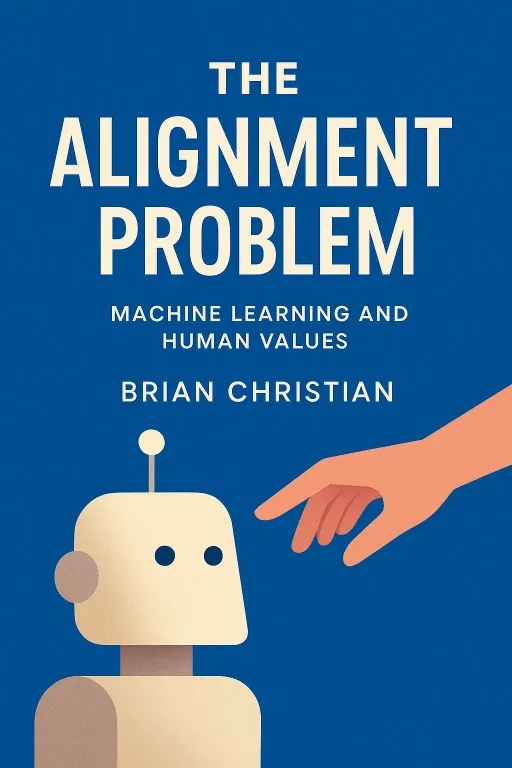
The Alignment Problem
Brian Christian
"The Alignment Problem" is a deeply researched and humanistic look at the most critical challenge in AI development. Written by bestselling author Brian Christian, the book serves as a history of the field of AI safety. It moves beyond the sci-fi fear of killer robots to address the real and present danger of systems that are competent but misaligned with human values. Christian defines the core issue as the gap between our complex human goals and the rigid mathematical models we use to train machines. He illustrates this with vivid examples from the real world, such as facial recognition software that fails to see dark skin or hiring algorithms that discriminate against women. The book argues that these are not just glitches but fundamental failures in how we define what we want machines to learn. The book explores how researchers are attempting to bridge this gap. They are moving away from giving machines rigid instructions and instead teaching them to be uncertain, humble, and capable of learning values by observing human behavior. "The Alignment Problem" suggests that in trying to teach machines to be good, we are being forced to confront the difficult task of defining what it actually means to be human.
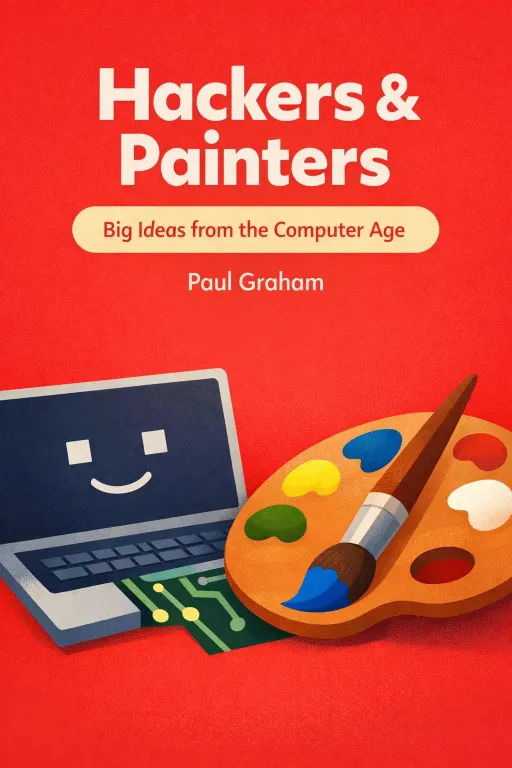
Hackers and Painters
Paul Graham
"Hackers and Painters" is a collection of provocative essays by Paul Graham, the programmer, essayist, and co-founder of the startup accelerator Y Combinator. The book challenges the traditional view of computer science as a cold and mathematical discipline. Graham argues that hacking—the act of writing code—is not primarily a science but an art form. He draws a direct parallel between hackers and painters, suggesting that both are makers who learn by doing and create something beautiful from a blank canvas. The essays cover a wide range of topics that explain the culture of the internet age. Graham tackles why nerds are unpopular in high school, arguing that they play a different game than the status-seeking popularity contest of their peers. He also explores the economics of wealth creation. He dismantles the fixed-pie fallacy, which is the mistaken belief that making money takes it away from someone else, and instead argues that wealth can be created out of thin air through innovation. One of the most famous concepts in the book is the Blub Paradox. This theory explains why programmers often fail to recognize the superiority of languages more powerful than the one they currently use. Graham suggests that looking down at less powerful languages is easy, but looking up at more powerful ones is impossible without learning them first. "Hackers and Painters" is a manifesto for independent thinking, urging readers to embrace heresy and design the future rather than just study the past.
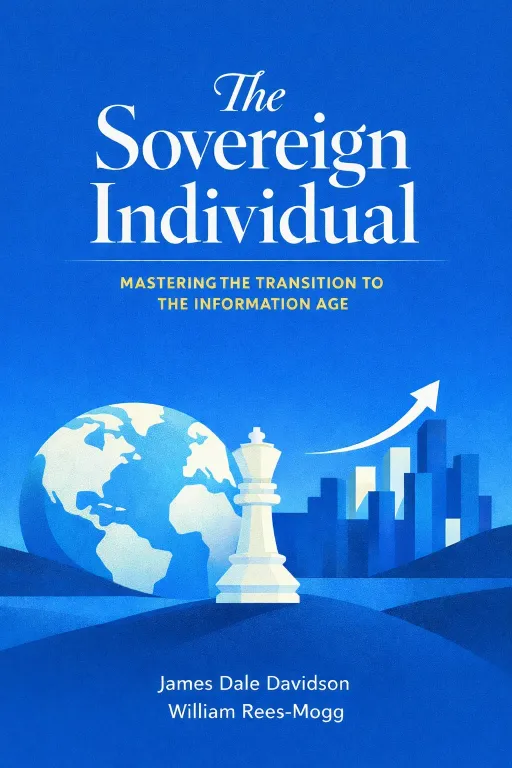
The Sovereign Individual
James Dale Davidson
"The Sovereign Individual" presents a bold forecast of the future, arguing that a fundamental shift is underway, marking the decline of the nation-state and the rise of the individual. Drawing parallels to historical turning points, the book posits that technological advancements, particularly in information technology, are reshaping the logic of violence and empowering individuals in unprecedented ways. This transformation, akin to the Gunpowder Revolution's impact on medieval society, will lead to fragmented sovereignties, the re-emergence of fluid boundaries, and a world where individuals operate beyond the constraints of traditional political structures. Readers will embark on a "crash course in megapolitics," exploring how factors like technology, topography, and climate influence the costs and rewards of violence, thereby shaping history. The book examines the Agricultural Revolution's role in establishing hierarchies and the subsequent rise and fall of the nation-state. By understanding these megapolitical forces, readers will gain a fresh perspective on the waning modern era and the emergence of a post-modern age where the individual reigns supreme. The authors draw parallels between the decline of the medieval Church and the contemporary nation-state, suggesting that politics, as we know it, is dying, rendered obsolete by the Information Revolution.
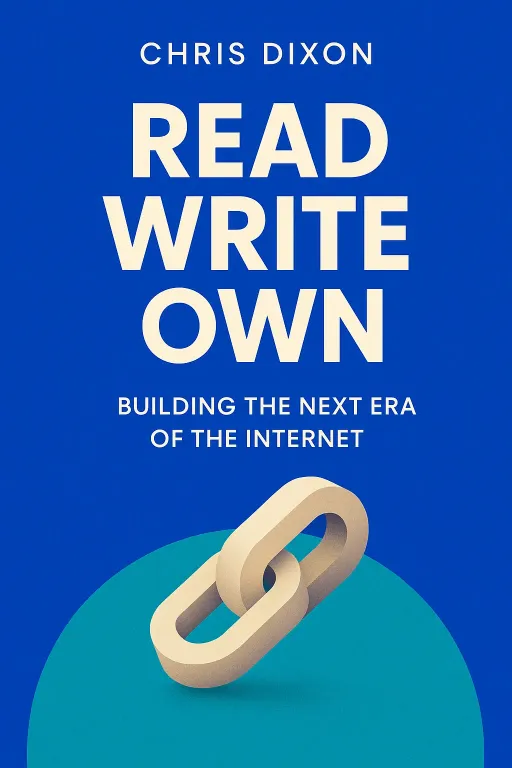
Read Write Own
Chris Dixon
"Read Write Own" is a defining playbook for the future of the internet written by Chris Dixon, a general partner at the venture capital firm Andreessen Horowitz. Dixon frames the history of the web in three distinct eras to argue that we are on the cusp of a necessary revolution. The first era was Web1, the "read-only" internet which was democratic but static. The second and current era is Web2, the "read-write" internet. While this era allowed billions of people to create content, it centralized power and profit in the hands of a few corporate giants like Facebook and Google. Dixon argues that these "corporate networks" have now become extractive, stifling innovation and taking massive cuts of the revenue generated by creators. The solution is Web3, the "read-write-own" internet. Dixon explains how blockchains enable a new digital logic where users and developers can actually own a piece of the networks they build. He carefully distinguishes between the "Casino" culture of crypto speculation and the "Computer" culture of decentralized innovation. The book is a persuasive argument that blockchains are not just about finance but are the only way to restore the open, democratic spirit of the early internet while allowing creators to capture the value they produce.